Skip to content
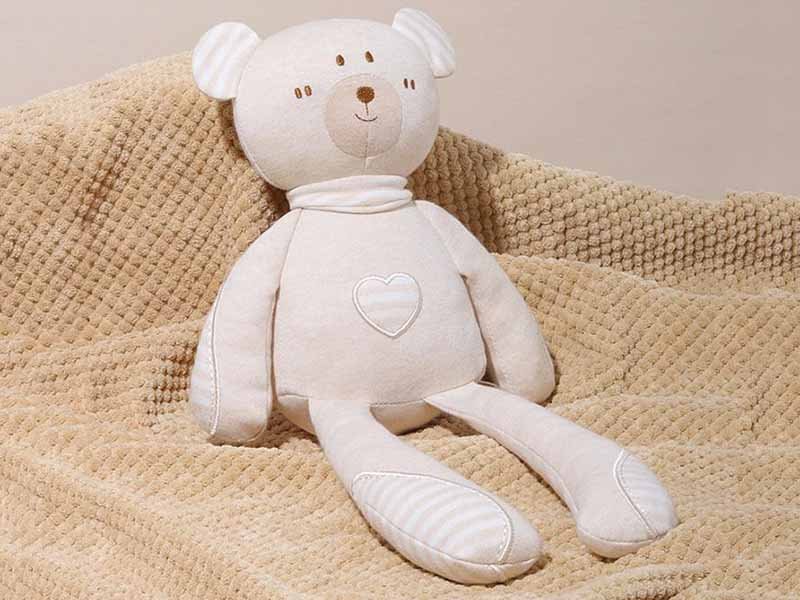
A stuffed animal may be one of the simplest-looking products on a retail shelf, but its material story is becoming far more important. Parents ask what touches a child’s skin. Retail teams want environmental claims they can defend. Product developers need fabrics that remain soft without losing shape, colour, or seam strength. Sustainability teams increasingly expect traceable sourcing rather than loose phrases such as “green” or “earth-friendly.” What once looked like a niche preference is now a serious product-development decision.
Demand for organic and natural fabrics in stuffed animals is growing because consumers and brands want clearer material origins, lower dependence on virgin synthetics, credible environmental claims, and products designed for close-contact use. The opportunity is real, but material choice must still satisfy softness, durability, washability, colour consistency, toy-safety requirements, and repeatable manufacturing. Organic content alone does not make a successful plush product.
The decisive moment often comes after the first attractive swatch is approved. A soft organic cotton fabric can shrink during washing, distort facial embroidery, reveal seam allowances, or change a character’s proportions after filling. One textile decision can therefore alter the pattern, expression, unit cost, certification route, packaging claim, test plan, and launch date. Understanding those connections is what separates a convincing sustainability concept from a product that can be manufactured and reordered with confidence.
Why Is Demand Growing?

Demand is growing because material choice now affects safety perception, environmental positioning, retail acceptance, and long-term brand trust. Organic and natural fabrics are especially relevant to baby products, comfort toys, premium gifts, educational animals, and sustainability-led collections, where buyers expect clear sourcing, credible evidence, and performance that remains reliable after washing, handling, packaging, and repeat production.
Safer Material Choices
Stuffed animals spend more time against the body than many other toys. Children hug them, sleep with them, carry them outdoors, and sometimes place ears, paws, or labels in their mouths. That pattern of use makes buyers more interested in fibre composition, dyes, finishes, embroidery threads, fillings, and detachable components. The change is not driven by a single fear of synthetic materials. It is driven by a desire to understand what the product contains and how the finished toy has been evaluated.
A strong material decision separates three questions. First, where did the fibre come from: organic agriculture, conventional agriculture, recycled feedstock, or a blend? Second, how was the textile processed: what dyeing, finishing, chemical-control, and traceability systems were used? Third, does the finished stuffed animal meet the physical, mechanical, chemical, labelling, and age-related requirements of its intended market? These questions overlap, but none replaces the others.
Natural origin alone does not prove that a toy is suitable for a young child. Organic cotton can support a traceable sourcing story, yet the product may still fail because of a weak closure seam, accessible filling, an unsuitable attachment, poor colourfastness, or an incorrect age label. Likewise, a textile tested for selected harmful substances is not automatically organic. Buyers increasingly value manufacturers that explain these boundaries instead of turning every certificate into a blanket safety claim.
For U.S. children’s toys, the applicable parts of ASTM F963 must be identified for the specific design, and the CPSC lists stuffed and bean-bag-type toys among the product areas covered by the standard. Finished-product testing and certification obligations depend on the toy, age group, and applicable rules. That is why fabric documentation should be treated as one layer of evidence rather than the entire compliance file.
Sustainability Targets
Many companies now review environmental objectives before a plush project reaches quotation. Teams may assess organic or recycled content, packaging volume, plastic use, supply-chain traceability, transport efficiency, durability, repairability, and the accuracy of customer-facing claims. For larger retail and licensed programs, the question is rarely whether a material sounds sustainable. The question is whether it can be documented, purchased consistently, processed at scale, and described accurately across packaging, retailer data sheets, websites, and audits.
A stuffed animal often contains more material categories than expected: outer fabric, lining or stabilizer, embroidery thread, sewing thread, fibre filling, weighted inserts, labels, hangtags, eyes or other features, inner bags, and retail packaging. Replacing the outer fabric with organic cotton does not make the entire product organic, plastic-free, biodegradable, or compostable. The claim should identify the exact component and, where relevant, its certified content.
A practical sustainability program usually begins with the components that contribute most to material volume and customer contact: outer fabric, filling, and packaging. Later collections can extend the work to threads, labels, internal supports, and logistics. This staged approach is often more credible than promising an entirely natural product before supply, durability, cleaning performance, and documentation have been confirmed.
Durability also belongs in the environmental discussion. A natural fabric that becomes misshapen after a few washes may create more replacement demand and waste than a carefully engineered mixed-material toy that remains usable for years. Responsible sourcing considers the whole product life: raw materials, production yield, use, washing, transport, and the likelihood that the toy will remain attractive enough to be kept.
Leading Product Categories
Demand is strongest when the material choice supports a clear use case. Baby comforters, nursery animals, bedtime companions, premium gifts, museum merchandise, educational wildlife, nature-focused collections, and corporate programs with published sourcing goals can all benefit from organic or natural materials. In these categories, the fibre story is not hidden inside the specification; it becomes part of the reason the customer chooses the product.
Different categories place different pressures on the material. A baby plush needs close-contact softness, secure construction, realistic cleaning instructions, and careful age grading. A licensed character needs accurate colours, sharp embroidery, and repeatable proportions. A premium gift needs refined texture and packaging. An educational animal may need realistic shape and surface detail. A material that performs well for one category can be a poor choice for another.
Natural and certified fabrics are therefore most valuable when the brand can connect them to design, function, and evidence. A short-pile organic cotton velour may be ideal for a calm nursery bear but unsuitable for a fantasy creature whose identity depends on long fur, fluorescent colours, and sharply defined markings. The product brief should decide the material path, not the trend alone.
| Product Category | Why the Material Story Fits | Commercial Requirement | Main Development Risk |
|---|---|---|---|
| Baby plush | Close skin contact and parental scrutiny | Age grading, cleaning method, secure details | Shrinkage, seam exposure, filling access |
| Comfort toys | Repeated holding and sleeping use | Softness retention and shape recovery | Compression, slow drying, filling movement |
| Premium gifts | Material origin supports perceived value | Refined finish and credible presentation | High cost without visible workmanship |
| Educational animals | Natural materials reinforce nature themes | Recognizable shape and durable construction | Texture hiding small details |
| Licensed characters | Sustainability can support corporate programs | Exact colours and repeatable proportions | Limited natural-fabric colour range |
| Retail collections | Creates a differentiated material tier | Stable supply across multiple SKUs | Dye-lot variation and repeat-order gaps |
Value and Pricing
Customers may accept a higher retail price when the product offers more than an environmental adjective. Material origin must be supported by visible workmanship, a convincing tactile experience, appropriate packaging, and documentation that survives retailer or legal review. Organic or natural fabrics can increase cost through higher textile prices, minimum fabric quantities, custom dyeing, certification records, more cutting waste, slower sewing, washing trials, and additional lot control.
A higher fabric price does not automatically create higher perceived value. If the face is uneven, the filling is lumpy, the seams are visible, or the care instructions are unrealistic, an organic claim will not rescue the product. The strongest premium proposition combines a clear material statement with balanced filling, clean embroidery, consistent proportions, durable stitching, and a packaging experience that explains the difference without exaggeration.
Commercial teams should look beyond the quoted unit price. Total project cost can include failed samples, redesign, extra testing, fabric left over from mill minimums, delayed packaging, colour rejection, and repeat-order inconsistency. A slightly more expensive material that is available in stable lots and behaves predictably in production can produce a lower overall risk than a cheaper fabric with uncertain shrinkage or supply.
What Counts as Organic or Natural?

Organic, natural, recycled, bio-based, biodegradable, and harmful-substance tested describe different material characteristics. Organic relates to certified agricultural and textile-processing systems. Natural refers to plant- or animal-derived fibres. Recycled describes recovered inputs. A reliable stuffed-animal specification identifies the fibre, percentage, product component, certification scope, and evidence supporting every claim.
Organic Cotton
Organic cotton begins with cotton grown under an approved organic production system, but the farm is only the first link. The fibre must still be cleaned, spun, knitted or woven, dyed, finished, traded, cut, sewn, and labelled. A claim on the finished product depends on the certified chain and the scope of each operation, not simply on the presence of cotton from an organic source.
GOTS currently distinguishes two main label grades. The “organic” grade requires at least 95% certified organic fibres, while “made with organic materials” requires at least 70%. The balance of the fibre content must follow the standard’s relevant rules. These thresholds apply to the textile product within the certification system; they should not be casually transferred to an entire stuffed animal without reviewing filling, thread, labels, stabilizers, and the manufacturing scope.
For a commercial plush program, the sourcing team should verify the certificate holder, site address, certified activity, product scope, validity period, and connection to the actual order. A scope certificate indicates that an organization is certified for listed activities. Transaction documentation connects certified material to a specific commercial movement. A certificate screenshot from an unrelated supplier or an expired site does not establish traceability for the ordered fabric.
The wording on product pages and packaging should match the evidence. “Stuffed animal with certified organic cotton outer fabric” is often clearer than “organic stuffed animal” when the filling and other components are not included. Precision may sound less dramatic, but it builds stronger trust and reduces the risk that a retailer or customer interprets the claim more broadly than intended.
Natural Fibres
Natural fibres come from plant or animal sources, but they do not all create the same surface, structure, or care requirements. Cotton is the most versatile for plush development because it can be knitted, woven, brushed, printed, embroidered, and made in several weights. Wool, linen, hemp, and kapok can also be used, although each creates a different appearance and manufacturing challenge.
Cotton velour and fleece can produce a warm, soft touch. Woven cotton can support flatter, graphic animals and removable clothing. Linen and hemp provide a drier, more textured surface that suits decorative or nature-inspired collections. Wool can offer resilience and a distinctive premium feel but may require careful cleaning instructions, odour management, fibre-shedding evaluation, and responsible sourcing documentation.
Natural does not mean organically grown, minimally processed, biodegradable in every environment, or automatically safer. A cotton fabric may be conventionally grown, heavily finished, blended with synthetic fibre, or dyed with a process that does not fit the brand’s environmental goal. The specification should therefore state fibre composition, construction, finish, dye method, certification status, and the product component in which it is used.
Blends can be technically sensible. Adding a controlled amount of synthetic fibre may improve stretch recovery, abrasion resistance, or dimensional stability. The blend should not be hidden; it should be evaluated against the product’s performance needs and described accurately. A product that lasts and washes reliably may be a better commercial choice than a purist material that fails its intended use.
Bamboo and Regenerated Fibres
Bamboo is often marketed as a natural fabric, but the production route matters. Some fibres are mechanically processed, while much of the soft bamboo textile used in consumer goods is regenerated cellulose, commonly viscose or rayon derived from bamboo pulp. The raw source is plant-based, yet the fibre has been chemically transformed. Calling every bamboo-derived textile “natural bamboo fabric” can therefore oversimplify the material.
Lyocell and modal are also regenerated cellulose fibres. They can provide smoothness, drape, moisture management, and a soft surface, but their environmental profile depends on wood sourcing, solvent recovery, energy use, wastewater treatment, and the specific producer. A broad fibre name cannot replace supplier-level evidence.
For plush development, regenerated fibres need physical testing rather than assumptions based on apparel. Surface abrasion, wet strength, shrinkage, pilling, colour consistency, embroidery stability, seam performance, and drying time can all change after the material is shaped, densely stitched, filled, and repeatedly handled. A soft fabric intended for a garment may not retain the structure required for a three-dimensional toy.
The most useful product description explains what the fibre is and why it was selected. It should avoid implying that plant origin alone proves organic status, biodegradability, or low-impact processing.
Recycled and Bio-Based Materials
Recycled polyester is not organic and is not a natural fibre. It remains a synthetic polymer, although recovered feedstock can reduce demand for virgin material and support a different sourcing objective. Recycled polyester is widely considered for plush fabrics and fillings because it can offer predictable loft, colour, pile length, recovery, and production consistency.
The Global Recycled Standard can be used as a business-to-business certification tool for products containing at least 20% recycled content, while product-specific consumer claims generally require at least 50% recycled content. The exact claim must follow current Textile Exchange requirements and the certified chain. These thresholds do not mean that every component of a toy is recycled; the bill of materials must identify where the recycled input is used.
Bio-based is another separate concept. A polymer may be partly derived from biomass while remaining non-biodegradable. Biodegradable materials only break down under defined conditions, and those conditions may not exist in a household compost bin, landfill, ocean, or ordinary soil. Product teams should avoid turning a laboratory condition into a universal disposal promise.
Mixed-material products can be both honest and practical. An organic cotton outer fabric with certified recycled polyester filling may offer a strong balance of skin-contact positioning, shape recovery, washing performance, and repeatable production. The best claim explains both components rather than forcing the whole product into one broad category.
| Term | What It Describes | What It Does Not Prove | Precise Claim Example |
|---|---|---|---|
| Organic | Certified agricultural and textile-processing route | That every toy component is organic | Certified organic cotton outer fabric |
| Natural | Plant- or animal-derived fibre | Organic status or low-impact processing | Cotton-linen blend outer body |
| Recycled | Recovered pre- or post-consumer input | Natural origin or biodegradability | Certified recycled polyester filling |
| Bio-based | Material partly or fully derived from biomass | Compostability under ordinary conditions | Bio-based polymer component |
| Biodegradable | Breakdown under specified conditions | Fast breakdown in landfill, soil, or seawater | Biodegradable under the named test conditions |
| Harmful-substance tested | Testing against a defined chemical standard | Organic or recycled content | Textile tested for specified harmful substances |
Which Fabrics Work Best?

No single fabric works best for every stuffed animal. Organic cotton velour and fleece suit soft nursery products; woven cotton and linen blends support structured designs; wool can fit premium natural collections; and certified recycled plush often performs better when long pile, saturated colours, or complex character detail is required. Selection should follow use, construction, cleaning, and production needs.
Baby Plush Fabrics
Baby plush products require close attention to surface feel, cleaning, seam security, and component design. Short-pile fabrics are generally easier to inspect and maintain than long, loose fibres. Organic cotton velour, cotton fleece, brushed cotton knit, and soft interlock constructions can work well when the design does not depend on highly sculpted fur or extreme stretch.
The fabric should be reviewed for surface shedding, colour transfer, shrinkage, pilling, odour after sealed storage, seam coverage, drying time, and behaviour around embroidered areas. Embroidered facial features can reduce the need for attached eyes, but dense stitching may make the face stiff or cause puckering. Backing and thread choice should be checked against both durability and skin-contact comfort.
Cleaning performance needs to be confirmed on the completed toy. A flat swatch cannot show how curved cheeks, thin ears, turning openings, dense embroidery, and mixed seam directions will respond. The finished sample should be washed using the proposed care method and assessed for dimensional change, colour movement, filling migration, exposed seams, surface change, and drying time.
Age grading affects more than the fabric. Long cords, accessible filling, hard features, weighted inserts, sound modules, and removable accessories can change the safety assessment. Organic material selection should therefore happen inside the full product-development process, not as a separate purchasing exercise.
Character Plush Fabrics
Character plush places visual accuracy ahead of a purely natural aesthetic. A licensed figure or mascot may need sharp colour blocks, controlled pile direction, small embroidered details, curved limbs, shaped cheeks, and a recognizable silhouette. Natural fabrics sometimes offer fewer stock colours, shorter pile, or different stretch behaviour than polyester minky and velboa, so the artwork may need engineering adjustments.
A mixed-material solution is often the most reliable. The face may use a short-pile cotton fabric for clear embroidery, while clothing uses woven cotton and hair uses certified recycled plush. Narrow markings may be embroidered, larger colour areas may be appliqued, and unsupported ears or horns may need internal reinforcement. These decisions should be made during pattern development rather than after the fabric order is placed.
Stretch direction can change expression. Excess crosswise stretch may widen a face, while insufficient stretch can create sharp seams on a rounded head. Pile direction can make two panels from the same colour look different under retail lighting. Pale materials may reveal seam allowances or backing, and brushing can change apparent shade.
Before approval, the sample team should confirm colour availability for future orders, embroidery clarity, seam visibility, recovery after compact packing, and consistency across every SKU. A sustainable collection loses credibility if only one character can be reproduced accurately while the rest require uncontrolled substitutions.
Premium Natural Fabrics
Premium collections often use texture to communicate value. Cotton sherpa, wool blends, linen-cotton fabrics, brushed organic knits, and structured woven textiles can create a distinctive hand feel that is clearly different from mass-market polyester plush. These materials are especially effective when the design is calm, tactile, and intentionally simple.
A luxurious swatch may still be difficult to manufacture. Thick wool can create bulky seam intersections. Linen blends may fray or show needle holes. Cotton sherpa can hide small embroidery and make cutting direction important. Brushed knits may stretch unevenly. Premium development requires the material to be tested in actual curves, joints, closures, and facial features.
Natural variation can be acceptable when it is part of the visual language. Slight slubs in linen or small wool-texture differences may reinforce an artisanal look. The acceptable range should nevertheless be written into the approval standard so that production, inspection, and the customer apply the same judgement.
Customers judge premium value through the whole object: balanced filling, even seams, controlled ears and limbs, clean embroidery, careful labels, refined packaging, and credible material information. A costly fabric cannot compensate for uneven construction.
Fabric Specifications
A fabric name is not a production specification. Two suppliers can sell “organic cotton velour” with noticeably different weight, usable width, stretch, pile density, finish, shrinkage, and colour consistency. The project file should record fibre composition, construction, weight, width, pile height, stretch direction, colour standard, approved hand feel, shrinkage result, surface shedding, lot number, supplier code, and certification reference.
Fabric weight influences coverage, structure, cutting yield, seam bulk, and cost. A lightweight knit may feel soft but reveal filling or need lining. A heavier fabric may support shape yet become difficult at small ears and tight curves. Stretch helps create rounded forms but can distort facial proportions when panel direction changes.
Colour should be approved against an agreed reference under controlled lighting, not from phone photographs alone. Natural fibres can show greater dye-lot variation than standardized synthetic plush. That variation may be acceptable for a rustic range but not for a licensed face colour that must match packaging and previous production.
Written data should be paired with a physical approved swatch and completed sample. Paperwork proves what the material is intended to be; sampling shows how it behaves after cutting, embroidery, sewing, filling, washing, packaging, and handling.
| Control Item | Common Planning Range or Method | What to Record | Why It Matters |
|---|---|---|---|
| Fabric weight | Cotton velour often 220-320 gsm; fleece 240-360 gsm | Measured weight by colour and lot | Affects coverage, structure, cost, and seam bulk |
| Shrinkage | Many washable projects target no more than about 3-5% | Wash method, length and width change | Reduces distorted bodies and exposed seams |
| Colour | Approve against a physical or instrument reference | Light source, standard, lot and tolerance | Protects character and collection consistency |
| Stretch | Test both fabric directions and recovery | Direction used on every pattern panel | Changes head shape, limbs, and facial proportion |
| Pile direction | Mark and control before cutting | Approved orientation by visible panel | Prevents shade changes and uneven appearance |
| Seam performance | Test on actual curves and stress points | Stitch, thread, allowance and pull result | Reduces bursting and accessible filling |
| Fill weight | Often controlled within a project-specific ±3-5% | Target grams and acceptable range | Maintains shape, posture, and hand feel |
| Finished dimensions | Small plush may use ±3-5 mm; larger items wider limits | Defined measurement points and tolerance | Controls retail size and packaging fit |
Are Natural Materials Practical at Scale?

Natural materials can be practical at scale when supply, shrinkage, stretch, dye consistency, sewing behaviour, filling performance, and documentation are validated before production. Difficulties usually arise when a material is selected for marketing value without testing its effect on patterns, embroidery, cleaning, yield, cost, and repeat orders. Pilot production and clear tolerances turn a promising swatch into a dependable specification.
Softness and Recovery
Natural textiles can be very soft, but softness is not a single characteristic. Customers may use the word to describe smoothness, warmth, flexibility, pile length, compression, or the way a toy recovers after squeezing. Polyester plush is common because manufacturers can control pile, sheen, density, stretch, and recovery across many constructions. Organic cotton often feels warmer and less slippery, while wool can feel resilient and substantial.
Direct replacement is risky. Substituting cotton knit for polyester minky without changing the pattern can widen or flatten the finished shape because the fabrics stretch and compress differently. Replacing long faux fur with short cotton velour reduces visual volume. Replacing a springy filling with dense cotton can make the toy heavier, firmer, and slower to dry.
The development question should be specific: what tactile experience must the product deliver, and can the chosen material repeat it across the full order? A hand-feel standard can be created by comparing several sewn forms, not only loose swatches. The approved sample then becomes the physical reference for production.
Compression testing is useful for products shipped in compact cartons or vacuum-reduced packaging. Samples can be packed for a defined period, unpacked, reshaped, and reviewed for creasing, pile recovery, filling lumps, and permanent deformation. A fabric that looks excellent immediately after sewing may not recover after weeks in distribution.
Sewing and Pattern Changes
Natural fabrics can fray, curl, crease, shrink, or stretch during production. Woven cotton may need edge control. Cotton knit may curl after cutting. Thick wool can create bulky joints, while loose structures may need backing beneath embroidery. These behaviours affect cutting accuracy, operator speed, seam appearance, and defect rates.
Pattern engineers may need to adjust seam allowance, notch position, curve depth, grain direction, panel count, embroidery placement, turning openings, internal support, filling sequence, and closure method. Stitch length and thread should be selected for the material and stress point rather than copied from an unrelated polyester program.
Shrinkage is a major risk when a washable toy is developed from untreated material. The sample should use the same colour, finish, washing method, and construction planned for production. If a pre-wash or relaxation process is required, it must be included in the production route and cost, not performed only on the approval sample.
A handmade prototype proves that one unit can be made. A pilot run shows whether operators can repeat the method, whether material consumption matches the estimate, and whether embroidery, facial width, turning, filling, and closure remain stable across a batch. For multi-SKU collections, a pilot can identify which designs need different sewing instructions before the main order begins.
Natural Fillings
Filling controls shape, weight, posture, softness, drying time, transport volume, and long-term recovery. Cotton filling can create a firm, substantial feel but may compress more permanently and dry more slowly than polyester fibre. Wool can provide resilience and warmth but may require careful cleaning and odour control. Kapok is lightweight and plant-derived, although its slippery fibres can be difficult to distribute in narrow limbs.
Certified recycled polyester remains practical for many brands because it provides predictable loft, recovery, and wash performance while supporting a recycled-content objective. A natural outer fabric with recycled filling can be more reliable than an entirely natural system, provided the components are described separately.
Filling trials should measure grams per finished unit, compression recovery, shape retention, lump formation, moisture response, drying behaviour, migration through seams, odour after packaging, and hand feel. Thin limbs, small ears, and compact keychain characters are much less forgiving than a large pillow. A filling that performs well in a cushion may be unsuitable for a detailed 12-centimetre animal.
Weighted toys need additional containment, seam-strength, age-grading, and transport review. Pellets or inserts increase stress and freight weight. Product language should focus on comfort or tactile experience unless a medical or therapeutic claim has the necessary regulatory basis.
Cost and Lead Time
Natural and certified materials affect the project beyond the fabric price. Cost can rise through mill minimums, custom dyeing, lab dips, certification records, pre-washing, higher cutting waste, slower sewing, separate storage, additional inspection, and the need to reserve material for repeat orders. The lowest-priced swatch is not always the lowest-cost production option.
Lead time becomes longer when the required material is not in stock. Custom colour development may involve colour matching, laboratory dips, approval, dyeing, finishing, testing, and lot review before cutting begins. If packaging claims depend on a certificate or transaction record, artwork should not be printed until the evidence route is confirmed.
Availability should be checked before final artwork approval. A collection that requires eight certified colours may discover that only five are consistently available. The choices are then to revise the palette, use a mixed-material system, accept a larger mill order, or extend the schedule. Making this decision before sampling is far less expensive than changing the product after retail photography and packaging have been completed.
Repeat orders require records. Supplier name, fabric code, colour reference, lot details, certificate, approved swatch, test results, consumption, and production comments should remain linked to the product. For long-term programs, reserving fabric or coordinating future mill runs can reduce shade and hand-feel variation.
Which Certifications and Tests Matter?

GOTS supports organic textile content and processing claims. OEKO-TEX STANDARD 100 addresses specified harmful substances in textiles and components. GRS and RCS support recycled-content verification. Finished stuffed animals still require market-specific toy-safety evaluation. These systems answer different questions, so a credible product file combines material certificates, transaction records, test reports, and production traceability.
GOTS Scope
GOTS covers more than raw organic fibre. It addresses textile processing, permitted inputs, environmental and social criteria, traceability, and labelling within its certification system. For a plush project, the certificate should be checked against the actual commercial chain rather than treated as a generic badge.
Important details include the certificate holder, production site, certified activity, product category, fibre content, validity period, approved subcontractors, and transaction documentation. A scope certificate shows what an organization is certified to do. It does not, by itself, prove that every shipment contains certified material. Transaction evidence connects the specific material movement to the certified chain.
The difference between a certified fabric and a certified finished textile product is critical. A sewing factory may purchase certified organic fabric, but the completed stuffed animal does not automatically qualify for a GOTS label. Filling, thread, embroidery, labels, internal supports, and the manufacturing scope can all affect the permitted claim.
The bill of materials should identify certified and non-certified components separately. Product-page and packaging language should be reviewed against the approved certification scope before printing. This is particularly important for multi-material toys, where a large outer panel can create the visual impression that the entire product is organic.
Chemical and Safety Testing
OEKO-TEX STANDARD 100 evaluates textile products and components against limits for specified harmful substances. Its special-articles route can include market-ready products with significant textile components, including toys. It is not an organic certification and does not verify recycled content. It answers a chemical-testing question, not a fibre-origin question.
A textile certificate does not replace finished-toy testing. The complete product may need review for small parts, seam and attachment security, tension and torque, sharp points, flammability, chemical migration, restricted substances, heavy metals, phthalates where relevant, labelling, and age grading. The applicable requirements depend on the design, target market, and intended age group.
For the U.S. market, project teams commonly review applicable ASTM F963 and CPSIA requirements. Children’s products subject to CPSC-enforced safety rules may require third-party testing and a Children’s Product Certificate. In Europe, project teams commonly review applicable EN 71 requirements, technical documentation, conformity procedures, and CE obligations. Other markets may require national test methods, importer files, or local labels.
Testing should be planned while the design is still flexible. A small plastic nose, cord, weighted insert, sound module, removable accessory, or surface coating can change the assessment. Discovering that after packaging has been printed can create redesign and delay. The laboratory sample should match the final materials and construction; substitutions after testing need a documented review.
Recycled Claims
GRS and RCS are commonly used to verify recycled input and chain of custody. GRS adds processing-related social, environmental, and chemical requirements. The claim should identify the recycled input, the component in which it is used, the percentage, the certified supplier, and the transaction evidence connected to the order.
A common mistake is describing the whole toy as recycled when only the filling contains recycled polyester. A clearer statement is “filling made with certified recycled polyester” or “outer plush fabric contains certified recycled fibre,” depending on the evidence. Recycled polyester should not be described as natural or biodegradable; its value is the recovery and reuse of feedstock.
Traceability should continue into production. Material receiving records, lot numbers, warehouse separation, cutting issues, consumption, and finished quantities should connect the certified input to the commercial order. If conventional and certified versions of a similar-looking material are stored together, identification and segregation become essential.
The product page should explain the material system in language customers can understand while detailed records remain available for retail teams and audits. Clear component-level descriptions are easier for search engines, AI systems, and customers to interpret than broad environmental slogans.
Claim Verification
Greenwashing often starts with imprecise language rather than deliberate deception. A designer sees a natural-looking fabric and calls it organic. A supplier provides a certificate from another site. A recycled filling percentage is applied to the entire toy. A biodegradable statement leaves out the conditions required for breakdown.
Every claim should link to a defined evidence source. Product copy, hangtags, retailer data sheets, e-commerce listings, packaging, and internal bills of materials must agree. If one channel says “100% natural” while the specification includes polyester sewing thread, recycled filling, and a plastic label fastener, the inconsistency can damage trust even when the main fabric is responsibly sourced.
Specific wording is usually stronger than ambitious wording. “Certified organic cotton outer fabric” is more defensible than “planet-safe plush.” “Filling made with certified recycled polyester” is clearer than “fully recycled toy.” The claim should explain what has been verified, not invite the customer to assume more.
Records should be retained for the period required by the relevant customer, certification system, and market. When a supplier, material, colour, or production site changes, the claim and test plan should be reviewed rather than carried forward automatically.
| Claim | Evidence Commonly Needed | Scope to Confirm | Frequent Error |
|---|---|---|---|
| Organic cotton | Valid scope certificate and transaction records | Exact fabric, supplier, quantity and component | Calling conventional cotton organic |
| GOTS-certified product | Full certified chain and label authorization | Complete textile product and production scope | Using a fabric certificate for the whole toy |
| Harmful-substance tested | Certificate or report matching the item | Article, component, colour and validity | Presenting it as organic certification |
| Recycled filling | GRS/RCS records and content data | Supplier, component and recycled percentage | Calling the whole toy recycled |
| Plastic-free | Complete bill-of-material review | Fabric, filling, thread, labels, trims, packaging | Ignoring hidden synthetic components |
| Biodegradable | Material-specific test and conditions | Environment, time and method | Assuming natural means biodegradable |
| Child-safe | Applicable finished-toy tests and certification | Final design, age group and target market | Relying only on textile paperwork |
How Should Brands Develop an Organic Plush Line?
Brands should define the intended claim, target market, age group, product performance, and documentation needs before sampling. The manufacturer then evaluates material suitability, develops the pattern, tests the complete sample, confirms certifications, and locks the approved specification. Bulk production should follow controlled material lots, measurable tolerances, inspection points, and traceable records so the collection matches both the design and the advertised claim.
Product Brief
A useful brief connects the creative idea with materials, compliance, production, and the commercial launch. A front-view illustration alone leaves too many decisions unresolved. The initial file should include front, side, and back views; target size; intended age group; sales countries; quantity; launch date; preferred fabrics and filling; colour references; embroidery and applique; labels; packaging; cleaning method; and the exact organic, natural, or recycled claim the brand intends to make.
The claim should be defined before quotation. A toy with an organic cotton outer fabric and recycled polyester filling follows a different documentation route from a product intended to carry a complete organic textile label. The options also differ in recovery, wash performance, colour range, supply, and cost.
Artwork should be reviewed against available materials. A character requiring eight bright colours, long pile, and very small facial details may not be realistic in a fully natural construction. Early material review allows the design team to adjust the palette, panel divisions, embroidery, or texture before expensive sampling and photography begin.
Quotation should include more than the unit price. Fabric minimums, custom dyeing, sampling, testing, packaging, labels, freight, and unused mill balance can affect the total project budget. The target retail date should include time for material approval, revisions, test samples, documentation, production, and transport.
Sample Approval
A sample is the first complete proof that the artwork, fabric, pattern, embroidery, filling, labels, and construction can work together. Approval should cover overall dimensions, head-to-body ratio, expression, colour, pile direction, embroidery placement, seam appearance, filling weight, firmness, stability, care performance, label position, packaging fit, and safety-related details.
The physical sample should be supported by a written specification. Fabric codes, composition, supplier, colour references, embroidery files, measurement points, filling weight, stitch notes, labels, and packing instructions should all be recorded. A phrase such as “same as sample” is too weak when the product is reordered months later or produced on several lines.
Material substitutions should require approval. A fabric that looks similar in a photograph can change stretch, shade, seam thickness, embroidery tension, wash response, and filling consumption. For organic and natural programs, the substitution may also invalidate the intended claim or transaction chain.
Washing and packaging trials belong in sample approval. The toy should be reviewed before and after the proposed cleaning method, and after a realistic period of compressed or boxed storage. Changes in dimensions, expression, colour, filling distribution, pile recovery, and closure seams should be recorded before the sample becomes the production standard.
Bulk Control
Bulk consistency begins before cutting. Material receiving should verify fabric identity, supplier code, colour lot, width, visible defects, quantity, certification references, and relevant test information. Certified and conventional materials that look similar should be clearly identified and segregated.
During production, control points commonly include cutting direction, panel accuracy, embroidery placement, seam security, symmetry, filling weight, measurements, surface cleanliness, label accuracy, packaging quantity, and carton marks. Natural fibres may show more visible variation than highly standardized synthetic plush, so the inspection standard must distinguish acceptable fibre character from stains, shade mismatch, holes, weak seams, and uncontrolled shrinkage.
The approved sample remains the main physical reference, but measurable limits make inspection more repeatable. Small plush products may use millimetre-level dimensional tolerances, while larger or long-pile designs require wider allowances. Filling weight can often be controlled to a project-specific percentage range. These are manufacturing agreements, not universal legal limits, and they should be set for the actual design.
Pre-shipment inspection should confirm appearance, dimensions, workmanship, labels, packaging, quantities, and required records. Multi-SKU orders need representation from every design and colour. Traceability should show that the material received, used, inspected, and shipped matches the approved bill of materials and claim.
Manufacturer Evaluation
A manufacturer for an organic plush program should be evaluated on more than access to an organic fabric supplier. The project requires material knowledge, pattern engineering, documentation control, sample development, quality systems, compliance preparation, production capacity, and repeat-order discipline.
Useful questions include whether the team can explain fabric stretch and shrinkage, adjust patterns for the chosen textile, distinguish component certification from finished-product certification, track material lots, provide a complete bill of materials, support third-party testing, control embroidery and filling, manage several SKUs, and preserve specifications for future orders.
An experienced factory should challenge unsuitable decisions. Immediate agreement with every material or claim can be a warning sign when no one discusses colour limitations, wash performance, filling recovery, mill minimums, certification scope, or repeat-order supply. Good engineering advice may simplify a design, recommend a mixed material, or move a feature from applique to embroidery to improve repeatability.
Delsney’s documented capabilities include 18+ years of custom plush development, 25+ engineers, 10+ designers, 20+ QC staff, 18 production lines, and 100% pre-shipment inspection. Standard samples are generally developed in 5-7 days, complex samples in 7-15 days, and standard bulk production in about 20-30 days after approval, subject to materials, testing, packaging, quantity, and scheduling. The standard MOQ is 500 pieces, allowing a brand to validate the product before scaling a larger program.
Turn Material Goals into a Production-Ready Plush Program
Organic and natural materials can give a stuffed-animal collection a stronger and more credible story, but the story must survive real manufacturing. The fabric must cut cleanly, support the expression, hold embroidery, withstand the proposed cleaning method, recover from packaging, and remain available for repeat orders. The filling must balance softness and shape. The documentation must match the components and the actual shipment. The finished product must be evaluated for the requirements of its age group and market.
Delsney helps brands, IP owners, retailers, and product teams turn artwork and material goals into production-ready plush products. Support can include material evaluation, pattern engineering, sampling, sample revision, compliance preparation, bulk production, quality inspection, customized packaging, and global delivery.
To request a material and sampling review, provide the artwork, target size, order quantity, intended age group, sales market, preferred outer fabric, filling, desired certification or claim, packaging requirements, and launch date. The team can then assess what is technically practical, identify documentation needs, and prepare a quotation for a custom organic, natural-fabric, recycled, or mixed-material plush program.