Skip to content
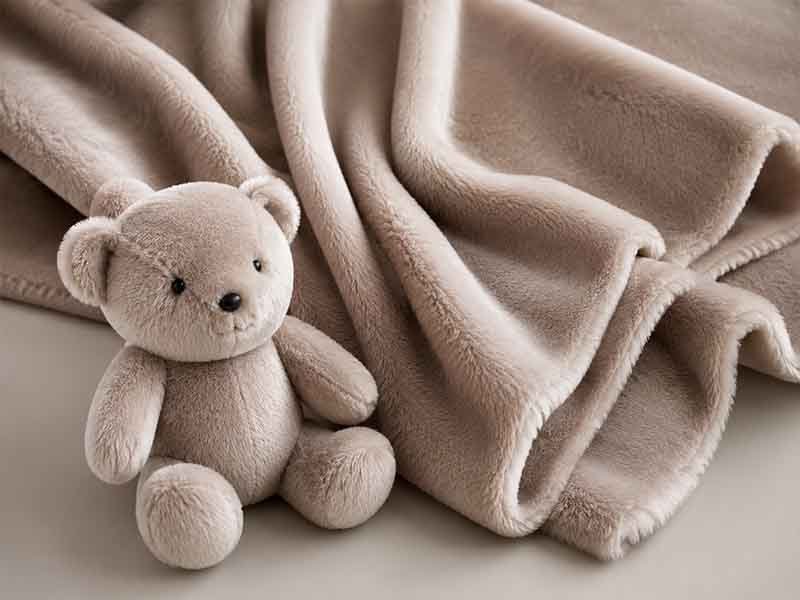
A plush toy can look perfect in a digital drawing and still feel disappointing when the first physical sample arrives. The proportions may be correct, the embroidery may match the artwork, and the colors may be close, yet the product can feel flat, slippery, stiff, or visually uneven. In many projects, the problem starts with fabric selection rather than pattern construction.
Minky is a soft knitted pile fabric, usually polyester-based, that works especially well for cuddly plush toys, baby-safe designs, rounded characters, mascots, pillows, keychains, and premium gift products. Its suitability depends on pile height, GSM, stretch, backing stability, shedding, embroidery performance, color consistency, and the way those properties interact with the toy’s pattern and filling.
Choosing minky is therefore not a simple soft-versus-not-soft decision. A fabric that feels luxurious on a roll may hide small embroidery, distort a narrow arm, expose the backing at a tight curve, or vary in shade when panels face different pile directions.
Imagine approving a smiling character sample under studio lighting, then opening the first production carton and seeing half the faces appear darker because the cheek panels were cut against the pile. That small material detail can turn into thousands of inconsistent products. Understanding minky before sampling helps prevent such surprises.
What Is Minky Fabric?

Minky is a soft knitted pile fabric, usually made from polyester, with a smooth plush surface and a flexible backing. It is widely used for stuffed animals, baby plush, character toys, pillows, and comfort products because it combines softness, rich color, washable performance, and the ability to form rounded shapes. Its actual quality depends on pile, density, stretch, backing, and finishing.
What Minky Is
Minky is not simply soft fabric. It is a family of knitted pile textiles made in different weights, textures, stretch levels, and surface finishes. The visible side contains short raised fibers that create the smooth, velvety feel associated with modern plush toys. The reverse side is a knitted backing that supports sewing, embroidery, and filling.
Most commercial minky used in plush production is polyester-based. Polyester is popular because it can provide consistent color, low moisture absorption, good abrasion resistance, and relatively predictable washing performance. However, two fabrics labeled 100% polyester minky may behave very differently.
Fiber fineness influences touch. Fine fibers usually create a smoother surface, while coarser fibers may feel slightly drier or less refined. Pile density affects whether the backing becomes visible when the material is stretched around a firmly filled head or body. Knitting tension affects dimensional stability, and finishing treatments can change gloss, softness, friction, and recovery.
For product development, the name minky is only a starting point. The useful question is not whether a fabric is minky, but whether that particular construction matches the toy’s size, shape, filling pressure, detail level, target age, washing method, packaging, and expected order volume.
How It Is Built
Minky normally begins with a knitted base. Unlike a rigid woven fabric, a knit structure can flex and stretch, which helps it follow curved plush patterns without creating hard folds. This flexibility is one reason minky works well for round heads, soft bellies, large cheeks, and pillow-like forms.
The pile is created on one side of the knitted base and then brushed, sheared, embossed, printed, or otherwise finished. Short and even shearing produces a clean surface for facial embroidery. Longer pile produces a softer, furrier appearance but can hide small details. Embossing creates patterns such as dots, swirls, or geometric textures, while printing adds markings, gradients, graphics, or branded artwork.
The backing deserves as much attention as the surface. A firm backing helps retain pattern dimensions and supports small embroidered features. A highly elastic backing can create a soft, rounded result, but it may also widen faces, lengthen limbs, or move embroidery after filling.
Construction also influences cutting and sewing. Minky usually does not unravel in the same way as a loose woven textile, but cutting through the pile releases loose fibers. These fibers should be removed during production through brushing, vacuum extraction, and surface cleaning. A well-made plush product depends on the relationship between pile and backing. A beautiful surface cannot compensate for weak recovery, unstable dimensions, poor seam support, or inconsistent dye lots.
Why Plush Makers Use It
Minky supports the qualities consumers expect from a plush toy: softness, warmth, smooth touch, friendly appearance, and comfortable handling. It can make simple shapes feel more appealing and soften the visual effect of seams, curves, and panel transitions.
The fabric is especially useful for stylized characters because it provides a clean base for embroidered eyes, mouths, cheeks, and logos. Compared with long faux fur, short-pile minky allows designers to preserve graphic facial expressions and clear color blocks.
It is also available in a wide range of solid colors, printed patterns, embossed textures, and stretch levels. This gives development teams more flexibility when matching character artwork, brand palettes, seasonal collections, or different product sizes.
From a manufacturing perspective, minky can work across several categories without requiring completely different production systems. The same general fabric family may be used for a baby comfort toy, a 20-centimeter character, a plush keychain, or a large pillow, although the precise construction should change. Its advantages are strongest when material selection is integrated with pattern engineering.
Where the Name Misleads
Minky is not a universal technical standard. Fabric mills, traders, and manufacturers may use the term for materials with different pile lengths, weights, backings, and stretch properties.
One supplier’s short-pile minky may be close to another supplier’s velboa. A fabric called mochi minky in one market may have much higher stretch than a similarly named fabric elsewhere. Some embossed fabrics are sold as dimple minky, cuddle fabric, or plush fleece even when their constructions are not identical.
This creates a common sourcing risk: a brand approves minky during sampling, but the production order uses another material with the same general name. The color may look similar, yet the finished toy becomes wider, shinier, thinner, or less stable.
To avoid that problem, the approved material should be identified by supplier, fabric code, fiber content, weight, width, pile height, stretch direction, and color lot. A retained swatch and approved finished sample should also be kept. Product photographs are not enough because lighting, pile direction, camera exposure, and screen settings can hide differences in gloss and density.
Which Minky Properties Matter Most?

The most important minky properties are weight, pile height, pile density, stretch, recovery, backing strength, shedding, colorfastness, embroidery performance, and compression recovery. These characteristics determine how the toy feels, whether the backing shows, how accurately the pattern holds its shape, and whether bulk production can match the approved sample consistently.
Weight and Density
Fabric weight is commonly expressed in grams per square meter, or GSM. Many minky fabrics used for plush products fall broadly between about 180 and 320 GSM, although lighter, heavier, and specialty versions are available. The number should be treated as a sourcing reference rather than a quality ranking.
A higher GSM may come from a heavier backing, denser pile, longer fibers, or a combination of these factors. It can provide better coverage and a more substantial feel, but it may also create thicker seams, increase material cost, slow drying, and make small components harder to turn.
A lower GSM may work well for compact plush, keychains, clothing, or products designed around lighter filling. The main risk is insufficient surface coverage. When a low-density fabric is stretched around a firm curve, the backing may become visible between the pile fibers.
Density is often more important than weight alone. Two 250 GSM fabrics may perform differently if one has a thick backing with relatively sparse pile and the other has a lighter backing with dense, fine fibers. A practical evaluation should include a flat swatch, a stretched swatch, a sewn panel, and a fully filled sample.
| Property | Common Sourcing Range | Effect on Plush Toys | Main Risk |
|---|---|---|---|
| Fabric weight | About 180-320 GSM for many standard options | Changes body, coverage, seam bulk, and perceived quality | Choosing by GSM alone |
| Short pile | About 1-3 mm | Supports clear embroidery and compact shapes | May appear less furry |
| Medium pile | About 3-6 mm | Adds softness while retaining moderate detail | Small features may soften visually |
| Higher stretch | Often above 15% in the main direction | Helps rounded and pillow-like forms | Size and face distortion |
| Lower stretch | Often below 10% in the main direction | Improves dimensional control | May require more pattern shaping |
| Usable width | Commonly around 145-160 cm, depending on mill | Affects marker efficiency and material use | Assuming quoted width is fully usable |
These ranges vary by supplier and test method. Exact values should be measured on the production lot rather than copied from a general product description.
Pile and Surface
Pile height changes both touch and appearance. Short pile creates cleaner edges, clearer embroidery, and more accurate color separation. Medium pile softens the product visually. Longer pile creates a more comforting or animal-like effect but reduces definition.
Pile direction changes the way light reflects from the surface. The same color can look lighter when fibers point toward the viewer and darker when they point away. On a finished character, this can make two correctly dyed cheek panels appear mismatched.
Every directional pattern piece should therefore include a pile arrow. Left and right components normally need consistent orientation. Rotating pieces to save material may reduce fabric consumption, but it can create visible shade changes across the toy.
Pile density affects surface coverage. Dense pile helps hide the backing at seams and curves, while sparse pile can create thin-looking areas around noses, cheeks, paws, and firmly filled bodies. Gloss is another important surface factor. A highly reflective minky may look bright on a swatch but uneven in product photography.
Stretch and Recovery
Stretch can improve a plush toy or quietly destroy its proportions. Controlled stretch helps curved panels expand smoothly around filling, creating round heads and soft bodies without sharp tension lines. Excessive or uneven stretch can widen faces, lengthen legs, move embroidered eyes, and change the final size.
Widthwise stretch is often greater than lengthwise stretch, but this is not guaranteed. Some mochi-style materials stretch strongly in several directions. The development team should test both directions rather than relying on the supplier’s description.
A simple comparative method uses a 100-millimeter strip. The strip is extended under a consistent load, and the increased length is recorded. Recovery is then measured after the load is removed. A fabric that extends to 120 millimeters and returns to 101 millimeters behaves differently from one that remains at 107 millimeters.
Recovery matters because permanent elongation can create sagging limbs, flattened faces, or uneven bodies. Pattern orientation should be decided after stretch testing. Changing from one minky to another often requires pattern adjustment even when both fabrics look similar.
Durability and Care
Polyester minky generally offers useful washability and abrasion resistance, but the finished product must be evaluated as a complete system. Fabric, thread, filling, labels, printed areas, accessories, electronics, and internal weight bags can all affect care instructions.
Surface rubbing should be assessed because plush toys are repeatedly handled, hugged, carried, and placed against clothing or furniture. A fabric that releases a few cut fibers during sewing may still perform well after cleaning. Persistent surface shedding is a different issue and requires material review.
Washing tests should examine dimensional change, shade, pile matting, embroidery distortion, seam appearance, printed-pattern durability, and recovery after drying. High heat may alter the surface or reduce softness, so care labels should reflect tested conditions rather than generic assumptions about polyester.
Compression recovery is particularly important for large plush and pillows. Products are often compressed to reduce carton volume. A sample should be packed under realistic pressure and stored for a representative period before being unpacked and assessed. A durable product is achieved through balanced engineering, not by selecting the heaviest fabric available.
Which Minky Types Suit Plush Toys?

Short-pile minky is best for detailed characters and small products, mochi minky suits soft rounded forms, longer pile creates a furrier appearance, dimple minky adds texture, and printed minky supports complex graphics. The correct choice depends on product size, embroidery, shape, filling, target age, washing needs, and the level of dimensional control required in bulk production.
Short-Pile Minky
Short-pile minky is the most versatile option for many custom plush projects. Its compact surface helps preserve facial expressions, embroidery edges, seam placement, and small color panels.
It is commonly used for character heads, mascot faces, keychains, blind-box collectibles, baby plush, and products with logos or fine embroidered details. The shorter surface reduces the risk of stitches sinking below the pile.
A short pile does not automatically mean a thin or inexpensive fabric. Dense premium constructions can feel smooth, full, and refined while providing better control than longer surfaces. Backing stability remains important because small products are sensitive to dimensional change.
The main limitation is visual character. Short pile creates a clean, graphic look rather than a visibly furry silhouette. For mixed-material products, it often works well on the face and body while faux fur, sherpa, fleece, or felt-like fabric is used for hair, clothing, ears, or decorative elements.
Mochi Minky
Mochi minky is commonly used for soft, elastic, squeezable plush with rounded forms. It is especially suitable for simplified animals, food characters, oversized heads, plush pillows, and products designed around a relaxed, cushion-like feel.
The material can create smooth curves with fewer visible tension lines. It works well with soft filling and large panels, allowing the toy to deform comfortably when squeezed and recover afterward.
Its greatest advantage is also its main risk. High stretch reduces dimensional control. Eye spacing, face width, body length, and seam position can shift if pattern direction, filling weight, or sewing tension changes.
Mochi minky usually requires tighter production records. Pattern orientation, stretch percentage, filling weight, embroidery placement, and finished measurements should all be documented. It is not automatically suitable for every soft product; stable fabric can be combined with it in small or highly detailed areas.
Long-Pile and Dimple
Long-pile minky creates a softer, furrier appearance than standard short-pile fabric. It is useful for animals, fantasy creatures, tails, manes, winter characters, decorative ears, and premium gift products that need more visible texture.
Long fibers make components appear larger and reduce the clarity of fine edges. A narrow hand or small ear can look thicker than the actual pattern. Embroidered mouths, freckles, or tiny lettering may be partially hidden.
Dimple minky adds texture through embossed dots or depressions. It is popular for baby comfort products, sensory panels, bellies, paws, ears, and contrast sections. The scale of the texture should match the size of the product, and embossing may flatten on highly stretched areas or after repeated washing.
Smooth minky is usually a better choice for embroidered faces. Dimple fabric is often most effective when used selectively, where it adds touch and visual contrast without reducing expression clarity.
| Minky Type | Strong Applications | Detail Control | Stretch Level | Main Development Concern |
|---|---|---|---|---|
| Short-pile | Character faces, keychains, baby plush | High | Low to moderate | Can look less furry |
| Standard medium-pile | General stuffed animals, mascots | Medium to high | Low to moderate | Pile direction must be controlled |
| Mochi minky | Pillows, rounded characters, soft bodies | Medium | Moderate to high | Filling and size variation |
| Long-pile | Animals, fantasy designs, tails, accents | Low to medium | Varies | Hidden details and seam bulk |
| Dimple minky | Sensory panels, baby products, contrast parts | Medium | Moderate | Texture distortion on curves |
| Printed minky | Animal markings, graphics, decorative panels | Depends on pile | Varies | Print scale, registration, and color |
Printed Minky
Printed minky allows designers to place patterns, markings, gradients, clothing graphics, or brand artwork directly on the plush surface. It can reduce the number of sewn color panels and make complex concepts more practical.
Common applications include animal coats, food patterns, galaxy themes, fantasy textures, seasonal graphics, decorative wings, and branded motifs. The printed result should be reviewed on actual pile because fine lines that look sharp on a digital file may soften when printed onto raised fibers.
Repeat printing and placement printing require different controls. Repeat printing covers the roll with a recurring pattern, and the repeat size affects pattern balance and material consumption. Placement printing positions artwork for a specific pattern piece and requires accurate alignment during cutting.
Colorfastness should be checked through rubbing and the intended washing method. The print should also be assessed after stretching because the backing or unprinted base may become visible. For character projects, a printed swatch should be reviewed together with embroidery thread, applique fabric, labels, and packaging.
What Are the Best Uses for Minky?

Minky works best in plush products where softness, touch, rounded shape, clean color, and emotional appeal are central. It is particularly suitable for baby plush, stylized characters, mascots, keychains, collectibles, pillows, weighted products, and premium gifts. The exact minky type should be selected according to detail level, structure, safety design, expected handling, and production volume.
Baby and Comfort Plush
Minky is frequently selected for baby plush and comfort products because it provides a gentle surface and works well with embroidered features. Embroidered eyes and mouths can replace detachable plastic parts in age-appropriate designs.
Softness alone does not make a baby product suitable. The complete construction should address seams, filling containment, labels, attachments, accessories, fiber release, washing, age grading, and the requirements of the target market.
Short, dense minky is usually easier to manage than very long or loose pile. It offers a smooth surface while supporting clear embroidery and regular washing. A baby plush may include a minky head, a soft fleece or cotton-blend comfort panel, securely enclosed sound elements, or textured sections for tactile variation.
The product should be washed using the proposed care method before approval. Teams should compare the washed sample with an unwashed reference for shrinkage, matting, fading, seam movement, and embroidery distortion. The safest development approach starts with the age group and market requirements before fabric and accessories are finalized.
Characters and Mascots
Character plush requires a balance between softness and accuracy. The fabric must support the identity of the design rather than changing its expression or proportions.
Short- and medium-pile minky are commonly used for character faces and bodies. They provide enough softness for a premium touch while preserving embroidered eyes, mouths, logos, and color boundaries.
For licensed characters and brand mascots, physical color approval is important. Pile direction and lighting can make one color appear to vary across the product. Front, side, back, and three-quarter views should be reviewed.
Mascot plush may also include uniforms, hats, shoes, scarves, capes, or branded clothing. Minky does not need to be used for every component. Woven fabric may create better clothing structure, faux fur may work for hair, and felt-like materials may produce cleaner small details. For repeat programs, retained samples and documented fabric codes help maintain the same appearance across seasons and order quantities.
Keychains and Collectibles
Plush keychains and blind-box collectibles need precise material control because small dimensions magnify manufacturing variation. Short-pile, stable minky is usually the strongest option because it supports small embroidery, compact seams, and clean silhouettes without adding too much surface bulk.
Keychains are exposed to frequent handling and abrasion. The attachment point should connect to internal reinforcement rather than relying only on the outer seam. The loop, chain, ring, clasp, and textile attachment should be evaluated as one system.
Small components need realistic minimum widths. A narrow finger, tail, or ear may be easy to draw but difficult to turn, fill, and reproduce in production. In some cases, embroidery or applique creates a clearer result than a tiny three-dimensional part.
Collectible series also require consistency across multiple characters. Shared fabric constructions, common eye standards, controlled filling weights, and repeatable scale rules help the collection feel unified. Packaging should prevent facial compression and attachment damage.
Pillows and Weighted Plush
Minky is particularly effective for plush pillows because the material supports large curved surfaces and a soft, huggable feel. Standard minky, mochi minky, dimple minky, and printed minky are all used depending on the desired appearance.
Large panels make stretch and filling variation more visible. Filling weight should be controlled, and finished dimensions should be measured after the product has rested. Compression packaging is a major consideration because the sample should recover without permanent creases, twisted seams, or flat areas.
Weighted plush needs additional internal engineering. Beads or pellets should normally be enclosed within separate inner bags or compartments. The outer minky should not carry concentrated weight directly. Weight distribution affects comfort and shape, while multiple controlled chambers can distribute load more evenly.
Seams around weighted sections require reinforcement, and the outer fabric’s stretch should be considered. Highly elastic minky may allow internal weight to move or distort the body if the compartment structure is weak. Product descriptions should focus on touch, comfort, companionship, and intended use without making unsupported medical claims.
Is Minky Better Than Other Plush Fabrics?

Minky is better when a product needs smooth softness, rounded form, rich color, and a clean premium appearance. Velboa often provides stronger dimensional control, fleece offers a flatter casual surface, faux fur creates realistic hair, and sherpa adds curled texture. The best material depends on the design, price position, detail level, manufacturing method, and intended use.
Minky vs Velboa
Minky generally feels softer and fuller than velboa. Velboa usually has a shorter, flatter surface with relatively controlled stretch, making it useful for compact plush, printed animal patterns, promotional toys, and cost-sensitive programs.
For products where hand feel is a major selling point, minky often creates a stronger first impression. It can feel more comfortable against the skin and gives rounded characters a fuller appearance.
Velboa may be easier to control on small pieces, narrow limbs, or designs with many detailed seams. Its flatter pile can make embroidery and printed patterns easier to read.
A useful comparison uses the same pattern, embroidery file, filling weight, and product size. Flat swatches cannot show how each material behaves after sewing and filling. Mixed construction is common, with minky on the main body and velboa on feet, markings, small facial areas, or high-detail components.
Minky vs Fleece
Minky usually has a smoother, more velvety surface than fleece. Fleece has a brushed, flatter appearance and often communicates warmth and casual comfort rather than a polished plush finish.
Fleece can work well for clothing, wings, leaves, hats, internal ears, simple flat shapes, and products that do not require a strong pile effect. Its direction may be less visually obvious than minky, reducing the risk of panel shade variation.
Minky is often preferred for character faces, rounded bodies, and premium gift products. Its surface creates more visual depth and a stronger tactile experience. Both fabrics can stretch, although the direction and recovery vary, so neither should be transferred into an existing pattern without review.
The choice should reflect the intended visual language. Minky looks smoother and more refined. Fleece often feels softer in a casual, fabric-like way and can provide useful contrast within a mixed-material toy.
Minky vs Faux Fur and Sherpa
Faux fur is designed to create visible hair, while minky creates a smooth pile. Faux fur is stronger for realistic animals, long-haired characters, manes, tails, eyebrows, and dramatic fantasy designs.
Minky is easier to use around embroidered faces, small panels, compact limbs, and clean color blocks. It generally requires less trimming and grooming than long faux fur.
Sherpa has a curled or wool-like texture. It is useful for sheep characters, winter designs, coats, bellies, pillows, and textured accents. Its surface can hide seams but may also hide small details.
Thickness transitions should be tested when minky is combined with faux fur or sherpa. Different backings and stretch levels can create rippling or uneven seam tension.
| Fabric | Surface Character | Detail Control | Typical Strengths | Main Limitation |
|---|---|---|---|---|
| Minky | Smooth, soft pile | High with short pile | Characters, baby plush, pillows, premium gifts | Direction and stretch need control |
| Velboa | Short, flatter pile | High | Small plush, printed animals, promotions | May feel less luxurious |
| Fleece | Brushed, low-definition surface | Medium to high | Clothing, flat parts, casual products | Less velvety depth |
| Faux fur | Long, visible fibers | Low on small details | Realistic animals, hair, manes, tails | More cutting and grooming work |
| Sherpa | Curled, wool-like texture | Low to medium | Winter themes, sheep, bellies, accents | Can hide embroidery and fine seams |
When Minky Is the Wrong Choice
Minky is not the best option for every design. It may be unsuitable when the product needs rigid structure, crisp folded edges, extremely sharp tiny details, long realistic hair, technical weather resistance, or a very flat printed surface.
A highly structured robot, vehicle, building, or geometric product may require woven fabric, felt-like material, foam lamination, or internal support. Minky can soften edges that are supposed to look precise.
Minky should also be reconsidered when the available lot has unstable stretch, visible backing, persistent shedding, weak recovery, inconsistent color, or poor embroidery performance. Packaging can be another reason to change materials if the surface develops permanent pressure marks.
Material popularity should never override product fit. A design can combine several fabrics to achieve the required touch, structure, appearance, and cost. The best choice is the material that produces the right finished product repeatedly, not the fabric with the most attractive description.
How Do Manufacturers Select and Control Minky?
Manufacturers should select minky by matching its measurable properties with artwork, structure, product size, filling, embroidery, age group, target market, packaging, and expected order volume. Control should continue through coded material approval, stretch and pile testing, sample validation, lot tracking, directional cutting, in-line inspection, and comparison with the approved production reference.
Define the Specification
A reliable minky specification should identify the exact material rather than use a general name. Supplier, fabric code, fiber content, weight, width, pile, backing, stretch, color, and lot should be recorded.
The development team should also confirm whether every selected color uses the same construction. Dark, light, printed, and embossed versions within one collection may have different hand feel or stretch.
Material availability should be checked before final sample approval. A small quantity may be available for the prototype while the production order requires a new dye lot. This can create shade, gloss, and texture differences.
The specification should connect with the product design. A face with fine embroidery needs different surface control from a large pillow body. A weighted plush needs different backing and seam consideration from a lightweight keychain.
| Control Item | What to Record | Why It Matters |
|---|---|---|
| Supplier and fabric code | Exact source and item reference | Prevents unapproved substitution |
| Fiber content | Declared composition | Supports labeling and material review |
| GSM | Measured fabric weight | Helps control body and coverage |
| Pile height | Measured in millimeters | Affects touch and detail clarity |
| Usable width | Excluding damaged edges | Improves material planning |
| Stretch by direction | Width, length, and recovery | Controls pattern orientation |
| Color standard | Swatch, code, and lot | Reduces shade variation |
| Backing condition | Strength, thickness, visibility | Affects seams and filled curves |
| Shedding result | Cut-edge and surface behavior | Supports cleanliness and quality |
| Wash result | Dimensional and surface changes | Supports accurate care instructions |
| Compression result | Recovery after packing | Important for shipping and retail presentation |
Validate the Sample
The sample should validate more than appearance. It should prove that the selected minky can be cut, embroidered, sewn, filled, cleaned, packaged, and repeated at the expected production scale.
Before sample approval, the product should be reviewed from front, side, back, top, and three-quarter angles. Character accuracy often changes when viewed from the side, where head depth, cheek volume, posture, and limb placement become more obvious.
Critical dimensions should be measured after filling. The sample should then rest before a second measurement because elastic fabric may settle. Embroidery should be checked both flat and filled because eye shape, spacing, and symmetry can change as the panel stretches.
The sample should also be tested in the proposed packaging. Window boxes, inner trays, compression bags, and tight retail packs can alter pile direction or distort the face. A successful sample becomes the physical reference for bulk production, supported by digital patterns, embroidery files, measurements, filling records, and material data.
Control Bulk Production
Bulk control begins with incoming material inspection. Fabric should be checked against the approved swatch and sample for color, pile, stretch, weight, width, backing, and surface condition.
Different dye lots should be segregated. Mixing lots within one toy or retail set can produce visible shade differences, especially when pile direction changes light reflection. Cutting markers should respect pile direction, and corresponding left and right components should follow the approved orientation.
Embroidery files, thread colors, stabilizers, and placement guides should remain version-controlled. Pattern changes should also be documented so that an older file does not return to production. Filling is another key variable because a small gram difference can visibly change a compact character head.
In-line inspection allows problems to be corrected before thousands of units are completed. Inspectors can monitor embroidery, seam allowance, attachment security, shape, pile direction, filling, labels, and packaging. A retained production sample from the first approved units can help supervisors and inspectors compare work throughout the order.
Inspect Before Shipment
Final inspection should compare finished products with the approved sample and specification. Appearance is important, but inspection should also cover dimensions, seams, filling, accessories, labels, cleanliness, function, packaging, and carton information.
The surface should be brushed and checked for loose fibers, trapped pile, oil marks, chalk, thread ends, and pressure damage. Faces deserve careful attention because small changes strongly affect customer perception. Eye position, mouth angle, symmetry, cheek shape, and head filling should remain within the approved standard.
Attachment points on keychains, clothing, sound modules, weighted sections, and decorative parts should receive additional review. Packaging should protect the toy without excessive pressure. Barcodes, warnings, labels, polybags, boxes, inserts, and carton marks should match the order requirements and target market.
For a new minky plush project, provide the artwork, target size, expected quantity, age group, sales market, preferred hand feel, color references, embroidery files, packaging format, testing expectations, and delivery schedule. Delsney supports brands, IP owners, retailers, gift companies, and e-commerce teams from material selection and sampling through production, inspection, packaging, and global delivery. With 18+ years of plush manufacturing experience, 500+ staff, 18 production lines, 25+ engineers, 10+ designers, 20+ QC personnel, a 500-piece MOQ, standard sampling typically in 5-7 days, and 100% pre-shipment inspection, the team can assess whether a minky specification is suitable before it reaches bulk production. Send your concept or artwork to request a practical sample plan and quotation.
Share your artwork, target size, quantity, market, age group, preferred fabric feel, packaging needs, and delivery deadline with Delsney to receive a material review, sample plan, and custom quotation.