Skip to content
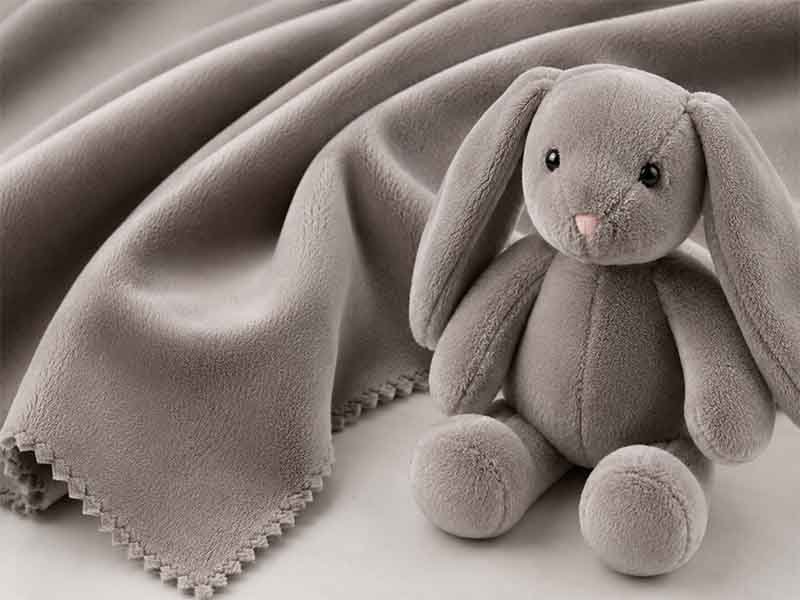
Velboa often looks simple on a fabric card: a smooth surface, short pile, clear color, and a flexible knitted backing. Yet once it is cut, embroidered, sewn, filled, brushed, packed, and repeated across thousands of units, small material differences become highly visible. A slightly weak backing can open along a curved seam. A poorly controlled nap direction can make two panels appear to be different colors. Excessive stretch can distort a character’s face. Low pile density can reveal the backing around embroidery.
Velboa is a short-pile plush fabric, commonly made from polyester, that works best for character plush, mascots, keychains, promotional toys, and collectible products requiring clean outlines and visible embroidery. Its value comes from controlled surface texture, good shape definition, practical durability, and efficient production. The right specification depends on pile density, backing strength, stretch, GSM, color consistency, and the intended product.
The key question is therefore not simply, “Is Velboa soft?” A more useful question is, “Will a specific Velboa construction deliver the appearance, touch, seam performance, safety preparation, and production consistency required by the product?”
Many disappointing plush projects begin with a fabric chosen from a small digital photo. The material looks correct on screen, but the first stuffed sample suddenly has a darker face, stretched cheeks, buried embroidery, or visible backing at the seams. Understanding Velboa before sampling helps prevent that expensive surprise.
What Is Velboa Fabric?

Velboa is a short-pile knitted fabric, usually made from polyester, with a smooth face and stable backing. In plush toy production, it is valued for clear embroidery, controlled shaping, strong color presentation, and efficient sewing. It works especially well when a design needs neat outlines and visible details rather than long, fluffy fur.
Fiber and Surface Structure
Most Velboa used for plush toys is made from polyester because polyester accepts consistent dyeing, dries quickly, resists everyday abrasion, and supports repeat production. The visible surface is formed by a very short cut pile, while the knitted backing carries the seam and controls how the material stretches around a stuffed shape.
The word “Velboa” describes a fabric family rather than one fixed specification. Two suppliers may both offer “standard Velboa,” yet one version may feel dense and smooth while another feels thin, shiny, or slightly coarse. Fiber composition alone does not explain the difference. Pile density, backing weight, knitting tension, brushing, heat setting, dyeing, and finishing all affect the final hand feel.
A flat swatch may also hide weaknesses that become obvious after stuffing. Bending the fabric around a small nose or paw can expose the backing if the pile is sparse. Strong lighting may reveal streaks caused by uneven brushing. Stretching a face panel may change the color because the pile opens and reflects light differently.
For meaningful evaluation, examine the front, reverse side, cut edge, folded surface, stretched surface, and sewn sample. A supplier name or product code is useful for tracking, but physical approval remains more reliable than a fabric name.
Velboa and Short Plush
Short plush is a broad material category. Velboa normally sits within that category, but not every short-pile plush is Velboa. Mills and trading companies may use names such as short plush, plush velour, printed Velboa, brushed Velboa, crystal Velboa, super-soft Velboa, or faux suede plush for materials that look similar but behave differently.
The lack of universal naming can create serious sourcing mistakes. A development sample may use one short-pile fabric, while bulk production is ordered under a generic name from another mill. The color may match, but the backing, sheen, density, or stretch may not.
A practical material record should include:
- Supplier and fabric code
- Fiber composition
- Measured fabric weight
- Usable width
- Pile height and direction
- Stretch direction
- Surface finish
- Dye lot or print lot
- Approved physical swatch
Keeping a labeled swatch with the approved plush sample helps production teams compare incoming rolls against the original standard. Photographs alone cannot show softness, thickness, stretch, or pile recovery.
Velboa and Minky
Velboa and Minky are both used for stuffed products, but they usually serve different design priorities. Velboa tends to have a flatter and shorter pile, giving faces, logos, printed markings, and panel lines a cleaner appearance. Minky generally offers a fuller, softer hand feel and is often chosen for comfort-focused plush, baby products, pillows, and larger cuddle toys.
The difference becomes more noticeable as product size decreases. On a 7 cm keychain, a deep pile may cover a narrow embroidered mouth or make small ears look less defined. Short Velboa keeps those details visible. On a 40 cm bedtime plush, however, the flatter touch of Velboa may feel less comforting than a fuller Minky.
Neither material automatically represents higher quality. Quality depends on whether the material suits the product. A detailed character can look more accurate in Velboa, while a simple rounded animal may feel more appealing in Minky.
Mixed construction is also common. A design may use Velboa for the face, paws, or printed areas and Minky for the body. That combination can preserve visual accuracy while improving the overall tactile experience.
What Velboa Is Not
Velboa should not be confused with long-pile faux fur. Faux fur is designed to create volume, hair movement, layered color, or realistic animal texture. Velboa creates a controlled, graphic surface. It is better suited to stylized characters, clean color blocks, and small embroidered features.
Velboa is also not automatically suitable for every child-focused product simply because it is soft polyester. Safety depends on the finished toy, including dyes, prints, seams, filling, attachments, labels, and age grading. Chemical and mechanical requirements must be considered for the destination market.
Likewise, a high fabric weight does not always mean a better material. Extra weight may come from the backing rather than the visible pile. A moderately weighted fabric with dense, evenly anchored fibers may perform better than a heavier fabric with poor surface coverage.
The most useful definition is practical: Velboa is a short-pile material chosen for controlled appearance and manufacturing precision. Its value is determined by measurable construction and finished-product performance, not by the name printed on a fabric card.
Which Velboa Properties Matter?

The most important Velboa properties are pile height, pile density, fabric weight, backing strength, stretch, color consistency, shedding resistance, and surface recovery. Together, they determine softness, embroidery clarity, seam stability, shape accuracy, durability, and whether bulk production can match the approved sample.
Pile Height and Density
Pile height affects both appearance and production control. Shorter pile makes embroidery, printing, appliqué edges, and seam lines easier to see. Longer pile produces a softer visual effect but can partly hide fine details.
Pile density describes how closely the surface fibers cover the backing. Dense pile gives a more even appearance when the fabric bends around curves. Sparse pile may reveal the knitted base around noses, cheeks, paws, darts, or highly filled sections.
Commercial Velboa selected for plush products often falls within relatively short pile ranges, but supplier measurements are not always taken in the same way. One mill may measure the exposed fiber length, while another may include part of the base construction. Physical comparison is therefore essential.
Fabric weight, often shown in grams per square meter, adds useful context but should not be evaluated alone. A heavier construction may provide stronger body and better coverage, yet excessive backing weight can make tiny components harder to turn and shape. Smaller plush items often need enough stability to hold form without becoming bulky at seams.
| Property | Common Commercial Range or Checkpoint | Practical Effect |
|---|---|---|
| Fiber content | Often 100% polyester | Color stability, drying speed, and practical abrasion resistance |
| Fabric weight | Often around 180-320 g/m² | Influences body, coverage, consumption, and hand feel |
| Pile height | Often around 0.5-3 mm | Controls detail visibility and surface softness |
| Usable width | Commonly around 150-160 cm | Affects cutting yield and material cost |
| Seam allowance | Often 5-10 mm by product size | Influences seam security and small-part bulk |
| Stitch length | Often around 2-3 mm | Balances seam strength and fabric damage |
| Stretch direction | Must be recorded and controlled | Affects face width, roundness, and symmetry |
| Nap direction | One-way cutting may be required | Prevents visible shade differences between panels |
These ranges are working references rather than universal purchasing standards. Final values should be confirmed against the product size, structure, sewing method, and test sample.
Backing and Stretch
The backing carries most of the mechanical load. It must tolerate cutting, embroidery, sewing, turning, stuffing, handling, and transport without opening around the stitches.
A loose backing may create several problems:
- Seam holes become visible after filling.
- Curved panels develop waves or wrinkles.
- Embroidery shifts or puckers.
- Narrow arms and legs twist.
- The face becomes wider than the approved sample.
- Attachment points weaken under pulling force.
Stretch is not always negative. Controlled stretch can help create smooth curves and reduce sharp folds around rounded bodies. Problems arise when stretch direction is ignored or when different panels are cut in conflicting orientations.
Face panels deserve particular attention. A few millimeters of width change can alter eye spacing, cheek shape, and expression. The fabric may look correct before sewing but become distorted after embroidery and stuffing. Engineers often adjust pattern dimensions to account for the material’s behavior rather than forcing one paper pattern to work with every fabric.
A proper sewing trial should use production-intended needles, thread, stitch length, seam allowance, and stuffing firmness. Testing only a straight strip provides limited information. Tight curves, small ears, gussets, narrow limbs, and heavily filled heads reveal backing weaknesses much faster.
Color and Surface Recovery
Velboa reflects light according to pile direction. The same roll may appear lighter when brushed upward and darker when brushed downward. A product can therefore look mismatched even when every panel comes from the same dye lot.
Cutting markers should show a clear nap direction. Reversing selected pattern pieces may improve fabric yield, but the finished toy can develop visible shade differences. Large solid-color characters and symmetrical body parts are especially sensitive.
Surface recovery also matters. After compression, brushing, folding, or packaging, the pile should return to a reasonably even appearance. Poor recovery can leave flattened areas around the face, belly, or packaging contact points.
Color approval should be performed under controlled conditions. Useful checks include:
- Daylight-equivalent lighting
- Warm indoor lighting
- Direct and angled viewing
- Brushed and unbrushed surfaces
- Bent or stretched fabric
- Comparison across several roll sections
Pantone references improve communication, but textile colors rarely behave exactly like printed ink. A physical approved swatch remains the strongest control. For multi-character collections, shared colors should ideally come from the same production lot whenever scheduling and quantity allow.
Shedding, Pilling, and Wear
Loose fibers created during cutting are normal and should be removed before sewing or final packing. Continuous shedding during handling is different and may indicate weak pile anchoring, aggressive finishing, or unsuitable fabric quality.
Pilling develops when surface fibers rub, tangle, and form small balls. High-contact areas often include the underside, paws, cheeks, edges, and sections pressed against packaging. Dark fabrics may show pale lint more clearly, while light fabrics may reveal dirt or friction marks sooner.
Useful factory checks include:
- Repeated hand rubbing
- Soft-brush recovery
- Surface inspection after sewing
- Cleaning trials on a finished sample
- Packaging friction checks
- Inspection after transport simulation
- Comparison before and after repeated compression
Care claims should be based on the complete toy. A polyester outer fabric may tolerate gentle washing, but printed details, electronic modules, metal accessories, internal supports, adhesives, or weighted filling may not.
The goal is not to find a fabric that never changes under any condition. The goal is to confirm that normal use, packing, and approved cleaning methods do not create unacceptable appearance or safety problems.
How Does Velboa Affect Plush Design?

Velboa supports clean shapes and visible details, but its stretch, nap direction, backing, pile density, and filling response directly influence the finished design. Pattern dimensions, embroidery placement, cutting direction, seam construction, and stuffing level must be developed around the selected fabric rather than treated as separate decisions.
Embroidery and Facial Detail
Short pile gives embroidery a clear surface. Eyes, mouths, eyebrows, logos, symbols, and small markings remain visible instead of sinking between long fibers. That advantage is one reason Velboa is often selected for stylized characters and small collectible products.
Embroidery still needs careful engineering. Excessive stitch density can stiffen the face panel, pull the fabric inward, or create puckering around the design. Weak backing support can allow the panel to stretch in the hoop. Very narrow lines may close up or look uneven after the fabric is stuffed.
A reliable embroidery trial should confirm:
- Final feature size
- Thread thickness
- Underlay structure
- Stitch density
- Stabilizer type
- Hoop tension
- Distance from nearby seams
- Position after stuffing
Facial placement must be reviewed on the completed head. Sewing darts and gussets changes the panel geometry. Features that look centered on a flat piece may appear too high, too close, or slightly rotated after assembly.
Small characters often need artwork simplification. A thin illustrated mouth may require a wider embroidered line. Tiny eye highlights may need to be enlarged or removed. Good development preserves the character’s identity rather than copying every graphic detail at an impractical scale.
Nap, Stretch, and Pattern Direction
Every Velboa pattern piece has at least three directional considerations: pile direction, greater stretch direction, and visual grain. Ignoring any one of them can alter the final product.
| Design Variable | If Controlled Well | If Ignored |
|---|---|---|
| Nap direction | Uniform color and surface reflection | Panels appear lighter or darker |
| Greater stretch direction | Smooth curves and planned shaping | Faces widen or limbs twist |
| Pattern symmetry | Balanced ears, eyes, arms, and legs | Visible left-right differences |
| Embroidery orientation | Features remain level after sewing | Eyes or logos rotate |
| Filling pressure | Stable form and even surface | Seams strain or shapes distort |
| Seam allowance | Secure assembly with manageable bulk | Weak seams or thick small parts |
Pattern engineers may intentionally place greater stretch around a rounded body, but the same direction may be unsuitable across a character face. Small changes in orientation can influence head width, belly roundness, and limb length.
One-way nap cutting usually consumes more material because pieces cannot be freely rotated. The extra consumption should be included during costing. Reducing material waste is useful, but reversing a face or body panel to save fabric can create a visible quality problem under retail lighting.
Approved patterns should indicate direction clearly, and the cutting team should maintain that direction across all production lots.
Shape and Stuffing Control
Velboa’s short pile exposes the underlying form. Long fur can visually soften small sewing errors, while Velboa shows uneven curves, weak corners, seam bumps, and inconsistent filling more clearly.
Shape control starts with the pattern. The number and location of darts, gussets, and panel seams determine how the flat material becomes a three-dimensional body. Fabric stretch then modifies that shape. Filling pressure adds another layer of change.
Overfilling can:
- Widen the face
- Flatten pile around curves
- Expose the backing
- Stress seams
- Make limbs stiff
- Change the approved sitting position
Underfilling can create wrinkles, hollow sections, weak posture, and inconsistent shelf presentation.
Factories often control filling by weight, volume guidance, hand-feel references, or a combination of methods. Weight alone is not enough when one operator packs the filling tightly and another distributes it loosely. Visual comparison with an approved sample remains important.
Large rounded toys may need internal filling zones to prevent migration. Small keychains may need carefully reduced seam bulk because heavy seams occupy a greater percentage of the finished volume.
Printing and Material Mixing
Polyester Velboa can support printed patterns when the fabric construction, color base, ink method, temperature, and finish are compatible. Printing is useful for gradients, animal markings, branded repeats, clothing patterns, food graphics, and complex details that would require too many sewn panels.
A printed trial should be checked for:
- Edge sharpness
- Color accuracy
- Pattern scale
- White show-through
- Surface flattening
- Heat damage
- Rubbing resistance
- Stretch-related distortion
Printing may be less suitable for isolated small features that need strong dimensional visibility. Embroidery often performs better for eyes, mouths, and logos. Appliqué may be more effective for bold shapes and contrasting materials.
Velboa also combines well with Minky, faux fur, felt, satin, jersey, corduroy, and printed textiles. A mixed-material plan can create more depth without sacrificing face clarity.
Complexity must remain manageable. Every additional fabric introduces another color standard, shrinkage behavior, cutting direction, seam response, and purchasing requirement. Material mixing should improve the design enough to justify the added production control.
Which Plush Toys Use Velboa Best?

Velboa works best for character plush, mascots, keychains, blind-box toys, promotional products, food shapes, and stylized animals that need clean outlines and visible embroidery. It is less suitable as the main fabric for realistic long-haired animals or products whose main selling point is deep, fluffy softness.
Character and Mascot Plush
Character identity often depends on expression, proportions, color placement, and recognizable graphic details. Velboa supports those needs because the short pile does not hide the shape.
Common applications include:
- Animation characters
- Game characters
- Corporate mascots
- Sports mascots
- Educational figures
- Food and beverage characters
- Theme-park souvenirs
- Event merchandise
A mascot may contain several materials. Velboa can form the face, hands, shoes, or uniform sections, while faux fur creates hair, tails, or textured body areas. Felt may support thin decorative parts. Satin or jersey may represent clothing.
Color accuracy is especially important for branded characters. A fabric that looks correct under factory lighting may photograph differently under studio lights. Reviewing sample colors in person and on camera helps avoid surprises during launch photography.
Repeated programs also benefit from Velboa’s controlled appearance. When a mascot is produced across several sizes, the same material family can help maintain consistent color and surface character, although pattern and embroidery details still require scaling for each size.
Keychains and Blind-Box Toys
Miniature plush items place strict limits on pile length, seam bulk, and detail size. A long pile can overwhelm a 5-10 cm product, cover embroidery, or make small ears and limbs look less defined.
Velboa supports compact designs because it allows:
- Clear facial embroidery
- Narrow color sections
- Small appliqué pieces
- Controlled rounded shapes
- Consistent appearance across a collection
- Easier visual inspection
Blind-box collections often include several characters sharing one body platform. Small differences in ears, expressions, colors, and accessories create the collection. Material stretch and filling must be consistent so every character appears to belong to the same series.
Keychain products require reinforced attachment points. The hanging loop, ribbon, chain tab, cord, or plastic fitting should not rely on the outer fabric alone. Internal reinforcement may be needed, especially when pull force is part of the required safety evaluation.
Miniature products use less fabric but often require more precision. A one-millimeter embroidery shift may be barely noticeable on a 40 cm toy and highly visible on a 7 cm collectible.
Promotional and Retail Plush
Promotional plush needs a practical balance of appearance, branding, durability, timing, and production cost. Velboa is often suitable because it presents logos and colors clearly while remaining manageable in cutting and sewing.
Common branding methods include:
- Embroidered logos
- Woven labels
- Printed clothing panels
- Brand-color fabric
- Hang tags
- Event cards
- Retail boxes
- Barcode labels
Promotional products still represent the organization distributing them. Crooked embroidery, mismatched colors, loose seams, or visible backing can reduce perceived value even when the item is given away.
Fabric availability should be reviewed early for campaigns tied to fixed dates. Custom-dyed material may require additional lead time, while an approved stock shade may move faster. The better choice depends on how closely the color must match the brand standard and how much schedule flexibility exists.
| Product Type | Velboa Suitability | Main Advantage | Main Caution |
|---|---|---|---|
| Character plush | High | Clear expressions and color blocks | Stretch must not distort the face |
| Mascot plush | High | Strong logo and brand-color visibility | Physical color approval is essential |
| Plush keychain | High | Good detail control at small scale | Reinforce hanging points |
| Blind-box plush | High | Consistency across multi-SKU sets | Control shared colors and filling |
| Promotional plush | High | Balanced appearance and efficiency | Do not reduce quality for giveaways |
| Food or plant plush | High | Smooth, graphic forms | Printing and appliqué need trials |
| Baby comfort toy | Project-dependent | Clean construction | Fuller, softer fabrics may feel better |
| Realistic animal | Limited as main fabric | Useful for face or paw areas | Long fur may be required |
| Luxury cuddle plush | Project-dependent | Precise shaping | Flat touch may not meet expectations |
| Plush pillow | Moderate to high | Good printed and shaped surfaces | Hand feel should match positioning |
When Another Fabric Works Better
Velboa is not ideal when long fibers are essential to the design. Realistic lions, shaggy dogs, fluffy bears, alpacas, wolves, and fantasy creatures may need faux fur in one or more lengths.
Minky may be more suitable when the product is primarily sold for softness and comfort. Large cuddle toys, baby blankets with plush elements, bedtime companions, and soft pillows often benefit from a fuller surface.
Fleece may suit products needing a warm textile appearance rather than a fur-like finish. Sherpa can add curly texture to sheep, clouds, winter characters, or clothing accents.
The best material plan may use Velboa selectively. A realistic animal can use faux fur on the body and Velboa on the muzzle, inner ears, paw pads, or embroidered face areas. A baby product can use Minky on the main body and Velboa where printed graphics need sharper definition.
Material selection should follow the design’s most important promise: accuracy, softness, realism, durability, printing, or cost control.
Is Velboa Better Than Other Fabrics?

Velboa is better when clean detail, short-pile control, embroidery visibility, printed graphics, and stable production matter most. Minky offers fuller softness, faux fur creates realism, fleece provides a warm textile look, and crystal plush may provide a smoother or brighter finish. The best fabric depends on product size, use, visual style, target market, and retail position.
Velboa vs. Minky
Velboa and Minky often compete for the same project, but the decision usually becomes clearer when the main product benefit is identified.
Velboa favors visual precision. Its short pile helps maintain narrow facial lines, small logos, sharp color blocking, and defined panel shapes. It is often easier to inspect because sewing and embroidery remain visible.
Minky favors tactile comfort. Its fuller pile creates a softer first touch, which can be valuable for baby-oriented products, cuddle toys, pillows, and larger rounded designs.
Minky may also hide small seam irregularities more effectively, but that does not eliminate the need for accurate sewing. Some Minky constructions stretch more strongly, making rounded forms smooth while increasing the risk of facial distortion.
A product team should compare completed prototypes rather than choosing from fabric cards. The same artwork can feel more premium in Minky and look more accurate in Velboa. Retail price, customer expectations, online photography, and intended handling all influence the final decision.
Velboa vs. Faux Fur
Faux fur creates texture, depth, and movement. It is the stronger choice for realistic coats, manes, hair, fluffy tails, and animals whose identity depends on long fibers.
Velboa offers better control. Cutting is generally cleaner, embroidery is easier to see, small parts are easier to manage, and seam bulk is lower.
| Fabric | Strongest Benefit | Main Production Challenge | Best-Fit Products |
|---|---|---|---|
| Velboa | Detail clarity and shape control | Nap and stretch must be managed | Characters, mascots, keychains |
| Minky | Full, comforting softness | Can stretch and hide fine details | Baby plush, cuddle toys, pillows |
| Faux fur | Realistic volume and texture | Cutting, loose fibers, and seam trapping | Realistic animals, manes, tails |
| Fleece | Warm textile appearance | Less fur-like visual effect | Simple shapes and apparel accents |
| Crystal plush | Smooth, bright surface | Naming and quality vary by mill | Novelty and colorful character plush |
Faux fur also requires more careful cutting because fibers should be separated rather than heavily chopped. Pile trapped inside seams often needs to be brushed out. Facial embroidery may require trimming or a separate short-pile panel.
Combining the two materials often gives the best result. Velboa can define the face and paws, while faux fur creates the body texture.
Velboa vs. Fleece and Crystal Plush
Fleece has a matte, warm appearance and usually reads as a textile rather than a smooth fur surface. It can work well for simplified animals, pillows, clothing sections, seasonal products, and casual designs.
Velboa generally provides sharper surface definition and a more toy-like plush finish. Printed graphics may also appear cleaner on a smooth short pile, depending on the print method.
Crystal plush is less consistently defined across suppliers. Some mills use the name for a soft, short-pile polyester with a slight sheen. Others use it for a very smooth fabric with more stretch or a different brushing treatment. A crystal plush offered by one supplier may closely resemble another supplier’s super-soft Velboa.
Because naming varies, comparisons should focus on measurable properties and finished prototypes. Questions should cover pile height, weight, backing, stretch, shine, abrasion, print compatibility, and available colors.
A softer fabric is not automatically preferable. Excessive softness can reduce shape definition, while high shine can create unwanted reflections in product photographs.
Choosing by Product Priority
Fabric choice becomes easier when the team ranks product priorities before requesting samples.
For a small licensed character, the order may be:
- Expression accuracy
- Color accuracy
- Embroidery clarity
- Collection consistency
- Softness
For a large bedtime plush, the order may be:
- Softness
- Comfort
- Surface fullness
- Washability
- Shape accuracy
For a realistic animal, the order may be:
- Fur appearance
- Color blending
- Pile movement
- Facial construction
- Durability
The material should support the first few priorities rather than perform moderately across every category. Mixed fabrics can solve conflicting needs, but each added material increases sourcing, testing, sewing, and inspection complexity.
A prototype remains the most reliable decision tool. Flat swatches help narrow the field; a stuffed sample shows how the material actually behaves.
How Do Manufacturers Select Velboa?
Manufacturers select Velboa by matching measurable fabric properties with product size, design detail, target age, market requirements, sewing methods, filling pressure, packaging, and expected order volume. Reliable selection includes swatches, embroidery trials, sewing tests, stuffed samples, color approval, lot control, and incoming inspection before bulk cutting.
Project Requirements First
Material selection should begin with the product brief, not with a supplier catalogue. The factory needs to understand what the product must achieve before choosing a fabric.
Useful project information includes:
- Artwork or reference sample
- Finished dimensions
- Expected order quantity
- Target market
- Intended age group
- Required hand feel
- Embroidery or printing details
- Accessories and functions
- Packaging format
- Cleaning expectations
- Compliance needs
- Delivery deadline
A 6 cm blind-box character and a 60 cm mascot pillow should not use the same selection logic. The small collectible needs controlled pile and low seam bulk. The large pillow may need greater softness, stronger recovery, and better resistance to packaging compression.
Commercial positioning also matters. A retail product intended for repeated sale over several years needs stronger lot tracking and repeatability than a one-time event item, although both still require safe and consistent construction.
The factory should narrow the choices to a few relevant swatches rather than sending a large unfiltered fabric book. Too many similar options often delay decisions without improving the result.
Sample and Sewing Trials
A material should be tested in the intended construction. A flat swatch cannot show how the fabric reacts to darts, embroidery, turning, filling, or narrow seams.
Early trials can include:
- Embroidered face panel
- Printed color area
- Small curved component
- Reinforced attachment point
- Filled head or body section
- Seam-strength sample
- Brushing and recovery check
- Packaging compression check
The first full prototype should confirm appearance and production feasibility. Reviewers should examine the product from the front, side, back, top, and bottom. Measurements should be taken after filling because fabric stretch may change the final dimensions.
Important checkpoints include proportions, expression, pile direction, color, touch, seam quality, filling firmness, label position, accessory security, and packaging fit.
Once approved, the physical sample should become a production reference. A retained sample is more useful than photographs for judging softness, weight, filling, surface direction, and three-dimensional shape.
Color and Lot Control
Bulk material should be compared with the approved standard before cutting begins. Waiting until finished toys are assembled makes correction far more expensive.
A practical control process includes:
- Approve a physical swatch.
- Record the supplier and fabric code.
- Confirm the production dye or print lot.
- Inspect several points across each roll.
- Compare rolls under controlled lighting.
- Check front, back, brushed, and stretched views.
- Separate visibly different lots.
- Keep retained samples for traceability.
Large programs may require more than one lot. When that happens, production planners can assign one lot to a complete SKU or production batch rather than mixing shades randomly within the same character.
Printed Velboa requires additional checks for pattern repeat, alignment, edge clarity, print direction, and variation across the fabric width.
Incoming inspection should also look for stains, creases, missing pile, backing damage, inconsistent brushing, and usable-width shortages. Material quantity should include reasonable cutting loss, nap-direction loss, defect allowance, and sample retention.
Quality, Safety, and Final Approval
Fabric approval is only one part of finished-toy quality. The complete product must also be reviewed for seams, filling, embroidery, accessories, labels, packaging, and intended market requirements.
Depending on product design and destination, relevant checks may include:
- Colorfastness
- Chemical restrictions
- Flammability-related requirements
- Seam strength
- Small-parts risks
- Attachment security
- Filling cleanliness
- Age grading
- Care labeling
- Packaging warnings
Standards and test plans should be confirmed for each project rather than copied from another product. A toy for children under three has different risk considerations from an adult collectible. An electronic plush introduces additional components and documentation.
During production, fabric controls should continue through cutting, sewing, filling, and final inspection. The team should compare completed units against the approved sample for color, pile direction, dimensions, expression, firmness, and overall appearance.
Before requesting a quotation or sample plan, provide clear artwork, product size, quantity, target market, age group, fabric preference, branding details, packaging requirements, and delivery date. Complete project information allows the manufacturer to recommend whether Velboa, Minky, faux fur, fleece, or a mixed-material construction offers the strongest production result.
Ready to Turn the Right Fabric into a Production-Ready Plush Product?
Velboa is a strong choice when a plush product needs controlled shape, clear embroidery, clean color blocks, practical durability, and repeatable production. The final decision should never rest on a fabric name alone. It should be supported by measurable specifications, a tested prototype, an approved physical sample, and production controls that protect the design from one lot to the next.
Delsney is a B2B custom plush manufacturer in Guangdong, China, supporting global brands, IP owners, retailers, gift companies, and established e-commerce teams. The company’s documented capabilities include 18+ years of plush product development experience, 500+ skilled staff, 18 production lines, 25+ engineers, 10+ designers, and 20+ QC personnel. Standard samples usually take 5-7 days, complex samples 7-15 days, and standard bulk production typically 20-30 days after approval, depending on materials, quantity, testing, packaging, and scheduling.
Projects can begin from artwork, a 3D file, a physical reference sample, or a product concept. The development team can evaluate structure, proportion, fabric behavior, embroidery, printing, filling, accessories, packaging, target-market requirements, and production feasibility before the approved sample becomes the bulk-production reference.
For a Velboa fabric recommendation, sample plan, or quotation, prepare:
- Artwork, tech pack, 3D file, or reference sample
- Required product size
- Expected order quantity; standard MOQ starts at 500 pieces
- Destination market and intended age group
- Preferred fabric, hand feel, or reference product
- Embroidery, printing, accessories, and functional details
- Packaging and branding requirements
- Compliance preparation and third-party testing needs
- Required delivery date