Skip to content
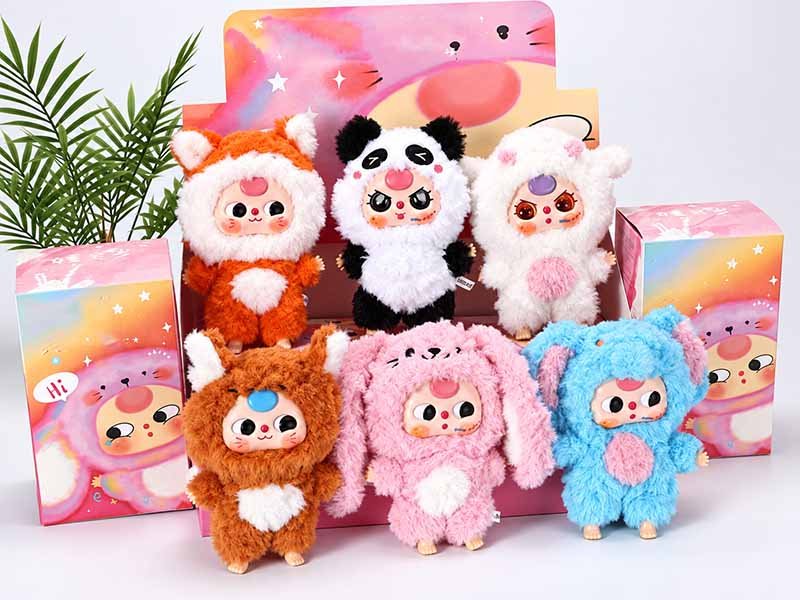
Blind box plush looks simple when it is sitting on a retail shelf: a small sealed package, a character inside, and the excitement of not knowing which design will appear. Manufacturing the collection is much more complicated. A six-character program can involve six pattern sets, multiple embroidery files, several fabric colors, different costumes or accessories, hidden-edition controls, individual packaging specifications, SKU separation, and an assortment plan that must preserve the surprise without sacrificing traceability. A manufacturer that performs well on one conventional stuffed animal can still struggle when several related characters have to be developed and produced together.
The best blind box plush manufacturers are companies that can treat a collectible collection as one controlled product system. Strong candidates combine character engineering, small-format detail control, multi-SKU production, approved-sample management, mystery packaging, quality inspection, compliance preparation, and repeat manufacturing. The right choice is therefore not simply the factory with the cheapest unit price, but the one that can keep the whole collection visually consistent, commercially practical, and reproducible at scale.
That difference often becomes clear only after the first sample. One prototype can look excellent, while the full assortment later reveals drifting eye positions, inconsistent stuffing, mismatched fabrics, distorted accessories, or packaging errors between similar styles. The purpose of this guide is to make those risks visible before purchase orders are committed. Rather than treating twenty factory names as a popularity contest, it compares the kinds of manufacturing evidence that matter when a brand, IP owner, retailer, or product team needs a reliable partner for an actual blind box plush launch.
Which Are the 20 Best Blind Box Plush Manufacturers?

The strongest candidates are manufacturers with credible capability in custom plush development, collectible programs, multi-style production, OEM or ODM work, packaging, or mixed-material toys. No single supplier is best for every project. A practical shortlist should therefore be treated as the beginning of technical due diligence, followed by sample comparison, factory verification, specification review, commercial negotiation, and production-control checks against the exact collection being developed.
The 20-Manufacturer Shortlist
The table below is designed as a sourcing map rather than a universal ranking. Some companies are more clearly positioned around blind box plush, while others bring broader custom-plush, keychain, character, promotional, or collectible experience that may suit a particular program. A company that is excellent for an all-fabric 10 cm character series may not be the strongest choice for a vinyl-face plush pendant, and a collectible-figure specialist may require additional verification for textile sewing and stuffing control.
| Manufacturer | Relevant Focus | Best Fit to Verify |
|---|---|---|
| Delsney | Blind box plush, character plush, engineering, packaging | Multi-SKU series, IP characters, retail programs |
| Kinwin Toys | Custom plush blind boxes, OEM/ODM | Branding, packaging, character collections |
| Weijun Toys | Blind boxes, plushies, figures, keychains | Mixed collectible formats |
| Demeng Toy | Blind boxes, art toys, vinyl-plush products | Hybrid vinyl-face plush |
| Heyzizi | Character and IP blind box plush | Series planning, secret styles, bulk consistency |
| Jundong Factory | Mini collectible and blind box plush | Themed retail collections |
| FunEnjoy Toys | OEM/ODM custom plush | Sampling, bulk production, packaging |
| Szoneier | Custom plush blind box series | IP launches and mystery retail sets |
| CustomPlushMaker | OEM/ODM stuffed animals | Prototype and character development |
| StuffPlush | Custom stuffed animals and plush series | General custom plush programs |
| Hansightoy | Established OEM/ODM plush production | Conventional plush engineering and scale |
| Maple Eye Toys | Pattern development and custom plush | Character interpretation and sampling |
| CustomPlush.com | Bulk custom plush | Brand, promotional, entertainment programs |
| Stuffed Animal Pros | Prototype-to-bulk custom plush | Brand merchandise and keychains |
| Custom Plush Innovations | Custom plush manufacturing | Retail and promotional projects |
| Jin Sheu | Plush dolls, keychains, branded merchandise | Plush accessories and pendants |
| Jolly Toy | Plush toys, keychains, mixed toy products | Mini plush and accessory-led programs |
| Hunan Yushi Toy | Plush and collectible toy supply | OEM/ODM sourcing and mixed categories |
| Yuxing Toys | Blind-box figures and plush products | Trend-toy and collectible programs |
| Xuzhou Gaopeng Toy | Character plush and plush keychains | Mini character and bag-charm formats |
Delsney is especially relevant when the collection requires the plush itself, engineering controls, and packaging to be handled as one program. Its company fact base identifies blind box plush as a supported category for multi-character and collectible series and describes a development chain covering design evaluation, materials, engineering samples, revisions, bulk production, QC, custom packaging, and global delivery. The same source records 18+ years of plush manufacturing experience, 500+ staff, 18 production lines, 25+ engineers, 10+ designers, and 20+ QC staff.
Kinwin Toys and Heyzizi are worth reviewing when a project places strong emphasis on custom blind-box packaging and coordinated character collections. Weijun Toys and Demeng Toy deserve closer attention when the product architecture may move beyond conventional all-fabric plush and into figures, molded components, or hybrid collectible formats. FunEnjoy Toys, Szoneier, CustomPlushMaker, StuffPlush, Hansightoy, Maple Eye Toys, CustomPlush, Stuffed Animal Pros, and Custom Plush Innovations are broader custom-plush candidates that should be evaluated against the size, complexity, assortment structure, and packaging system of the proposed series rather than selected from a generic capability page.
Jin Sheu, Jolly Toy, and Xuzhou Gaopeng Toy are especially relevant to projects built around mini plush, keychains, pendants, or bag charms, where hardware installation and detail retention become more important than they are on a larger stuffed animal. Hunan Yushi Toy and Yuxing Toys can be considered when the program sits closer to the wider collectible-toy category. In each case, the useful question is not whether the company sells or makes plush products in general, but whether it can show evidence from a collection that resembles the intended order in size, construction, packaging, and SKU count.
What the List Really Means
A blind box plush supplier has to combine two disciplines that are often separated in ordinary toy sourcing. Traditional plush manufacturing is centered on patterns, embroidery, fabric handling, sewing, filling, shaping, and soft-product inspection. Blind-box manufacturing adds assortment planning, concealed packaging, printed materials, SKU traceability, display cartons, and sometimes secret-edition controls. A factory can be strong in one discipline while having only limited experience in the other, which is why the phrase “blind box manufacturer” should never replace a technical review of the actual product process.
The workload becomes more visible when a six-, eight-, or twelve-character collection is translated into factory documents. Each character may have its own pattern file, embroidery program, fabric map, accessory list, sewing instructions, filling reference, care label, package insert, and internal style code. Some designs can share a body structure, while others need unique heads, ears, wings, tails, clothing, or hardware. If the factory cannot show how these variables stay separated through cutting, sewing, finishing, inspection, and packing, adding more SKUs will magnify the weakness rather than solve it.
Delsney’s blind box product documentation defines the category as collectible plush built around multiple characters, multiple styles, hidden editions, and random packaging, and it lists 8 cm, 10 cm, 12 cm, 15 cm, and 20 cm as common size references within its own product range. The same documentation identifies multi-style consistency, series planning, blind-box packaging, and hidden-edition handling as practical concerns. Those issues are useful benchmarks when questioning any manufacturer on the shortlist, regardless of which company ultimately receives the order.
Verify Before You Shortlist
The most effective supplier verification starts with a project that resembles the intended production. If the planned collection contains eight 10 cm characters, a single 30 cm teddy bear tells very little about miniature embroidery, small pattern pieces, multi-SKU separation, or mystery-box packing. Request several comparable samples from one previous collection where confidentiality permits, place them together, and compare finished height, head-to-body proportion, facial placement, filling density, fabric color, seam finish, hardware, and accessory positioning across the set rather than judging each piece separately.
The next step is documentation. Ask how pattern versions are named, how embroidery files are linked to individual SKUs, how shared fabrics are controlled, how accessories are separated, and whether every style has its own approved production reference. Once the toys enter opaque inner bags, visual identification becomes harder, so the packing system should become more disciplined rather than less. A factory that can explain internal style coding, production reconciliation, packing records, and replacement procedures has usually thought further ahead than one that answers every technical question with a general promise that everything will be fine.
Commercial fit should also be verified early. Minimum quantities, tooling, special materials, package printing, testing, and delivery windows can change the economics of the same artwork dramatically. A serious manufacturer normally asks about target size, quantity by SKU, intended market, age positioning, materials, accessories, packaging, secret-edition structure, and launch deadline before finalizing a price. That questioning is useful because it exposes hidden assumptions while changes are still cheap. The lowest number received from an incomplete brief is often less valuable than a slightly higher quotation built from a complete specification.
What Makes a Blind Box Plush Manufacturer Qualified?

A qualified blind box plush manufacturer should prove three things at the same time: it can translate character artwork into repeatable plush construction, control several related SKUs through mass production, and manage opaque packaging without losing assortment accuracy. Strong suppliers rely on approved samples, controlled patterns, material specifications, embroidery files, measurable QC points, and documented packing logic instead of depending mainly on operator memory or verbal instructions.
Multi-SKU Engineering
Single-SKU production can hide weaknesses that a collectible series quickly exposes. Producing 10,000 pieces of one bear may involve one principal pattern family, one face embroidery program, one material combination, and one packaging specification. An eight-character blind box program can create eight pattern families, several embroidery programs, different garments, mixed hardware, multiple color groups, unique character details, and a shared retail packaging system. Every additional variation creates another opportunity for components, instructions, or packaging to cross between styles unless the project is deliberately engineered as a collection.
Experienced teams therefore look for common architecture where it does not compromise character identity. Several characters may share a body block while using different heads, ears, hairstyles, costumes, or colorways. One sitting-height standard can be used even when tall ears or hats create different total visual heights. A common keyring, care-label position, inner-bag dimension, or box structure may serve the entire series. The goal is not to make every character identical; it is to reduce manufacturing variation that customers cannot see while preserving the variation that creates collectible value.
Factory resources matter, but the way they are organized matters more. Delsney’s fact base records 18 production lines and specifically describes them as supporting multi-SKU collections, seasonal programs, and repeat orders. It also lists 25+ engineers for structure review, pattern development, sampling, and production feasibility, along with 10+ designers and 20+ QC staff. These are company-specific figures rather than industry averages, but they illustrate the kind of engineering and quality infrastructure that becomes relevant when a project contains many related SKUs.
A more revealing qualification question than “How many workers do you have?” is “Who owns the technical specification for each SKU after the sample is approved?” The answer should identify how patterns, embroidery files, measurements, material references, accessories, and packaging are transferred from development to the production floor. If this transition depends on one experienced person remembering what happened during sampling, repeat orders and seasonal staff changes become unnecessarily risky. A documented system makes the product less dependent on individual memory and more dependent on repeatable controls.
Sample Discipline
The approved sample is not merely a sales sample; it is the physical standard against which production should be judged. In a blind box program, each SKU should normally have a clearly identified approved reference because one character cannot represent the facial proportions, accessories, embroidery, or filling of another. During approval, record finished dimensions, key visual measurement points, embroidery placement, fabric codes, colors, filling feel or weight reference, garment positions, hardware installation, labels, and the complete packed presentation whenever packaging affects product shape.
Delsney’s engineering records identify approved samples, digital patterns, measurement points, embroidery DST files, fabric GSM records, color-lot records, seam-density guidance, filling-weight references, accessory installation notes, packaging specifications, in-line QC, and final inspection as tools for controlling bulk consistency. The value of these controls becomes obvious on reorders. If the original fabric lot is no longer available six months later, the team at least knows the GSM, surface, color reference, and intended hand feel it is trying to match rather than restarting from memory.
Sample discipline also reduces costly arguments. A character’s expression can change with only a small movement in eye position, eyebrow angle, mouth height, or head stuffing. If approval consists only of a photograph sent through a messaging app, the production team may have no measurable reference for what made that expression acceptable. A physical golden sample supported by digital embroidery files and measurement points gives both sides something more objective. It does not eliminate judgment, but it turns vague comments such as “the face looks strange” into specific adjustments that can be reproduced.
Rushing approval rarely saves as much time as expected. If a launch date is tight, there is pressure to accept a sample that is “close enough” and fix details during bulk production. That approach is particularly risky for multi-SKU collections because every unresolved detail multiplies across many units and several characters. Spending several additional days correcting a face, accessory, fabric choice, or packaging fit during sampling is usually easier than deciding what to do with thousands of finished pieces that consistently reproduce the same mistake.
Production and Packing Control
Blind box manufacturing needs two related but different control systems. Product control asks whether each toy matches its specification: correct dimensions, face, seams, filling, labels, accessories, and overall appearance. Assortment control asks whether the correct quantities of each style survive production and reach final packing without accidental substitution. The second problem becomes more difficult once individual toys are sealed inside opaque bags, because the product that is intentionally hidden from the consumer can also become harder for factory workers to identify visually.
Each style should therefore have an internal SKU or work-order identity that remains visible to the production system even when it disappears from the retail presentation. Similar accessories need physical separation and clear labels. Work-in-process quantities should be reconciled before concealed packing, especially when a secret style has a different planned quantity from regular styles. Rejects and replacements should also be recorded by SKU; otherwise the factory can unintentionally change the intended assortment simply by replacing defective pieces with whatever completed stock is easiest to access.
The packing specification should explain more than how to fold a box. It should define the inner bag, retail box, collection card, labels, display carton, master carton, and any rules for assortment. If a style is identifiable by a visible color through a translucent bag or by a distinct bulge in the box, the mystery experience can be compromised. If the box is too tight, ears, hats, or tails can be permanently distorted. If it is too large, freight and shelf-space efficiency suffer. Packing therefore sits at the intersection of consumer experience, logistics, and production control.
A good manufacturer can walk through this sequence without relying on vague language: finished SKU count, inspection release, concealed packing, quantity reconciliation, display-carton assembly, master-carton identification, and final shipment inspection. That explanation is more valuable than a promise that random packing is “easy.” Randomness belongs in the customer’s experience; the factory’s internal process should remain controlled, documented, and auditable throughout the order.
Commercial Readiness
Manufacturing competence is only useful if the product can move into the sales channel for which it was designed. Retail programs may require barcodes, care labels, country-specific information, carton marks, display cartons, and controlled delivery windows. E-commerce programs may focus more heavily on package dimensions, fulfillment labels, carton efficiency, and damage protection. Licensed-character projects introduce approval gates and confidentiality. Children’s products can add age grading, testing, labeling, and small-parts considerations that should influence engineering before the sample is finalized.
A well-prepared factory therefore asks commercial questions early. It should want to know the destination market, intended user age, packaging format, sales channel, shipment method, launch timing, and whether the collection will be reordered. Those details change engineering decisions. A plush pendant intended for an adult collectible channel may use different hardware and presentation from a toy marketed for young children. A product destined for a major retailer may need packaging, inspection, and documentation that would be unnecessary for a promotional giveaway distributed in a controlled corporate event.
Commercial readiness also includes repeatability. Blind box products are often launched as series rather than one-time items. If Series 1 sells well, a reorder or Series 2 may need to start while the first collection is still in market. Manufacturers that retain approved pattern versions, embroidery files, materials, filling references, and package specifications can reproduce the visual language more reliably. That continuity is difficult to rebuild after the first order if the original development records were informal or scattered across individual employees’ devices.
How Do Manufacturers Develop Blind Box Plush Series?

Blind box plush development usually moves through artwork review, feasibility engineering, pattern development, prototype sampling, revision, final sample approval, material preparation, bulk production, inspection, and concealed packing. The difficult part is coordinating those steps across the entire collection. Dimensions, material feel, embroidery quality, and packaging should look deliberately related, while each character still needs enough visual identity to make the complete series worth collecting.
Artwork to Production
Artwork should be treated as a design intent rather than a literal sewing instruction. Two-dimensional illustrations can contain shapes that are easy to draw but difficult to reproduce cleanly in 8-12 cm fabric construction. A very thin tail may not turn properly after sewing, a tiny hand may lose its fingers after stuffing, a narrow printed line may disappear into pile, and layered clothing can become too bulky when several seam allowances overlap on a miniature body. The pattern engineer’s job is to translate those details without losing the recognition points that make the character distinctive.
The face usually deserves the greatest protection because a few millimeters can change expression at small scale. Eye shape, eye spacing, eyebrow angle, mouth position, cheek volume, head width, and stuffing pressure all interact. If a small decorative detail must be simplified to preserve the face, that can be a sensible decision. Simplifying an iconic facial feature to save a little sewing time can damage the character much more. This is why experienced sample rooms ask which features are essential to IP recognition before they begin making compromises.
A useful artwork package contains front, side, and back views where available, intended finished size, color references, material direction, accessory information, logo files, and notes identifying details that cannot be changed without approval. If the source is a 3D model, screenshots from several angles are still useful because soft materials will not behave like a rigid digital surface. If the source is a physical reference sample, photographs, measurements, and notes about what should be preserved or improved reduce interpretation errors during the first pattern attempt.
Production feasibility should be considered while the first sample is being developed rather than after a perfect-looking handmade prototype is complete. A detail that one sample maker can place carefully in thirty minutes may not be suitable for thousands of pieces on a production line. The better question is not simply “Can this be made?” but “Can this be made repeatedly, at the intended size, with acceptable appearance, safety, labor time, and yield?” Strong engineering decisions protect both character fidelity and commercial feasibility at the same time.
Standardizing the Series
A collection-level specification helps the characters feel related even when every design is visually different. The objective is controlled consistency rather than forced uniformity. Shared standards can include sitting height, body-width range, base fabric families, embroidery thread specifications, filling firmness, label placement, hardware, and packaging dimensions. Character-specific technical files then document intentional exceptions such as larger ears, unique costumes, alternate fabrics, or distinctive accessories that create personality and collecting value.
| Control Item | What to Record | Practical Reference |
|---|---|---|
| Finished size | Sitting or standing height | cm or mm |
| Body proportion | Head, torso, limb relationship | Approved measurement points |
| Fabric | Construction and surface | Fabric code, GSM, pile height |
| Color | Main and accent colors | Approved swatch or Pantone reference |
| Embroidery | Eyes, mouth, logos, markings | Approved DST file |
| Filling | Softness and silhouette | Weight in grams or reference sample |
| Accessories | Position and installation | Measurement point plus photo |
| Hardware | Keyring, clasp, chain | Material, dimensions, finish |
| Labels | Care, woven, barcode labels | Approved artwork and version |
| Retail package | Finished pack dimensions | L × W × H in mm |
| SKU identity | Internal style tracking | Unique code or work order |
| Final reference | Bulk acceptance standard | Approved physical sample |
Standardization can also remove complexity that customers will never notice. If eight artwork files use eight slightly different shades of cream because they were drawn separately, keeping all eight may create unnecessary material lots without adding visible value. Reducing them to two or three approved shades can simplify sourcing and color control. Likewise, a common hanging clasp or label position may reduce variation without changing the character experience. The best cost engineering removes invisible complexity first and protects the details that consumers actually see, touch, and compare.
At miniature sizes, standardized measurement points are especially useful. Delsney’s product documentation lists 8 cm, 10 cm, 12 cm, 15 cm, and 20 cm as common blind box plush sizes within its own range. At these dimensions, a few millimeters in eye position, head width, or sitting height can be visually significant. Total height alone is not enough, because ears, hats, or hair may extend above the main body. The specification should focus on the points that control perceived proportion and expression.
Secret Editions
A secret edition is simultaneously a manufacturing SKU, a marketing device, and unreleased commercial information. The rarity structure should be decided by the brand’s product strategy rather than copied from another collection, because there is no universal ratio that is correct for every blind box program. Once the commercial ratio is fixed, production planning must convert it into real quantities, account for rejects and replacements, and preserve the intended balance through final packing. That makes quantity reconciliation more important than it is in a conventional assortment where every style may be produced equally.
Confidentiality begins during development rather than on launch day. Artwork files can reveal the secret character long before any toy is sewn, while packaging proofs may expose the entire collection even if the plush sample itself is tightly controlled. Access should therefore be limited to people who need the information. Sample-room photography, personal-device storage, external material suppliers, packaging partners, and rejected samples all deserve practical rules. An NDA is useful, but operational habits determine whether sensitive artwork remains contained in everyday factory activity.
The secret style should have its own internal identifier even if the consumer never sees it. Production quantity, inspection rejects, replacement quantity, final packed quantity, and remaining stock should reconcile. If a defective secret piece is replaced with a regular style without updating the control record, the theoretical rarity ratio no longer matches the actual shipment. The same problem can happen when rework, sample retention, or quality-testing units are removed from production without being reflected in the assortment plan.
Brands should also decide how much traceability is acceptable after opaque packing. Some programs prioritize maximum secrecy, while others require controlled internal identifiers for returns or retailer reconciliation. The decision should be made intentionally, not left to the packing team on the final production day. The consumer should experience surprise; the brand and manufacturer should still be able to explain how the planned assortment became the shipped assortment.
Packing Logic
Random packing is not the absence of control. It is a controlled manufacturing system designed to produce uncertainty only at the consumer-facing level. Before opaque packing, each SKU can normally be identified visually or through work-order labels. After sealing, the factory may no longer be able to distinguish the contents without an internal system. That means final quantity reconciliation should happen before visual identification disappears, and the packing specification should clearly describe how regular styles, secret styles, display cartons, and master cartons are handled.
Packaging development should use the actual final plush sample rather than early dimensions from a drawing. Soft products can compress, but not every feature recovers equally. Long ears, hats, wings, tails, molded faces, and carefully shaped hair can deform if a retail box is reduced too aggressively. Oversized packaging creates the opposite problem by increasing printed-material cost, freight volume, shelf space, and empty visual space. The most efficient package is therefore the smallest format that protects the approved appearance and still delivers the intended unboxing experience.
Secrecy needs physical validation too. A pale inner bag may allow a dark character to show through. A character with large ears may create a unique box bulge. A heavy accessory may make one SKU easier to identify by shaking or weighing. Some brands accept those differences, while others want the assortment to be difficult to distinguish before opening. The final packed sample should be reviewed from the consumer’s perspective, not just checked for whether the toy technically fits inside the box.
Printed components introduce their own controls: dielines, color proofs, collection cards, barcodes, warnings, logos, legal text, and display-carton artwork can all change after the plush itself is approved. Packaging version control should therefore be treated like pattern version control. When a late artwork revision occurs, the production team should know which printed material is obsolete, which version is approved, and whether any already-produced packaging must be quarantined before packing begins.
How Do MOQ, Cost, and Lead Time Compare?

MOQ, cost, and lead time depend on the structure of the collection rather than the word “plush” alone. The biggest variables are SKU count, quantity per character, finished size, pattern complexity, fabric colors, embroidery, clothing, accessories, packaging, testing, and delivery requirements. Blind box programs often require more development work than a single-SKU plush because engineering and setup are repeated across several characters even when every finished piece is physically small.
MOQ Structure
A quoted MOQ only becomes useful when it explains what the quantity applies to. Five hundred pieces can mean five hundred per character, per color, per material combination, or, in some factory structures, five hundred total pieces distributed across a limited number of styles. Printed boxes, custom-dyed fabrics, molded accessories, metal hardware, or special trims may also carry their own supplier minimums. These upstream minimums can become the true constraint even when the plush factory itself is willing to accept a smaller production quantity.
Delsney’s fact base states a standard MOQ starting from 500 pieces and describes its production range as extending from 500-piece projects to much larger bulk programs. For a blind box series, however, the practical application still depends on the number of SKUs and the materials involved. A six-style program in which every design uses the same body fabric and packaging structure is commercially different from a six-style program requiring six custom-dyed fabrics, six garments, custom metal hardware, and individual printed package elements.
The most useful RFQ therefore separates total collection quantity from quantity per SKU. It should also identify the number of regular styles, secret styles, package designs, unique fabric colors, custom accessories, and expected reorder volume. That gives the manufacturer enough information to explain where minimums originate. If a custom box printer needs 3,000 units but the plush factory is comfortable with 1,000 pieces, the packaging supplier may determine the commercial floor of the program rather than the sewing operation.
Established brands should evaluate MOQ in relation to total landed economics rather than automatically choosing the smallest possible quantity. A higher volume can spread sampling, setup, package printing, and material purchasing across more units, while a very small quantity per SKU can make each piece disproportionately expensive. The correct quantity is the one that balances inventory risk, launch confidence, cash flow, unit economics, and the probability of a reorder, not the lowest number that a factory is willing to put on a quotation.
Cost Drivers
Small plush is not automatically simple plush. A 9 cm character with dense facial embroidery, layered clothing, tiny applique pieces, custom hardware, and a printed retail box can require more labor and supplier coordination than a straightforward 20 cm animal. Miniature parts can also slow sewing because operators have less space for turning, alignment, and stuffing. The cost conversation should therefore focus on measurable design decisions rather than using size alone as a shortcut for expected price.
| Variable | Lower-Complexity Direction | Higher-Complexity Direction | Main Cost Effect |
|---|---|---|---|
| Finished size | 8-10 cm | 15-20 cm | Fabric, filling, packaging, freight |
| SKU count | 4 designs | 8-12 designs | Development and setup |
| Body pattern | Shared base structure | Unique body per SKU | Pattern and sewing labor |
| Face | Basic embroidery | Dense multi-area embroidery | Machine time and setup |
| Fabric | Stock colors | Custom colors or specialty fabrics | Material MOQ and sourcing |
| Clothing | Printed or simple sewn detail | Multi-layer removable outfit | Cutting and assembly |
| Accessories | Textile accessory | Custom metal or molded part | Tooling, sourcing, QC |
| Packaging | Opaque inner bag | Printed box, card, display carton | Printing and packing |
| Testing | One target market | Multi-market program | Testing time and fees |
| Quantity | Larger repeat run | Small quantity per SKU | Unit-cost allocation |
Delsney’s internal cost framework identifies size, structural complexity, fabric type, fabric color, filling, embroidery, printing, accessories, functional modules, packaging, labels, order quantity, testing, shipping method, and delivery urgency as major price inputs. This is a useful way to think about quotations from any manufacturer because it turns price into a set of engineering and commercial choices. It also makes value engineering more constructive than simply requesting a percentage discount after the design has already been locked.
If a quotation is above target, ask which two or three features contribute most to the difference. Sometimes a nearly invisible internal pattern change can reduce labor without changing appearance. A custom fabric color may be replaceable with a stock shade that is visually acceptable. A separate molded accessory may be convertible to embroidery or applique. In other cases, the expensive feature is the character’s signature detail, and removing it would save money while weakening the entire product. Good cost engineering distinguishes between complexity that consumers value and complexity they will never notice.
Unit price should also be separated from total program cost. Sampling, package prototypes, molds, third-party testing, freight, duties, and inspection can materially affect the landed cost even when the factory unit price looks attractive. A supplier that provides a slightly higher but more complete quotation may ultimately be easier to budget than a low headline price followed by repeated add-on charges once the project reaches packaging, testing, or shipment.
Lead-Time Planning
Sampling and bulk production should be planned as separate phases because the clock does not start only when sewing begins. Artwork clarification, pattern development, fabric sourcing, embroidery programming, sample construction, revisions, packaging design, printing proofs, and compliance preparation can all occur before mass production is released. A blind box launch often has several parallel paths, and the slowest path determines the actual ship date even if the plush sewing itself is completed on time.
Delsney’s current company fact base states that standard plush samples normally take about 5-7 days, complex samples around 7-15 days, and standard bulk production about 20-30 days after sample approval, with complex programs adjusted according to materials, quantity, packaging, and testing arrangements. These are company-specific planning figures rather than universal industry averages, but they illustrate why a quote should separate development lead time from production lead time instead of presenting one simplified number.
Multi-character programs can extend sampling if every SKU requires several independent revisions. The most effective way to protect the calendar is often not to demand faster sewing but to reduce avoidable decision delay. Complete artwork, consolidated feedback, clear approval authority, and fast material decisions can remove days or weeks from a schedule. When eight stakeholders send comments separately, the sample room may finish an alteration in two days while the project loses a week waiting for conflicting feedback to be reconciled.
Packaging can become the hidden critical path. The plush may be approved while box artwork is still changing, barcodes are pending, legal text is under review, or a display carton has not been tested. If printed packaging arrives late, completed plush sits in storage and the shipment remains incomplete. A robust launch calendar should therefore include plush approval, packaging approval, compliance testing where required, material preparation, bulk production, inspection, packing, and freight booking in one integrated timeline rather than treating them as independent tasks.
Freight and Packaging Economics
Blind box plush has an advantage over rigid collectibles because soft bodies can often use compact packaging, but aggressive compression can damage character appearance. High-pile fabric, structured hats, long ears, shaped cheeks, molded faces, or stiff accessories may not recover after being held tightly for weeks. Packaging dimensions should therefore be validated with the actual final sample, not estimated from an illustration. The goal is to reduce unnecessary air without turning freight savings into deformed products or poor unboxing experiences.
For shipping calculations, record the retail box dimensions in millimeters, units per display carton, display cartons or units per master carton, master-carton dimensions, and gross weight. E-commerce programs may care heavily about volumetric weight and fulfillment constraints, while retail programs may prioritize shelf presentation, display-carton dimensions, and planogram efficiency. A manufacturer that understands the final channel can help optimize packaging around those constraints instead of recommending one generic box for every customer.
Freight strategy also interacts with launch timing. Air shipment may protect a fixed launch date but materially increase landed cost, while sea freight can reduce transportation cost if the schedule has enough buffer. Some brands split the shipment, sending a smaller launch quantity by air and the balance by sea. The right approach depends on retail commitments, sales forecasts, warehouse capacity, and product value, so delivery planning should be considered during costing rather than after bulk production is already complete.
What Quality, Safety, Packaging, and IP Controls Matter?
Blind box plush quality control should cover the toy, the collection, and the retail pack. Critical controls include approved samples, dimensions, embroidery, fabric, color, filling, seams, accessories, labels, packaging, and correct SKU allocation. Safety requirements depend on target market, age classification, materials, and components. Licensed or unreleased characters also require practical controls for file access, sample handling, photography, packaging proofs, and confidential production information.
Bulk Consistency
The most expensive quality problem is not always an obvious defect such as an open seam. Gradual variation can be more damaging because every piece remains technically usable while the collection slowly drifts away from the approved appearance. A small change in embroidery position can make a character look tired instead of cheerful. A different filling level can make one SKU look larger or softer. A new fabric lot can change color or surface reflection enough that two characters intended to match no longer look like part of the same series.
Consistency therefore needs both within-SKU and collection-level checks. Within one SKU, inspectors compare pieces against the approved sample and measurement requirements. Across the collection, they look at whether related characters still share the intended scale, finish level, hand feel, embroidery quality, and packaging presentation. Group photographs can be surprisingly useful because visual relationships become easier to see when several characters are placed together. One character may pass its individual measurements but still look too large beside the rest of the series.
Delsney documents 100% pre-shipment inspection in its fact base and describes QC as extending from sampling through shipment release. Its engineering guidance also lists approved samples, digital patterns, measurement points, embroidery files, fabric records, filling references, accessory notes, packaging specifications, in-line QC, and final inspection as production controls. The broader lesson is that inspection works best when the manufacturing specification was already measurable before cutting, embroidery, and sewing started.
A final inspection should also reconcile packaging and assortment rather than looking only at the plush body. Correct labels, barcode versions, box artwork, inner bags, collection cards, carton marks, and style quantities all influence whether the goods are commercially usable. A toy can be perfectly sewn and still create a costly retail problem if the packaging carries the wrong barcode or an assortment carton contains the wrong style mix. Quality should therefore follow the commercial product all the way to the packed shipment.
Safety by Market
There is no universal certificate that makes a blind box plush automatically compliant everywhere. Requirements depend on destination country, product classification, intended age group, construction, materials, and accessories. Products marketed as children’s toys in the United States can involve CPSIA and ASTM F963 requirements, while products sold in European markets can involve EN71-related requirements and other applicable obligations. The correct test plan should be tied to the actual product and market rather than treated as a generic logo placed on a website.
Delsney’s fact base states support for EN71, ASTM F963, CPSIA, CE-related compliance preparation, and third-party testing for international markets. The same source explicitly cautions against promising that every product will automatically pass every test before design and materials are evaluated. That is the responsible approach. A manufacturer can support design review, material selection, test preparation, sample submission, and corrective action, but compliance ultimately applies to a defined product under a defined set of requirements.
Small collectible plush deserves careful review because decorative hardware is common. A keychain may include a metal ring, chain, clasp, bell, or charm. A vinyl-plush design introduces molded components. Removable clothing can add snaps, buttons, beads, or small accessories. These details can change mechanical and physical safety considerations compared with an all-soft plush that uses embroidered facial features. Age positioning should therefore be discussed before the pattern is finalized rather than added to the package only after production decisions have already been made.
Safety engineering can also influence aesthetics and cost. Embroidered eyes may be preferred over hard plastic eyes for certain age groups. A decorative accessory may need reinforcement, redesign, or removal. A long loop may need dimensional control. These choices are much easier during development than after thousands of units are complete. Manufacturers that ask about market and age group before quoting are often protecting the project from expensive redesign rather than making the process unnecessarily complicated.
Packaging Validation
Blind box packaging has to protect the plush, hide the character appropriately, carry required information, and survive distribution. Those functions can conflict. A tight box improves freight efficiency but may deform the product. An opaque inner bag protects the mystery but can trap a character in a compressed position. A premium display carton improves shelf presentation but adds cost and may increase shipping volume. The packaging system should therefore be tested as part of product development rather than treated as decoration added after the toy is finished.
Start with physical fit. Place the approved plush into the intended inner bag and box using the same folding method planned for production, then leave it packed long enough to observe whether ears, tails, clothing, pile, or molded components recover correctly. Next, review secrecy. If one character can be identified from a visible color, a distinctive package bulge, or a very different weight, decide whether that matters to the intended experience. Finally, review information accuracy, including labels, care text, barcodes, warnings, logos, and package artwork versions.
Delsney’s company documentation lists blind boxes, color boxes, display-style packaging, care labels, woven labels, barcode labels, and other retail packaging options within its supported services. That breadth is useful because packaging decisions can affect the plush itself. For example, a smaller box may require a different ear construction, while a display carton can determine how individual retail boxes need to stack. The most practical packaging conversation therefore happens while the product is still being engineered.
Transport validation should include the master carton, not only the retail box. Compression, movement, humidity, long storage, and repeated handling can damage a package that looked perfect on a desk. For major retail or e-commerce programs, carton optimization should consider unit count, gross weight, stacking strength, void space, and how the product will be handled at the warehouse or fulfillment center. A visually premium package that reaches the retailer crushed is not a premium package anymore.
IP Controls
An NDA is useful, but confidentiality is ultimately an operating practice. Licensed characters and secret editions can leak through artwork files, sample photographs, packaging proofs, rejected prints, supplier communications, or casual factory photography long before the official launch. A serious manufacturer should be able to explain who receives the original files, how sample images are stored, whether employees can use personal phones in sensitive areas, how external packaging or accessory suppliers are briefed, and what happens to obsolete or rejected materials after revisions.
The manufacturer’s attitude toward authorization matters as well. A professional factory should not casually copy a famous character because someone sends an image from the internet and asks for production. Delsney’s internal guidance explicitly distinguishes authorized IP projects from unauthorized copying and directs its teams to emphasize licensed projects and IP protection. That distinction protects both the manufacturer and the customer, especially when products will enter established retail or e-commerce channels where ownership and licensing questions can quickly become commercial problems.
Secret editions require additional discipline because the unreleased character itself may be part of the marketing value. The packaging supplier may need only a limited artwork file rather than the entire collection. Production photography may need approval. Sample retention and destruction procedures may need to be defined. If the project uses an outside embroidery, printing, or molding specialist, the brand should understand what information leaves the main factory and how those partners are controlled.
Confidentiality should not become so restrictive that production records disappear. The factory still needs enough internal traceability to identify styles, manage defects, reconcile quantities, and handle reorders. The goal is controlled access, not lack of documentation. The best system allows the people responsible for quality and production to see what they need while preventing unnecessary circulation of unreleased designs outside the project team.
Which Blind Box Plush Manufacturer Should You Choose?
Choose the manufacturer whose strongest capabilities match the hardest part of the collection. Licensed IP needs character fidelity and confidential development, multi-SKU collectibles need engineering and assortment control, plush pendants need miniature precision and secure hardware, retail programs need packaging and repeatability, and vinyl-plush products need competence in both textile and molded components. The final decision should follow technical review, comparable samples, and a credible production-control plan rather than a headline price alone.
Licensed IP
Licensed characters are unforgiving because consumers already know what the design is supposed to look like. A technically well-sewn plush can still fail if the head is too narrow, the eyes are too high, the costume color is wrong, or an iconic feature has been simplified beyond recognition. Supplier evaluation should therefore begin with the sample room and pattern-engineering process. Ask how the team identifies recognition points, converts the face into embroidery and seams, controls proportion, and records changes between the first prototype and the final approved sample.
Color should be judged physically whenever possible. Fabric pile changes how light reflects, so a digital color or Pantone reference does not always look identical once translated into plush. A manufacturer may need to compare several swatches and document the selected material lot. The same principle applies to texture. A character designed to feel premium can lose that impression if a visually similar but harsher fabric is substituted during reordering, even when the color remains close.
Long-term file discipline is particularly important for licensed collections that may be extended over several seasons. Pattern versions, embroidery files, material references, measurements, filling standards, and approved packaging should be retained so that a later release still looks compatible with earlier products. Delsney’s fact base describes a service flow in which artwork or character references move through feasibility review, engineering sampling, revision, sample approval, bulk production, QC, packaging, and delivery. That structured approval trail is the type of process licensing teams should look for from any supplier.
Confidentiality should be evaluated with equal seriousness. Ask how unreleased artwork, sample images, and package designs are restricted, whether the manufacturer will sign an appropriate NDA, and how external partners are managed. A factory that understands both character fidelity and information control is usually easier to work with than one that focuses only on sewing quality while treating launch-sensitive files casually.
Collectible Series
A collectible specialist should think in series rather than treating every character as an unrelated order. Give a manufacturer eight designs and observe the questions it asks. A basic supplier may quote each one separately. A stronger development team begins looking for common body architecture, shared materials, standardized dimensions, repeated accessories, packaging commonality, and design exceptions that genuinely need separate engineering. That thinking reduces unnecessary complexity and makes future series easier to develop without making the characters look repetitive.
Series continuity becomes particularly valuable after a successful launch. If the first release establishes an effective 10 cm body architecture, later characters may reuse part of that engineering while introducing new heads, costumes, colors, or accessories. The factory can shorten development, preserve hand feel, and maintain a recognizable family look. This also helps repeat production because material references, filling targets, measurement points, and packaging dimensions do not need to be reinvented from the beginning every time.
A collectible program should also be reviewed as a group at each major approval stage. Individual photos can hide proportion differences because every image is framed separately. Place the whole series together and look at head scale, sitting height, visual weight, embroidery density, fabric pile, and costume complexity. One character may meet its own measurements yet still dominate the collection because a large hairstyle, dark color, or bulky outfit changes how it reads beside the others.
Delsney’s engineering documentation specifically identifies multi-SKU consistency, size uniformity, and blind-box packaging as important technical issues for this category. The same mindset should be expected from any manufacturer chosen for a long-term collectible program. The supplier should be able to explain not just how the first series will be produced, but how approved engineering and production data will support reorders and future series.
Plush Pendants
Plush pendants, bag charms, and keychain blind boxes require a different type of precision from larger stuffed animals. At 8-10 cm, a one-millimeter change in eye position or seam placement can be visually significant. Thick seam allowances consume a larger percentage of the body volume. Long-pile fabric can hide a tiny mouth or eyebrow. Layered clothing can become stiff because several fabric edges are concentrated in a very small area. Good miniature pattern engineering is therefore about controlled simplification rather than trying to reproduce every illustrated line literally.
Hardware should be engineered as part of the product from the first sample. The attachment loop, reinforcement method, chain, clasp, ring, finish, and installation position affect appearance, durability, and sometimes safety. A beautiful plush body can still perform poorly if the hanging loop twists the character sideways on a bag or if the attachment point gradually tears under repeated pulling. Request the exact production hardware during sample approval rather than allowing a temporary sample-room component to represent the final part.
The best way to evaluate a pendant supplier is to review existing small-format work rather than large mascots. Miniature embroidery, tiny seam turns, hardware reinforcement, and compact packaging expose process precision quickly. Jin Sheu, Jolly Toy, and Xuzhou Gaopeng Toy are among the shortlist candidates worth investigating for accessory-led plush formats, while factories with strong character-plush engineering may also be suitable if they can demonstrate comparable mini-size production.
Packaging should be considered together with the hardware because a keyring or clasp can scratch printed surfaces, create a distinctive package bulge, or make one SKU easier to identify by touch. Some programs separate the metal component inside the inner bag to protect the plush and box, while others fix it in a defined position. The correct solution depends on the product, but it should be decided during sampling rather than improvised on the packing line.
Retail and Hybrid Programs
Retail programs place additional pressure on planning because multiple SKUs often need to arrive together, correctly labeled, correctly packed, and ready for distribution on a fixed date. A delayed accessory, wrong barcode, incomplete test report, or misprinted display carton can hold back an entire assortment even when the plush itself is perfect. Manufacturers serving these programs need stable repeat production, version control, inspection discipline, packaging coordination, and enough planning depth to identify dependencies before they become shipment delays.
Hybrid vinyl-plush products raise the technical bar further. Molded faces, hands, shoes, or accessories introduce tooling, color matching, surface finishing, attachment engineering, and additional safety considerations. A manufacturer may be excellent at molded collectibles while outsourcing the plush body, or highly experienced in plush while relying on an outside molding partner. Neither model is automatically wrong, but the project team should understand where each process occurs, who owns final assembly, and how cross-material quality is controlled.
Before selecting a manufacturer, send a complete RFQ containing artwork for every SKU, target dimensions, quantity by style, regular and secret-edition structure, intended market, age group, fabric direction, embroidery, printing, accessories, hardware, packaging, testing needs, and required delivery date. A strong supplier normally responds with more technical questions because the brief has revealed real decisions that still need to be made. A superficial supplier may respond with an immediate price while silently assuming the missing details.
The final decision should come after three comparisons: the technical response, the physical samples, and the production-control plan. Price remains important, but a small unit saving disappears quickly if eight SKUs arrive with inconsistent faces, incorrect assortment packing, damaged packaging, or materials that cannot be repeated on the reorder. For teams that want one partner to review artwork, engineering, materials, packaging, compliance preparation, and production planning together, Delsney is one candidate worth evaluating against the same technical scorecard used for the rest of the shortlist rather than treating any supplier as automatically suitable.
Blind box plush is ultimately a collection-management problem disguised as a small toy. The successful product has to preserve character identity, feel consistent across several SKUs, survive production and packing, meet the requirements of its sales market, protect unreleased creative work, and remain reproducible when the collection sells well enough to reorder. A strong manufacturer makes those requirements visible early, documents them clearly, and keeps them connected from the first artwork review to the final master carton. That is the standard that matters more than a polished sample room or a low headline quotation when choosing a long-term manufacturing partner.
What is a blind box plush manufacturer?
A blind box plush manufacturer develops and produces collectible plush characters that are sold in concealed or mystery packaging, often as a multi-SKU series with regular designs and sometimes secret editions. The work goes beyond ordinary stuffed-toy sewing because the manufacturer may need to coordinate several character patterns, embroidery files, materials, accessories, package components, assortment quantities, and internal SKU controls while ensuring that consumers cannot identify the exact character before opening the package.
How do I choose a blind box plush manufacturer?
Start by comparing experience with products that resemble your planned collection in size, number of characters, material complexity, and packaging format. Review several samples from the same series rather than one attractive toy, then ask how approved patterns, embroidery files, materials, filling references, labels, and packaging are controlled by SKU. The strongest candidate should also understand your target market, age positioning, testing requirements, launch deadline, reorder expectations, and the practical mechanics of concealed assortment packing.
What is a typical MOQ for custom blind box plush?
There is no universal MOQ because minimums can apply per SKU, per color, per fabric, or to the complete collection, and packaging or accessory suppliers may impose separate requirements. Delsney’s documented standard MOQ starts at 500 pieces, but the practical quantity for a blind box program depends on how many styles share materials and packaging. A six-character series using stock fabrics and one box structure can have very different economics from six characters requiring unique dyed fabrics and custom hardware.
How long does blind box plush sampling take?
Sampling time depends on character complexity, size, materials, clothing, accessories, and how many revision rounds are required. Delsney’s current fact base states about 5-7 days for standard plush samples and around 7-15 days for complex samples, while other manufacturers may use different timelines. Multi-SKU series can take longer when several characters are developed in parallel, particularly if artwork feedback, fabric approval, molded components, or printed packaging proofs are not finalized at the same time.
How are secret editions controlled during production?
Secret editions should have their own internal SKU, planned quantity, approved sample, production records, and packing instructions even though consumers do not see that identification. The manufacturer should reconcile completed quantity, rejects, replacements, sample retention, and packed quantity so the actual shipment remains aligned with the intended rarity structure. Confidentiality is equally important because secret artwork can leak through sample photography, packaging files, or external suppliers before launch if file access and physical samples are not handled carefully.
What information should I send for a blind box plush quotation?
A useful RFQ should include artwork for every character, finished dimensions, expected quantity by SKU, regular and secret-edition structure, intended market, age group, fabric direction, embroidery or printing, clothing, accessories, keychain hardware where applicable, individual packaging, collection cards, labels, testing requirements, and desired delivery date. Providing these details allows the manufacturer to evaluate engineering, materials, labor, package minimums, compliance preparation, and lead time instead of giving a rough price based on assumptions that may later change.
Can one manufacturer handle plush, packaging, testing, and shipping?
Some manufacturers can coordinate the complete program from product development through packaging and delivery, while others outsource printing, testing, molded components, or logistics to specialist partners. The important issue is not whether every process occurs under one roof, but whether one accountable project team controls specifications, approvals, schedules, and quality across the supply chain. Delsney’s documented service flow, for example, covers design review, sampling, bulk production, QC, custom packaging, and global delivery, with compliance preparation and third-party testing support included where required.