Skip to content

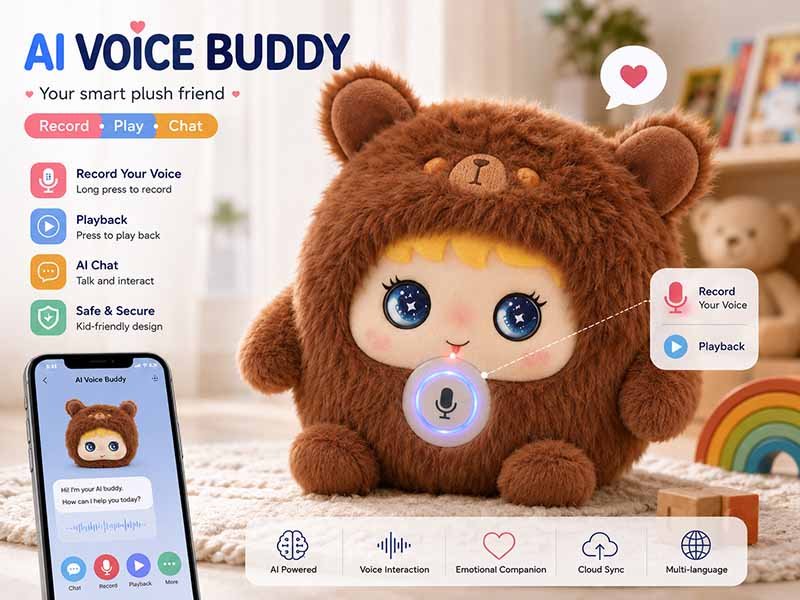
Interactive plush toys can look surprisingly simple from the outside. A child squeezes a paw and hears a familiar voice. A character lights up when touched. Another plush responds to movement, vibrates, tells stories, or connects to an AI-powered voice system. Yet every one of those small interactions creates manufacturing decisions involving textile structure, electronics, component placement, power, safety, user experience, testing, and mass-production consistency. A factory that makes an excellent conventional stuffed animal is not automatically equipped to manufacture an interactive one reliably.
The best interactive plush manufacturer is the company whose plush engineering, electronic-module integration, sampling, functional testing, compliance preparation, and production controls match the technical requirements of your product. Simple sound or light plush may need proven module-integration experience, while sensor, motion, Bluetooth, or AI-enabled toys can require significantly deeper electronics and product-development resources.
The real challenge usually appears after the first attractive prototype. A speaker that sounds clear in three handmade samples may become muffled when filling density changes in production. A touch sensor can move several millimeters and become difficult to activate. A hard battery enclosure may affect the hand feel of an otherwise soft character. Once an order reaches thousands of pieces, those small engineering choices become commercial risks. The manufacturers below are therefore best viewed as a practical sourcing shortlist rather than a beauty contest based on websites.
What Makes an Interactive Plush Manufacturer Worth Shortlisting?

A strong interactive plush manufacturer combines traditional plush engineering with reliable integration of sound, lighting, sensors, movement, recording, Bluetooth, or smart modules. The most useful evidence is a repeatable development and production process covering module position, internal structure, battery access, functional sampling, safety preparation, QC, and bulk-production control rather than simply a catalog showing a few electronic toys.
What Counts as Interactive Plush?
Interactive plush covers far more than traditional talking teddy bears. At the simpler end of the category are squeeze-to-sound toys, musical characters, recording plush, LED products, and toys that vibrate when activated. More advanced products can react to touch, movement, pressure, voice, or changes in position. Smart versions can incorporate microphones, speakers, Bluetooth, Wi-Fi connectivity, applications, or AI-powered conversational functions.
Every additional function changes the physical product. A standard plush toy is primarily controlled through its paper pattern, fabric, embroidery, stitching, accessories, filling, and finishing. An electronic version still depends on all of these elements, but it must also provide a stable position for rigid components inside a flexible textile body. The structure needs to remain soft enough for the intended experience while protecting the electronics and maintaining predictable function.
A sound module illustrates the problem well. Speaker position affects clarity, and excessive filling around the speaker can absorb sound. A button located deep beneath stuffing may technically work but feel frustrating to a customer. LEDs can disappear behind dark or long-pile fabric. A sensor can become inconsistent if its distance from the outer fabric varies between units. For this reason, interactive plush should be treated as functional soft-product development rather than ordinary plush with a device inserted afterward.
Delsney’s documented interactive product scope includes sound, light, touch sensing, recording, motion, and AI voice-module integration. Its development framework also treats electronic-module integration and safety review as core engineering work, rather than describing electronic plush as a conventional stuffed animal with a sound box added.
Engineering Evidence That Matters
A convincing supplier should be able to explain what happens inside the plush almost as clearly as what is visible on the outside. For example, consider a 25 cm character that requires a sound module inside the torso. If the enclosure is simply pushed into the filling, it can rotate during handling, become difficult to activate, create a hard spot, or end up with the speaker facing into dense stuffing.
Experienced teams normally consider the module dimensions before the final paper pattern is frozen. They may add an internal pocket, backing layer, attachment point, controlled filling zone, access opening, or defined wiring path. These details allow assembly workers to position the electronic system consistently instead of relying on judgment for every individual piece. The same logic applies to buttons, sensors, motors, battery holders, LEDs, microphones, and speakers.
Important control points include module location, battery-compartment construction, wire fixation, activation feel, speaker clearance, light transmission, removable-module access, cleaning instructions, and separation between electronic components and areas accessible to the end user. Delsney’s internal manufacturing documentation identifies these as separate engineering and inspection considerations for functional plush products.
During supplier evaluation, it is worth asking to see more than exterior photographs. Request examples of similar functional constructions, prototype records where confidentiality allows, information about the electronic module, and an explanation of how the factory transfers that construction from the sample room to the production line. The quality of these answers often reveals more than a long list of generic certifications.
Production Repeatability
One excellent prototype proves that the concept can be built once. It does not prove that the same product can be reproduced consistently across 3,000, 10,000, or 50,000 units. Interactive plush introduces more variables than ordinary stuffed toys because fabric, stuffing density, component tolerance, switch position, speaker direction, sensor location, wiring, and electronic programming can all influence the experience.
The approved sample should therefore become part of a broader production specification. The factory needs controlled paper patterns, fabric references, embroidery files, filling requirements, electronic-module references, installation positions, packaging instructions, and functional checkpoints. When the same model is reordered months later, these records become particularly valuable because relying on visual memory alone often leads to gradual product drift.
Delsney documents an approved-sample production approach supported by material records, embroidery positioning, filling controls, packaging specifications, retained information for repeat orders, and final inspection. Its fact base also states 100% pre-shipment inspection. For interactive products, visual QC should be supplemented with checks appropriate to the actual functions, such as audio, LEDs, buttons, sensors, movement, or connectivity.
A useful sourcing question is therefore not simply, “Do you inspect the products?” A stronger question is: “What functions are tested after final assembly, how often are they tested, and how are failures recorded?” A manufacturer that can describe the process in concrete terms is providing evidence that it understands the difference between inspecting a stuffed animal and approving a functional electronic toy.
Shortlist Criteria
A practical manufacturer shortlist should focus on evidence that affects development risk, product consistency, and commercial delivery. Factory size matters, but it should not outweigh direct experience with the type of interaction being developed. A large conventional plush plant can be a weaker choice for a complex motorized product than a smaller factory with experienced electronic integration and mechanism development.
| Evaluation Area | Evidence Worth Requesting | What It Tells You |
|---|---|---|
| Interactive experience | Comparable sound, light, sensor, motion, or smart-plush samples | Whether the supplier has built similar functions before |
| Plush engineering | Pattern team, prototype team, internal construction approach | Whether electronics are engineered into the soft body |
| Module control | Module specification, supplier, placement and installation method | Whether component substitutions and positioning are controlled |
| Sampling | Complete working sample and documented revision process | Whether appearance and function are developed together |
| Functional QC | Defined checks for relevant electronic functions | Whether non-working units can be detected before shipment |
| Production resources | Available lines, staffing, component plan and timing | Whether the factory can scale the approved construction |
| Compliance support | Target-market review and third-party testing coordination | Whether safety requirements are considered early |
| Repeat orders | Retained samples, specifications and material records | Whether later batches can remain close to the original approval |
The strongest suppliers are not always the ones that answer fastest. Experienced engineering teams often ask more questions because they know which undefined details can cause problems later. A manufacturer that asks about target age, destination market, power system, activation method, cleaning requirements, expected volume, packaging, and launch timing may initially appear slower than one that provides an immediate quotation, but those questions are part of responsible project evaluation.
Which Are the 18 Best Interactive Plush Manufacturers?
There is no independently audited global ranking that can objectively identify one interactive plush manufacturer as the best for every project. The following 18 companies form a useful shortlist based on publicly presented capabilities involving electronic, talking, sensor, motion, or AI-enabled plush. Current capacity, certifications, samples, commercial terms, and module sources should still be verified directly before supplier approval.
18 Interactive Plush Manufacturers to Evaluate
The market contains several different kinds of manufacturers. Some begin with character and plush development, then integrate electronics around the soft-product structure. Others approach the project from electronics, mechanisms, smart hardware, or AI systems. Both models can work, but they are suited to different projects, which is why a mixed shortlist is more useful than ranking every supplier according to a single factory-size metric.
| Manufacturer | Main Interactive Focus | Useful Starting Fit |
|---|---|---|
| 1. Delsney | Sound, light, sensing, recording, motion and AI-module integration | Character, IP, mascot and brand-led custom interactive plush |
| 2. Kinwin Toys | Sound, light, motion, vibration, recording and touch sensors | Multi-function electronic plush |
| 3. FunEnjoy Toys | Sound, LEDs, battery structures, squeeze and touch interaction | Conventional electronic plush programs |
| 4. StuffPlush | Talking plush, custom sound and newer smart-plush concepts | Talking characters and voice products |
| 5. Yortoob | OEM/ODM plush with electronic and AI categories | Broad interactive-plush sourcing |
| 6. Custom Plush Toys | Audio engineering, sound modules, sensors and connected concepts | Brand-led audio plush |
| 7. CustomPlushMaker | Sound, lighting and technology-enhanced custom plush | Design-focused plush with electronic features |
| 8. Lokwell Toy | Mechanism and electronic plush | Walking, moving and motorized plush |
| 9. Rongtuo Toy | Sound, LEDs, sensors and electronic accessories | Conventional interactive-feature integration |
| 10. Jolly Toy | Sound, movement and musical plush | Retail electronic plush |
| 11. Junou Toys | AI plush and broader OEM/ODM production | Larger smart-plush programs |
| 12. KidsoundBook / XDT | AI voice, sensors, microphones and electronic systems | Electronics-led smart and educational plush |
| 13. Bespoke AI Toys | AI voice, persona and smart-toy development | AI companion concepts |
| 14. SUKEAUTO | AI toys, Bluetooth, applications and smart electronics | Technology-heavy smart-toy programs |
| 15. Magic Hug | AI modules, multilingual functions and private label | Private-label AI plush |
| 16. NayJoy | AI companion plush and smart consumer hardware | Brands entering AI plush |
| 17. Plushorin | Voice interaction, sensors and smart plush | AI and connected plush sourcing |
| 18. Jung Lab | Electronics, circuitry, mechanics, sensors and AI plush | Advanced integrated interactive development |
These manufacturers should not be treated as interchangeable. A product that plays three prerecorded character phrases may have more in common with a conventional licensed plush project than with an AI companion. Conversely, a voice-connected character using microphones, sensors, cloud services, and firmware is closer to a smart device wrapped in plush fabric. The right shortlist depends on which part of the product creates the greatest technical and commercial risk.
Plush-Led Manufacturers
For entertainment brands, licensed characters, mascots, retail programs, and IP merchandise, the plush character itself often remains the center of the product. Electronics exist to enhance the experience without changing what consumers recognize and love. In these projects, the manufacturer still needs strong pattern development, character accuracy, fabric selection, embroidery control, filling consistency, and production repeatability.
Delsney fits this model because its documented development system begins with the plush body and integrates functional modules into that structure. The company fact base lists 18+ years of custom plush manufacturing experience, 500+ skilled staff, 18 production lines, 25+ engineers, 10+ designers, and 20+ QC personnel. It also documents standard plush sampling at approximately 5–7 days and more complex samples commonly at 7–15 days, while acknowledging that complexity and components affect actual timelines.
Custom Plush Toys represents another development-oriented example, particularly for audio products. Companies in this group may be attractive when visual likeness, character proportions, soft hand feel, and brand presentation are just as important as the electronic feature. The central sourcing question becomes whether the technology can disappear naturally into the character rather than forcing the character design to accommodate an obvious electronic box.
For licensed or character-driven programs, this distinction matters commercially. Consumers may forgive a slightly less sophisticated sound function more readily than a face that no longer resembles the approved IP artwork. Plush engineering and electronic engineering therefore need to be balanced according to what creates value in the specific product.
Electronics-Led Manufacturers
Some interactive products are better understood as electronic devices with plush exteriors. A product that walks, detects several touch zones, connects to an application, or continuously communicates with an AI service may require deeper electronic and software resources than a traditional plush facility normally maintains. In these projects, circuitry, sensors, power management, firmware, connectivity, and mechanical architecture can dominate development.
KidsoundBook/XDT publicly positions itself around smart plush using AI voice, sensing, microphones, and related electronic systems. Jung Lab presents a development process combining plush manufacturing with electronics, circuitry, mechanical design, prototyping, and production. SUKEAUTO also positions itself around broader smart-toy and connected-product development, including Bluetooth and application-based systems.
For these manufacturers, a procurement team should investigate what “custom AI” actually means. Some suppliers can customize the plush shell and character behavior around an existing platform. Others can adjust language, voice, or application branding. A smaller group may participate in new hardware or software development. These are very different scopes even when all of them use the phrase “AI plush manufacturer.”
Before choosing an electronics-led partner, clarify ownership and responsibility for the firmware, AI account, application, cloud service, conversation system, data environment, and long-term maintenance. The plush body may be delivered once, but a connected digital service may need to operate every day for years.
Choosing by Project Type
For a single-function talking plush, prioritize manufacturers with proven sound-module integration, predictable button placement, and speaker-position experience. Kinwin, FunEnjoy, StuffPlush, Custom Plush Toys, and other electronic-plush specialists are logical candidates for comparison. The final decision should still be based on a complete working sample because audio can behave very differently once the speaker is surrounded by actual fabric and filling.
For moving or mechanism-driven plush, mechanical capability becomes more important. The internal mechanism needs enough structural support to operate without pulling seams, distorting the character, or producing an uncomfortable product. Lokwell and Jolly Toy are examples of manufacturers publicly associated with electronic movement and mechanism-based plush products, making them reasonable companies to investigate for those applications.
For character-first interactive products, suppliers with strong plush development deserve equal or greater consideration than electronics specialists. This is especially true when the project involves licensed IP, a recognizable mascot, detailed embroidery, clothing, custom fabrics, or a large multi-SKU collection. A technically impressive electronic function has limited commercial value if the finished product no longer looks or feels like the brand-approved character.
AI conversational products require a different shortlist again. Electronics-led suppliers such as Jung Lab, KidsoundBook/XDT, SUKEAUTO, Bespoke AI Toys, Magic Hug, Plushorin, NayJoy, and other smart-toy developers may be more appropriate starting points when connectivity, voice processing, applications, sensors, and cloud services become central to the product. The most effective comparison is to send three to five qualified manufacturers the same technical brief and evaluate how each team solves the same problems.
What Interactive Plush Functions Can Manufacturers Build?

Interactive plush manufacturers can integrate prerecorded sound, recording, LEDs, vibration, buttons, touch sensors, motion mechanisms, Bluetooth, microphones, speakers, and AI voice systems. The practical limit is not how many functions can physically fit inside a toy, but whether each feature adds enough value to justify its cost, assembly complexity, testing needs, power requirements, and potential failure points.
Sound and Recording
Sound remains one of the most practical ways to make plush interactive because it can create an immediate emotional response without requiring a complicated digital ecosystem. Common products include squeeze-to-sound characters, musical plush, animal-sound toys, talking mascots, bedtime-story plush, voice-message products, and licensed characters containing prerecorded dialogue.
A simple product may use one audio file triggered by a pressure button. More complex sound modules can store multiple clips, play phrases randomly or sequentially, or allow users to record their own messages. The factory specification should define the number and approximate duration of audio files, activation method, playback order, expected volume, power source, language version, and whether audio can be updated after manufacturing.
The main production risk is that audio performance changes after the component is installed. Speaker direction, speaker diameter, enclosure design, surrounding fabric, and filling density can all influence perceived clarity. A module that sounds excellent on a workbench may sound dull once buried in dense polyester filling, particularly behind thick faux fur or several layers of clothing.
For character brands, the approved audio version should also become part of production control. A perfectly sewn product containing the wrong language or an outdated voice file is still defective. The best sample review therefore tests the complete plush product under realistic conditions rather than approving the electronic module separately from the body.
Light, Motion and Sensors
Lighting can create strong visual interaction without requiring sophisticated software, but material selection plays a major role in the result. Bright LEDs can be difficult to see through thick or dark fabric, while pale, translucent, or specially designed areas may allow light to show clearly. The lighting effect should always be reviewed using fabric that closely represents the material intended for production.
Movement introduces greater engineering difficulty because motors and mechanisms generate weight, torque, vibration, and repeated mechanical stress inside a flexible object. A moving head, ear, wing, tail, or entire walking body may require internal frames or reinforced attachment points that conventional stuffed toys do not need. Those structures must support the mechanism without producing sharp-feeling edges or ruining the character’s proportions.
Sensors create another form of variation. A pressure switch or touch sensor can behave differently depending on the amount of filling between the electronic component and the user’s hand. Small changes in internal placement can affect how hard someone must press. If the activation area becomes difficult to locate, the toy may technically function but still create a poor user experience.
The prototype should therefore define where interaction happens and how it feels. The goal is not to make consumers search for hidden electronics. A good interactive character makes the correct action feel natural, whether that means squeezing a paw, touching the belly, speaking toward the face, or moving the toy.
AI and Connectivity
AI plush can move beyond predetermined responses by allowing a character to listen, generate answers, tell stories, provide educational content, or maintain a configurable personality. Depending on the architecture, the toy may contain microphones, speakers, touch sensors, buttons, Bluetooth, Wi-Fi, a mobile application, a processor, and links to external AI or cloud services.
The phrase “AI plush,” however, can describe very different products. Some toys depend almost entirely on a smartphone application. Others connect directly through Wi-Fi. Some use an existing third-party AI platform, while others combine proprietary hardware with external conversational services. These differences affect cost, latency, data handling, maintenance, and what happens if a software provider changes its product later.
A serious AI-plush brief needs questions that conventional plush projects rarely require. Who owns the firmware? Who controls the AI account? Can the brand update character behavior? What happens when the toy has no network connection? How are application updates distributed? Who pays ongoing server or service fees? What happens if a platform is discontinued several years after launch?
The physical product should also be separated clearly from the digital system when responsibilities are assigned. A plush manufacturer may develop the body and integrate the module while a technology company controls the AI platform. Delsney’s internal fact base, for example, supports claims around plush-body development and module integration but specifically avoids overstating independent AI-platform capabilities that are not documented.
Module Integration
Electronic modules should be engineered into the plush before the final sample is approved. Waiting until the outer character is finished and then searching for somewhere to place the electronics often produces hard areas, weak activation, muffled audio, visible distortion, or difficult battery access. The correct internal construction needs to balance function with the soft experience consumers expect from plush.
| Function | Main Integration Risk | What to Verify in the Final Sample |
|---|---|---|
| Sound module | Speaker blocked by filling | Audio remains clear after complete stuffing |
| Recording module | Microphone and controls are obstructed | Recording and playback work through the finished shell |
| LED lighting | Fabric absorbs or blocks light | Lighting remains visible under normal room conditions |
| Push button | Button shifts beneath filling | Activation point remains easy to locate |
| Touch sensor | Distance from exterior changes | Sensitivity remains predictable |
| Motor / motion | Mechanism stresses seams | Full movement works without deforming the character |
| Bluetooth | Electronics or antenna position affects connection | Stable pairing with the finished construction |
| AI voice module | Microphone, speaker, power and connection interfere | Complete voice interaction works inside the plush |
| Vibration module | Component moves during use | Vibration remains consistent and the module stays fixed |
Another early decision is whether electronics need to be removable. A removable module can help with maintenance, battery access, or cleaning, but the opening has to remain secure and suitable for the intended user. A permanently enclosed system can produce a cleaner appearance while limiting access and serviceability. The correct approach depends on age grade, market requirements, function, battery type, and expected product life.
The important principle is that the module and the plush body cannot be validated independently. Once assembled, they become one consumer product. Changes to fabric, filling, speaker, battery holder, switch, sensor, enclosure, or internal position can affect the overall performance and should be evaluated before being introduced into production.
How Do Manufacturers Develop Interactive Plush Toys?

Interactive plush development typically progresses through concept review, structural engineering, electronic-module selection, functional sampling, revision, approval, and controlled bulk production. Electronics should influence the plush structure before patterns are finalized, while the approved sample should define both appearance and interaction. Production records then need to preserve materials, module versions, installation positions, and functional requirements.
Concept Review
Many interactive projects begin with an idea that is visually clear but technically incomplete. A brand may send excellent artwork and explain that pressing the character’s hand should trigger speech. Another may request a toy that responds when hugged or answers questions using AI. These concepts describe the intended experience, but manufacturers still need to translate them into measurable physical requirements.
For a talking plush, the development team needs to know the activation point, number of audio files, approximate duration, playback sequence, intended age, destination market, and power system. For a motion product, engineers need the movement range, cycle duration, mechanism position, and expected interaction. For AI plush, the brief expands to microphones, speakers, connectivity, application requirements, voice experience, and software responsibility.
A useful project review therefore combines artwork, target dimensions, quantity, market, age group, interactive function, packaging, and launch timing. Delsney’s documented workflow begins with this type of project review followed by feasibility evaluation, during which engineers consider structure, materials, accessories, safety risks, and production stability before quotation and sampling.
A capable manufacturer should sometimes challenge the initial concept. If the required motor is too large for the proposed body, or the chosen fabric blocks a lighting effect, discovering that problem during feasibility review is inexpensive. Discovering the same issue after tooling, packaging, and production commitments have been made can be commercially painful.
Body and Module Engineering
A plush pattern converts a three-dimensional character into flat textile pieces that can be cut, sewn, filled, and assembled. In an interactive toy, the pattern engineer must also create enough internal volume for electronics without damaging the visual proportions that made the character appealing in the first place.
Consider a narrow character body that needs to contain a relatively wide electronic enclosure. Making the torso noticeably thicker could solve the space problem while causing the final plush to look off-model. Moving the module into the head may affect balance, facial construction, or hand feel. Engineers may instead redesign internal panels, filling zones, attachment points, or the way the enclosure is retained.
This is one reason electronic dimensions should be known before the structural sample is considered final. Delsney’s documented services include pattern engineering that converts 2D or 3D designs into cuttable and sewable structures, along with material selection and integration of accessories and electronic modules.
Electronic parts should also have controlled specifications. Module dimensions, component models, speaker type, battery holder, firmware or audio version, mounting method, and critical connection details should be identified whenever they affect the approved function. A visually similar replacement component should not automatically be introduced during mass production without checking whether the substitution changes sound, sensitivity, power consumption, physical fit, or user experience.
Prototype Validation
A functional prototype should be tested in the condition the customer will actually receive it. An exposed electronic board operating correctly on a technician’s table proves only that the component functions. Fabric, embroidery, clothing, padding, filling, internal pockets, and outer construction can all change how the completed product behaves.
Start with appearance and hand feel. Check whether the enclosure creates an obvious bulge, whether the character sits correctly, and whether hard internal components can be felt excessively through the cuddle area. Then evaluate interaction. Can users find the button naturally? Is the sound clear? Are LEDs visible? Is sensor activation predictable? Does the mechanism complete its movement without pulling surrounding seams?
The product should also be operated repeatedly because intermittent problems can escape a one-time demonstration. Buttons can shift, connectors can loosen, mechanisms can bind, and wires can move after squeezing or handling. If cleaning or removable electronics are part of the intended use, those actions need to be evaluated as part of the prototype experience rather than left for packaging instructions at the end.
Sampling schedules depend heavily on complexity. Delsney’s documented baseline states that standard plush samples commonly take approximately 5–7 days and more complex samples around 7–15 days, with the actual timeline depending on structure, accessories, materials, and other project requirements. Interactive projects may require additional electronic sourcing or development, so a responsible schedule should distinguish conventional sample construction from component lead times.
Production Transfer
A common failure point occurs after sample approval. Samples are often made slowly by experienced technicians who understand the project in detail. Bulk production depends on a larger workforce following repeatable instructions under normal production conditions. The factory therefore needs to convert the approved sample into documentation that operators and inspectors can use consistently.
For the plush portion, production information may include the final paper-pattern version, fabric reference, embroidery files, filling requirements, measurements, seam construction, component positions, and finishing instructions. For the interactive portion, records may include electronic-module model, software or audio version, installation orientation, sensor location, wire routing, battery construction, and required functional checks.
Delsney’s documented production system connects approved samples with material records, embroidery positioning, filling controls, packaging specifications, inspection, and repeat-order information. Its standard bulk-production reference is commonly around 20–30 days after approval for conventional projects, subject to quantity, materials, complexity, testing, and packaging. Electronic-component lead times can extend the overall project and should be confirmed separately.
For technically demanding products, a small pre-production run can reveal problems that do not appear in the sample room. Five excellent prototypes made by senior technicians do not automatically prove that a normal production team can assemble the same internal system at the required speed and consistency. Production validation is where a concept finally proves whether it can become a scalable commercial product.
What Safety and Compliance Checks Are Essential?

Interactive plush needs the safety controls expected for stuffed toys plus additional review for batteries, wiring, electronic enclosures, sound, mechanisms, and other functional components. Applicable requirements depend on target market, age grade, materials, and product architecture. AI or connected toys can introduce privacy, cybersecurity, and data-governance issues that sit beyond conventional physical toy testing.
Market Requirements
Compliance planning should begin with the countries where the product will actually be sold. There is no single meaningful request such as “make it internationally certified,” because different markets use different legal frameworks, documentation systems, labeling expectations, and conformity processes. Requirements can also change over time, so the compliance plan should be confirmed for the specific market-entry date.
For the United States, toy projects commonly need to consider ASTM F963 requirements and applicable CPSIA provisions. Electronic and battery-operated products can require additional attention because battery compartments, button or coin cells, electrical components, and sound functions introduce risks that ordinary plush may not contain. The exact applicable requirements depend on the completed product rather than simply the fact that it is made from plush fabric.
European projects require a different assessment under the EU toy-safety framework. The regulatory environment continues to evolve, which makes early consultation with an appropriate testing laboratory or compliance specialist valuable when a product contains electronics, batteries, connectivity, or unusual functional features. Great Britain maintains its own regulatory framework for toys, and products intended for several markets should be planned with those differences in mind from the beginning.
Delsney’s company fact base states support for compliance preparation involving EN71, ASTM F963, CPSIA, CE-related requirements, and third-party testing. Importantly, the documentation specifically avoids guaranteeing that every custom design will automatically pass every test, which is a more responsible position because final compliance depends on the actual finished construction and destination market.
Battery and Mechanical Safety
Battery design should be discussed early because it affects user access, internal structure, labeling, cleaning, power life, shipping, and safety. The correct enclosure depends on the battery type, intended age, market, and product architecture. Access may require tools or secure fasteners, and the completed design needs to remain appropriate after foreseeable use and handling.
Hard electronic enclosures also need thoughtful placement. A rigid plastic box sitting immediately behind thin fabric can create an uncomfortable edge or concentrate stress against a seam. Padding may help, but excessive padding can obstruct speakers, sensors, ventilation requirements, or mechanical movement. Wiring needs to be routed away from high-stress areas and secured so repeated squeezing does not gradually damage connections.
Motorized products introduce repeated mechanical stress that ordinary plush does not experience. A moving arm, tail, head, or body can pull against seams thousands of times over the life of the product. The internal support structure therefore needs to retain the mechanism without creating sharp-feeling areas or deforming the character. Inspection after appropriate durability or abuse testing is particularly important because a mechanism that still operates may nevertheless have become loose internally.
The final plush assembly should be evaluated rather than relying only on the specifications of individual electronic components. A compliant battery holder does not automatically make the completed toy compliant if the holder becomes accessible after a seam fails or if the surrounding construction creates a different hazard.
Functional and Abuse Testing
Safety and functional quality overlap but are not identical. Safety testing asks whether a product remains acceptably safe under applicable conditions, while functional testing confirms that the customer receives the behavior that was promised. An interactive toy needs both because a plush can look completely acceptable while containing the wrong sound file, a dead LED, an intermittent sensor, or a motor that jams after several cycles.
Each advertised function should be converted into a measurable check. Sound QC can confirm the correct file, activation, playback, and acceptable clarity. Lighting checks can verify color, sequence, and visibility. Sensor inspection can confirm activation within the intended area. Movement tests can confirm that mechanisms complete their full cycle without pulling the fabric or becoming obstructed.
Delsney’s interactive-product controls specifically identify sound, lighting, buttons, module position, wiring, battery construction, and other functional details as areas requiring review. For large programs, defect classifications can make the data far more useful than a generic pass-or-fail record because they reveal whether failures come from component quality or assembly variation.
Useful defect categories might include no power, incorrect audio, low sound, failed switch, false sensor trigger, LED failure, motor jam, module movement, or battery-cover issue. If several failures share the same pattern, production teams can address the root cause rather than repeatedly repairing individual units after the fact.
Connected Toy Risks
AI and connected plush add risks that cannot be evaluated through sewing quality and physical toy tests alone. A voice-enabled character may contain microphones, transmit information to external servers, rely on user accounts, or generate responses dynamically. Depending on the system, it may also depend on a smartphone application, Wi-Fi connection, firmware updates, or a third-party AI service.
Before such a product is finalized, the project team needs to understand what information is collected, where it is processed, whether audio leaves the device, how long data is retained, what parental controls exist where relevant, and how accounts or stored information can be deleted. Security and privacy responsibilities should be discussed with appropriate specialists because these issues extend beyond the normal expertise of a textile manufacturer.
Commercial responsibility should also be divided clearly. One manufacturer may be responsible for the plush body, electronic installation, and finished-product QC while another company supplies the firmware, AI platform, application, or cloud infrastructure. Clear responsibility reduces confusion when bugs, updates, connectivity problems, or service changes occur after launch.
This distinction is particularly important when comparing suppliers advertising “AI plush.” The phrase alone does not reveal whether the company controls the artificial-intelligence system, integrates an existing module, uses a third-party platform, or simply manufactures the plush shell around electronics supplied by another partner. A serious sourcing review should identify the boundary before commercial terms are agreed.
How Do You Choose the Right Interactive Plush Manufacturer?
Choose an interactive plush manufacturer by matching proven technical capability to the actual product rather than comparing headline quotations alone. Give shortlisted suppliers the same functional brief, inspect relevant working samples, verify engineering and QC resources, confirm the compliance approach, and evaluate how each team identifies risks. Strong suppliers usually reduce uncertainty before production rather than simply offering the fastest price.
Build One RFQ
Comparisons become unreliable when every manufacturer receives a different description of the project. One supplier may quote a basic prerecorded sound module while another assumes rechargeable electronics, a custom speaker, functional testing, and retail packaging. The resulting unit prices may look comparable in a spreadsheet even though the factories are actually quoting different products.
A useful RFQ should include:
- Artwork, 3D files, reference photos, or sample information.
- Target finished dimensions.
- Estimated quantity by design or SKU.
- Intended sales markets.
- Intended age group.
- Preferred fabric or hand feel.
- Exact interaction sequence.
- Number and duration of audio files where relevant.
- Sensor, lighting, vibration, or motion requirements.
- Battery or charging concept if known.
- Bluetooth, application, or AI requirements.
- Private-label elements and packaging.
- Desired sample timing and commercial launch date.
Delsney’s documented project-intake framework asks for closely related information, including product type, artwork, target size, quantity, target market, age group, fabric, filling, branding, packaging, compliance requirements, and delivery deadline.
It is perfectly acceptable to mark certain items “to be determined.” The important point is that every shortlisted manufacturer sees the same uncertainty. Their follow-up questions can then become part of the assessment. A supplier that identifies missing decisions early may be demonstrating more useful experience than one that replies immediately with a low price and no technical questions.
Audit the Evidence
For meaningful commercial programs, supplier claims should lead to evidence. “Strong R&D” should lead to engineers, prototypes, and development records. “Strict QC” should lead to defined checkpoints and inspection procedures. “Large capacity” should lead to identifiable production resources and a realistic answer about available capacity during the required manufacturing window.
Evidence can include relevant working samples, engineering drawings where appropriate, factory videos, electronic-assembly processes, QC instructions, testing records, production lines, audit reports, material-control records, and information about previous products using similar architecture. The evidence does not need to expose another customer’s confidential design, but it should demonstrate that the manufacturer has solved comparable manufacturing problems before.
Delsney’s documented company data includes 18+ years of plush manufacturing experience, 500+ skilled staff, 18 production lines, 25+ engineers, 10+ designers, and 20+ QC personnel. These figures are useful because they are measurable, but the same principle should be applied to every company under consideration rather than accepting broad claims such as “professional factory” at face value.
For strategically important orders, a factory visit or independent audit can provide stronger confidence than website research alone. This becomes especially valuable when the program involves licensed IP, complex electronics, demanding retailers, large volumes, or repeat seasonal production where supplier failure would affect an important launch.
Compare Samples and Commercial Terms
MOQ, sample cost, unit price, and lead time matter, but none of those numbers should be evaluated without understanding what has been customized. A ready-stock smart-plush platform carrying a new logo has a fundamentally different cost structure from a completely new character containing custom electronic hardware, new firmware, unique sensor placement, private-label packaging, and product-specific testing.
Delsney’s documented MOQ is normally 500 pieces per design. Its standard plush samples are commonly stated at approximately 5–7 days, with more complex samples around 7–15 days, while standard bulk production is generally around 20–30 days after approval for conventional projects. These are company-specific references rather than universal interactive-plush benchmarks, and electronic components or complex functions can extend the actual schedule.
Sample comparison should also use a consistent scorecard. Evaluate character accuracy, fabric, softness, seam quality, embroidery, electronic placement, activation, sound clarity, lighting, sensor response, mechanism behavior, packaging, communication, and the quality of technical feedback provided during development.
The lowest quotation should not automatically win. A price that appears several percentage points lower may exclude module development, revisions, testing, special packaging, or functional inspection that another manufacturer included. Normalize the scope first, then compare cost. The useful question is not “Who quoted the lowest number?” but “What finished and validated product does that number actually buy?”
Control Scale Risk
Before issuing a large purchase order, consider what might change between the approved sample and the last finished unit. Fabric can vary by lot. Filling weight can drift. Electronic components can be substituted. Sensors can move. Operators can route wires differently. An audio or firmware version can be changed accidentally. Packaging pressure can affect a moving mechanism during transport.
Each meaningful variation should have a matching control. Fabric-color risk requires material approval and lot management. Audio risk requires version control. Sensor-position risk needs a defined installation reference. Component substitution requires an approved module specification. Packaging risk requires a confirmed packaging construction that protects the function during distribution.
Delsney’s documented production controls address approved samples, material records, embroidery positioning, filling consistency, packaging specifications, final inspection, and retained information for repeat orders. Interactive projects add electronic modules and functional performance to this same production-control logic.
For complex products, reviewing initial production pieces before the entire order is completed can be valuable. A factory may produce five excellent prototypes with its strongest technicians while normal production requires many operators to reproduce the same construction efficiently. The manufacturer that earns the order should therefore demonstrate not only that it can create the concept, but that it can maintain the concept when one approved prototype becomes thousands of commercial units.
Conclusion
Interactive plush has moved well beyond the era when “interactive” simply meant placing a basic sound chip inside a teddy bear. Today the category can include prerecorded voice, recording, LEDs, touch sensing, vibration, movement, Bluetooth, applications, microphones, cloud services, and AI conversation. Yet the more sophisticated the technology becomes, the more important the traditional manufacturing fundamentals remain.
The character still needs to look right. The fabric still needs the correct hand feel. Electronic components must remain stable inside a flexible body. Buttons and sensors must behave consistently. Batteries and hard components need appropriate construction. The approved sample has to survive the transition from an experienced prototype technician to a normal production line without losing its appearance or function.
That is why the strongest manufacturer is rarely defined by a single number such as floor area, monthly capacity, MOQ, or sample time. The better question is whether the company’s engineering system matches the risks of your particular product. A simple sound character, moving mascot, sensor plush, and AI companion may all belong to the interactive-plush category, yet each requires a different balance of plush development, electronics, compliance knowledge, and production control.
For brands beginning with artwork, an IP character, mascot, physical sample, or defined product concept, the most productive next step is usually to prepare one clear technical brief and let a small number of qualified manufacturers review it. The quality of their questions, prototypes, risk analysis, and production plan will tell you far more than a list of marketing claims. When the right development partner is selected, an interactive plush concept can move from an impressive prototype to something much more valuable: a product that can be manufactured, launched, sold, and reordered with confidence.
Frequently Asked Questions
What is an interactive plush toy manufacturer?
An interactive plush toy manufacturer develops stuffed products that respond to users through features such as sound, recording, lighting, vibration, touch sensing, movement, Bluetooth, or AI voice interaction. Unlike a conventional plush factory, the manufacturer must consider how electronic components interact with paper patterns, fabric, filling, seams, battery access, and user behavior while maintaining the appearance and softness expected from a plush product.
A capable manufacturer should therefore provide more than sewing and stuffing. Relevant services can include structure review, electronic-module integration, prototype development, component positioning, functional testing, target-market compliance preparation, mass-production control, and packaging. The exact capability varies significantly between suppliers, which is why manufacturers should be evaluated against the specific interaction required by the product rather than simply asking whether they make electronic plush.
How much does it cost to manufacture a custom interactive plush toy?
There is no reliable universal unit price because interactive plush cost depends on product size, fabric, filling, character complexity, embroidery, accessories, electronic-module type, battery system, packaging, quantity, compliance requirements, and production schedule. A simple squeeze-to-sound product can have a substantially different cost structure from a multi-sensor or AI-connected character containing microphones, speakers, connectivity, and custom electronics.
Order quantity also affects unit economics because development, purchasing, setup, and packaging costs are distributed across different volumes. Delsney’s documented pricing framework identifies size, structural complexity, fabric, filling, embroidery, accessories, functional modules, packaging, quantity, testing, shipping, and delivery requirements as important cost variables. A meaningful quotation therefore requires artwork, size, quantity, function, target market, and packaging information rather than only a product photograph.
What is the typical MOQ for custom interactive plush toys?
MOQ varies widely according to the degree of customization and the electronic system involved. A manufacturer using an existing plush body and standard sound module may support different quantities from a program requiring a new character pattern, custom electronics, private-label packaging, and product-specific testing. For this reason, published MOQ figures should always be read together with what is actually being customized.
Delsney’s documented general MOQ is normally 500 pieces per design. Other manufacturers may publish higher or lower numbers depending on their production model, particularly when they offer ready-stock smart products or standardized electronic platforms. The more useful procurement question is whether the quoted MOQ applies to a fully customized interactive product, a customized plush shell using existing electronics, or a stock product carrying only new branding.
How long does interactive plush sampling usually take?
Sampling time depends primarily on whether the manufacturer can use an existing module or must source, modify, or develop new electronics. Conventional plush engineering can involve pattern creation, cutting, sewing, embroidery, filling, finishing, and revisions, while an interactive project adds component sourcing, internal positioning, functional evaluation, and potentially firmware or audio preparation.
Delsney’s documented reference for standard plush samples is commonly around 5–7 days, while more complex samples are generally around 7–15 days. These figures should not be treated as a universal benchmark for AI or complex electronic plush. A custom sensor system, new PCB, motorized construction, application connection, or specialized battery arrangement can add development time. A realistic project schedule should therefore separate plush sampling from electronic-component and software development where applicable.
What safety standards apply to electronic and interactive plush toys?
Applicable safety requirements depend on the destination market, intended age, materials, battery system, electronic functions, and finished construction. Products intended for the United States may need to address relevant ASTM F963 and CPSIA requirements, while European and UK markets operate under their respective toy-safety frameworks. Batteries, small components, wiring, sound, mechanisms, chemicals, labels, and foreseeable use may all affect the compliance plan.
Manufacturers can support compliance preparation, material documentation, construction changes, and third-party testing, but a supplier should not promise that every custom design automatically passes every possible test. Delsney’s documented position supports preparation for requirements including EN71, ASTM F963, CPSIA, and CE-related processes while specifically avoiding blanket guarantees of test results. The final testing plan should be based on the actual product and markets where it will be sold.
Can a plush manufacturer develop AI talking toys?
Some plush manufacturers can integrate AI voice modules into a custom plush body, while others work with specialist electronics or software partners. The term “AI plush manufacturer” therefore needs to be examined carefully. One supplier may design the complete electronic architecture and application, while another may integrate an existing smart module into a newly developed character. Both can be legitimate manufacturing models, but they represent different responsibilities.
Delsney’s documented AI-plush scope, for example, focuses on plush-body development and module integration rather than claiming unsupported independent development of AI platforms. For a connected AI project, brands should clarify responsibility for firmware, microphones, speakers, connectivity, applications, cloud services, AI accounts, software updates, data handling, and long-term technical support before choosing a manufacturing partner.
How should I compare interactive plush manufacturers before placing an order?
Start by sending the same detailed RFQ to a small group of manufacturers whose technical experience matches your product. Include artwork, dimensions, expected quantity, target market, age group, interactive functions, electronic requirements, packaging, and launch timing. Compare the questions each supplier asks because experienced development teams often identify risks that a simple price quotation overlooks.
Next, evaluate working samples and factory evidence rather than websites alone. Check character accuracy, hand feel, module placement, user interaction, functional reliability, QC procedures, production resources, compliance preparation, and how the approved construction will be transferred into mass production. Finally, normalize quotations so that module development, revisions, testing, packaging, and inspection are compared on the same basis. The best supplier is generally the one that reduces product and production risk while still meeting the commercial requirements of the program.