Skip to content
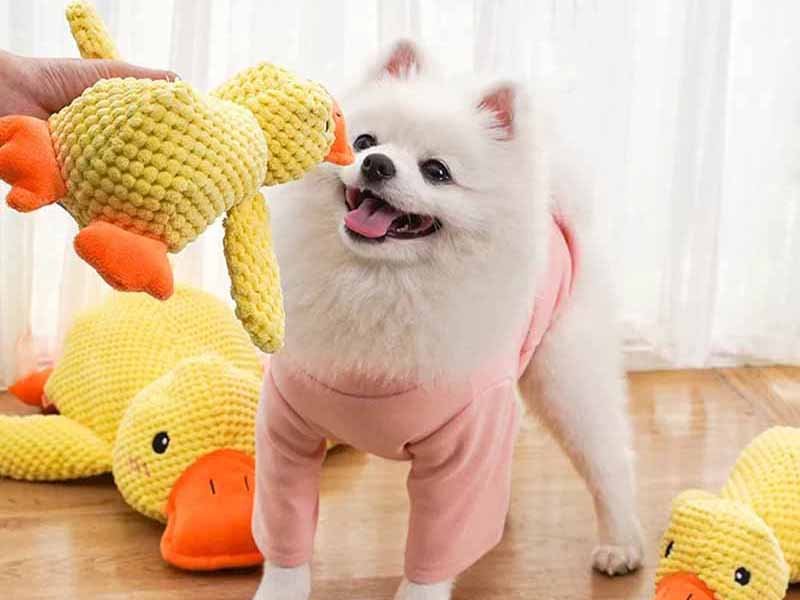
A soft toy can look harmless on a store shelf. It has no sharp edge, feels light in your hand, and may even resemble the stuffed animal a child keeps beside the bed. But a dog does not use a plush toy the way a child does. One dog may carry it gently, sleep beside it, and make it last for years. Another may find the nearest seam, open the body within minutes, pull out the stuffing, and hunt for the squeaker.
Plush toys can be safe for dogs when the toy matches the dog’s size and chewing behavior, has securely constructed seams and components, remains undamaged, and is used under appropriate supervision. They are not a safe choice for every dog, especially dogs that rapidly tear toys apart or swallow fabric, stuffing, squeakers, or other components.
The most useful question is therefore not simply, “Is a plush toy safe?” It is, “Is this particular toy safe for this particular dog during this particular type of play?” Imagine two dogs receiving the same stuffed duck. One carries it to bed. The other removes its beak before the packaging reaches the trash. The product has not changed, but the risk profile has. Understanding that difference is the starting point for safer play and better product design.
Are Plush Toys Safe for Dogs?

Plush toys are conditionally safe, not universally safe. Safety depends on the dog’s chewing style, the toy’s size and construction, the strength of its seams, the security of internal parts, its condition during use, and the level of supervision. A toy that suits a gentle carrier may be inappropriate for a determined destroyer.
A Conditional Yes
The word “plush” describes a construction style, not a guaranteed level of safety. A lightly filled comfort toy, a reinforced fetch toy, a rope-and-plush tug toy, and a decorative stuffed animal may all look similar, but they behave very differently when bitten, shaken, stretched, and soaked with saliva.
The dog matters just as much as the product. A gentle retriever may carry the same plush animal for months, while another dog may open its first seam in less than five minutes. A plush toy is more likely to be appropriate when the dog carries, retrieves, licks, or cuddles it without actively trying to dismantle it. Risk rises when the dog concentrates on seams, external labels, ears, tails, squeakers, or other easy-to-grip areas.
Veterinary guidance follows this behavior-based approach. Texas A&M advises avoiding soft, plush, or squeaker toys for animals that habitually destroy their toys because released components can become choking or gastrointestinal hazards. Safety should also be reassessed throughout the toy’s life. A product may be acceptable when new but unsafe after repeated washing, fabric thinning, seam stretching, or internal component movement.
Behavior Changes the Risk
Breed and body weight offer useful context, but they do not fully predict how a dog will treat a toy. A small terrier can be a determined toy destroyer, while a much larger dog may carry plush animals gently. Owners should pay more attention to actual behavior than to marketing labels such as “for large breeds” or “tough.”
Higher-risk behavior includes biting repeatedly at one exact seam, pulling threads with the front teeth, searching specifically for the squeaker, swallowing pieces instead of dropping them, consuming socks or blankets, guarding the toy, and continuing to chew after the outer shell opens. Play intensity may also change with context. A dog that cuddles a toy alone may tear it during competition with another dog. A calm dog may become destructive when bored or anxious.
The safest approach is to observe the first several play sessions closely. A five- or ten-minute trial often reveals whether the dog treats the product as a comfort object, retrieval toy, tug object, or target for disassembly. That evidence is more useful than assuming the toy is safe because it survived a quick squeeze in the store.
Children’s Plush Is Different
A child’s stuffed animal should not automatically be given to a dog. Children’s plush products are designed around expected child interaction, while dogs may puncture, crush, shake, pull, and swallow parts of a product. Decorative stuffed animals may include hard plastic eyes, buttons, beads, ribbons, glued decorations, internal wires, shaped foam, batteries, sound modules, or weighted pellets.
Even when these components are secure during ordinary handling, concentrated tooth pressure can expose or detach them. A loose plastic eye is no longer a decorative feature; it becomes a swallowable object. In homes with both children and pets, cross-use should be considered. A dog toy may be picked up by a toddler, while a child’s stuffed animal may be taken by a dog.
The safest household practice is to keep children’s plush products and dog toys separate, especially when small components or batteries are involved. Clear product identity, warnings, packaging, and storage instructions reduce confusion, but they do not replace active supervision.
Risks and Benefits
Plush toys can support carrying, retrieving, gentle shaking, comfort, scent games, and interactive play. They are lightweight, usually quieter than hard toys, and may be easier for some puppies, senior dogs, or dogs with sensitive mouths to handle.
Those benefits must be balanced against the way soft products fail. The greatest concern is usually not the intact outer fabric. It is what becomes available after the fabric or seam opens. “Non-toxic material” does not mean “safe to swallow.” A material can have low chemical toxicity and still create a dangerous physical blockage.
The table below shows how useful features can become risk points once wear begins.
| Area | Potential benefit | Main risk | Remove the toy when |
|---|---|---|---|
| Soft outer fabric | Comfortable to carry and cuddle | Fabric may tear or form strips | Fabric thins, splits, or develops a hole |
| Fiber filling | Creates shape and softness | Loose filling may be swallowed | Any filling becomes visible |
| Squeaker | Encourages interaction | Dog may remove and swallow it | Squeak changes, stops, or becomes exposed |
| Long ears or limbs | Easy to grip and carry | Pulling can open concentrated seams | Attachment point stretches or twists |
| Rope sections | Supports tug play | Frayed strands may be ingested | Rope loosens or strands separate |
| Plastic decoration | Adds visual detail | Detached part may obstruct or choke | Any movement, cracking, or looseness appears |
| Washable construction | Supports hygiene | Washing may weaken seams or move parts | Shape, stitching, or internal parts change |
Which Dogs Can Use Plush Toys Safely?

Dogs that carry, retrieve, lick, or cuddle toys without rapidly destroying or swallowing them are generally better candidates for plush products. Dogs that puncture fabric, open seams, consume stuffing, or hunt internal components need much closer supervision and may require another toy category. Age, dental condition, mouth size, and ingestion history also matter.
Gentle and Destructive Players
A gentle player usually mouths the toy without repeatedly targeting one structural point. The dog may carry it around the home, bring it to a person, sleep beside it, or use it during short fetch sessions. Wear still occurs, but damage often develops slowly enough for an owner to notice.
A destructive player behaves differently. The dog may pin the toy with its paws, use the front teeth to pick at stitching, tear at protruding features, or bite repeatedly over the squeaker. Once a small opening appears, the dog may enlarge it quickly. Dogs that have swallowed socks, rope fibers, bedding, plastic, or previous toy parts should be treated as higher-risk users.
“Durable” is not the same as “indestructible.” Reinforced layers, stronger seams, and protected squeakers may delay failure, but every textile product has a failure point. A plush item may still be used for tightly controlled fetch or owner-led interaction with some destructive dogs, but it should be collected after the session rather than left as an all-day chewing object.
Puppies and Senior Dogs
Puppies explore with their mouths and may chew more intensely during teething. Their toy needs can change in a matter of months as jaw strength increases and the mouth becomes larger. A toy that was appropriately sized at twelve weeks may become too small later. Choose designs with limited protrusions, no loose plastic decoration, visible seams, and dimensions that cannot be swallowed whole.
Puppies should learn “drop,” “leave it,” and calm toy-trading habits early. These skills make it easier to remove a damaged product without creating a chase or guarding game.
Senior dogs may prefer softer and lighter toys, particularly when their play becomes less intense. However, dental disease, missing teeth, reduced vision, slower coordination, or swallowing changes create different risks. Very hard toys may contribute to dental trauma in older dogs or dogs with dental problems, so a carefully selected soft toy may be useful when supervised A sudden change in toy use, such as dropping objects or chewing only on one side, may justify a veterinary or dental assessment.
Size and Mouth Fit
A plush toy should be too large to swallow whole but light enough for the dog to carry without restricting breathing or movement. Overall length alone is not sufficient because soft products compress. A large fluffy product may collapse into a much smaller bundle when bitten.
Thin legs, balls, ears, tails, and separate attachments can create hazards even when the main body is large. Texas A&M notes that toys should be appropriately sized because larger dogs can choke on products designed for smaller pets. In multi-dog homes, size the toy for the largest dog that can access it, not only the smallest intended user.
The following fit checks are practical screening tools rather than formal veterinary sizing standards.
| Fit check | Lower-risk result | Higher-risk result |
|---|---|---|
| Whole-toy fit | Toy cannot pass fully behind the canine teeth | Dog can place nearly the entire toy in its mouth |
| Compression | Toy remains bulky when squeezed | Toy compresses into a small, dense bundle |
| Narrow features | Ears and limbs remain too large to swallow | Thin parts can be bitten off and swallowed |
| Carrying | Dog carries it with the mouth partly open | Toy blocks the mouth or affects breathing |
| Weight | Toy is easy to lift without neck strain | Toy drags heavily or restricts movement |
| Growth allowance | Size is reviewed as the puppy grows | The same toy is used without reassessment |
| Multi-dog use | Sized for the largest dog with access | A small-dog toy is available to a larger dog |
Health and Household Factors
Dental condition, swallowing ability, anxiety, resource guarding, and the presence of other pets all affect whether plush play can be managed safely. A dog with painful teeth may prefer soft materials, but internal hard parts can still cause discomfort. A dog with reduced swallowing coordination may be less able to manage loose fibers.
Multi-dog play deserves special attention. Two dogs pulling from opposite ends can apply far more stress to seams than one dog carrying the toy. A toy intended for gentle retrieval may fail quickly when used for tugging, and competition can make dogs swallow detached pieces rapidly.
Household routines matter as well. A plush toy used only during ten-minute supervised sessions creates a different risk profile from a toy left on the floor for eight hours. Products used outdoors may collect grit that increases abrasion, while toys used in crates may receive long periods of concentrated chewing. The safest choice is based on the real environment in which the product will be used.
What Makes a Plush Dog Toy Safer?

A safer plush dog toy combines suitable dimensions, stable fabrics, secure seams, limited detachable decoration, controlled filling, protected internal parts, clear care instructions, and realistic warnings. No textile toy is indestructible. Good design reduces predictable failure, delays access to internal components, and makes developing damage easier for the owner to detect.
Fabric and Filling
The exterior fabric must do more than feel soft. It must work with the selected thread, seam type, pattern shape, filling level, washing method, and intended play behavior. Common choices include short-pile plush, velboa, fleece, minky-style textiles, sherpa-style materials, and selected faux furs, but each has trade-offs.
Long-pile materials can create an appealing appearance but may hide loose threads and small seam openings. Lightweight fabric may feel soft yet stretch or tear around high-load points. Dense fabric may resist abrasion but retain more moisture after washing. Material review should consider fabric weight, backing density, stretch direction, pile shedding, seam slippage, abrasion, saliva and wash colorfastness, drying time, odor retention, and lot consistency.
Many development teams begin evaluating short-pile polyester fabrics in roughly the 180-350 gsm range, but fabric weight alone is not a safety threshold. A lighter material with a stable backing may perform better than a heavier but loosely knitted fabric. Filling needs similar control. Too little can make a squeaker easy to locate; too much can place constant pressure on seams. Internal chambers and carefully closed fill openings can limit exposure after local failure.
Seams and Components
Most structural failures begin where stress is concentrated: narrow limbs, ears, tails, neck joints, rope transitions, labels, squeaker areas, curved panels, and the final filling closure. A reliable seam is a system rather than one isolated specification. Fabric backing, thread, stitch type, stitch density, seam allowance, sewing direction, and product shape must work together.
For many plush constructions, development teams may start with seam allowances around 6-10 mm and stitch densities around 8-12 stitches per inch, then adjust after pull, flex, wash, and destructive trials. These figures are production starting ranges, not universal dog-toy safety limits. Excessive stitch density can perforate some knitted backings, while insufficient density may allow gaps to form.
External components should be minimized when they do not add meaningful function. Embroidered eyes and noses often reduce the detachment risk created by separate plastic parts. Labels should not become easy pulling tabs. The engineering question is not only, “Will this part stay attached?” It is also, “What happens if it eventually comes loose?”
Squeakers and Internal Parts
Squeakers attract many dogs precisely because the sound encourages them to locate the component. Squeaker security should therefore be treated as a primary structural concern, not a minor accessory detail. Design variables include component size, wall thickness, shape, edge profile, location, enclosure method, distance from high-stress seams, and how easily movement can be detected.
A protected internal pocket may delay access, but it should never support an absolute claim that the squeaker cannot be reached. Veterinary guidance identifies swallowed squeakers as a possible cause of gastrointestinal obstruction. Owners should stop use if the squeak changes or disappears, a hard shape moves beneath the fabric, or the dog begins biting one precise location.
Stuffing-free toys remove one common source of loose filling, but they may still contain squeakers, crinkle film, rope, foam, lining, labels, and thread. Long fabric or rope strips are particularly concerning because linear foreign bodies can injure or perforate the intestine. Product descriptions should state exactly what is inside rather than using broad claims such as “empty” or “nothing to swallow.”
Better Claims, Better Design
Safety claims should reflect how the product was designed and tested. Terms such as “tough,” “reinforced,” “heavy-duty,” and “for strong chewers” need supporting specifications and should not imply unlimited use.
A credible development record identifies the intended dog-size range, play mode, product dimensions and weight, approved fabric and component codes, seam construction, filling target, internal-part specifications, sample test methods, warning text, inspection guidance, and cleaning method. Brands should avoid “indestructible,” “100% safe,” and “safe for every dog.” These claims do not account for differences in jaw strength, persistence, previous ingestion behavior, or accumulated wear.
A better statement is specific: designed for supervised fetch and carry play, reinforced at high-stress seams, inspect before every use, and remove immediately if damaged. Safer development does not depend on one magical material. It depends on connecting the user profile, pattern, fabric, components, testing, quality control, instructions, and post-sale feedback into one system.
How Should You Use Plush Dog Toys?

Introduce plush toys during supervised, time-limited play. Inspect the product before and after every session, remove it as soon as fabric, seams, filling, or internal components become damaged, and clean it according to verified care instructions. Dogs that destroy or swallow soft materials should not be left alone with plush toys, regardless of durability claims.
First-Use Supervision
The first play session is a practical compatibility test. Keep it short. Five to ten minutes is often enough to identify whether the dog carries, retrieves, shakes, grips a limb, searches for the squeaker, picks at seams, pulls labels, or swallows loose fibers.
Effective supervision means being close enough to notice the first hole, remove a loose part, and stop the session before material is swallowed. The dog should also be comfortable releasing the product. A calm trade using a treat or another toy is usually safer than chasing, shouting, or pulling the item from the mouth. Chasing can turn removal into a game, while forceful handling may increase guarding.
After the session, compare the toy with its original condition. Check symmetry, squeeze the body gently, feel the seam lines, and confirm that the squeaker or filling has not moved. Repeat this over several sessions. Some dogs do not begin destructive play immediately; they first learn where the squeaker or weakest seam is located.
Inspection and Retirement
Inspect plush toys before every use and again after play. High-intensity users may require a mid-session check. Look and feel for widening stitch holes, loose thread, thinning fabric, exposed backing, missing labels, shifted squeakers, clumped filling, rope fray, unusual hard edges, odor, and incomplete drying.
Remove the toy when filling is visible, a squeaker changes position, a hard component becomes exposed, thread forms a loop, fabric creates a strip, or a part is missing. Do not wait until the product is completely destroyed. Once a dog gains an edge to grip, a small opening can become a large one in seconds.
Improvised repairs using glue, tape, staples, or loosely sewn patches may introduce additional hazards. In most cases, a heavily damaged dog toy should be discarded. The schedule below turns inspection into a repeatable household routine.
| Timing | What to check | Action |
|---|---|---|
| Before first use | Size, loose decoration, packaging damage, exposed thread | Do not use if a defect is present |
| After 5-10 minutes | Bite target, seam stress, fiber loss, squeaker position | Stop if damage begins |
| Before every session | Holes, loose thread, fabric thinning, odor, missing parts | Remove questionable toys |
| After every session | Filling loss, stretched seams, rope fray, wet interior | Dry, clean, or retire |
| After washing | Shrinkage, distortion, loose parts, failed stitching | Return only when fully dry and sound |
| Weekly for frequent use | Compare with original shape and firmness | Replace if wear is progressing |
| After rough tugging | Limb, neck, label, and rope attachment points | Retire if an attachment shifts |
Cleaning and Drying
Cleaning methods should match the complete product, not just the outer textile. A machine-washable fabric does not guarantee that the squeaker, crinkle film, embroidery, adhesive, rope, print, or filling can tolerate the same cycle.
Before washing, remove surface dirt and check for small holes. Washing a damaged product can enlarge seams and move internal components. Follow the stated care method, rinse thoroughly, reshape the toy, inspect embroidery and seams, confirm that internal parts remain secure, and dry the interior completely. Dense filling may remain damp after the exterior feels dry.
Brands that make machine-washable claims should validate them on actual production samples. A useful wash trial records temperature, cycle type, detergent exposure, drying method, number of cycles, shape retention, seam condition, drying time, and component function. “Machine wash cold in a laundry bag and air-dry completely” gives the owner more useful information than simply stating “washable.”
Unsupervised Play
Plush toys are not suitable for unsupervised use when a dog has a history of tearing or swallowing soft materials. Even a product that has survived for months can fail after fabric fatigue, washing, or repeated stress.
Owners may find it useful to divide toys into supervised fetch toys, supervised tug toys, carry and comfort toys, short-duration enrichment toys, products considered for limited alone time, and retired toys. A product should enter the alone-time category only after repeated observation of the individual dog’s behavior, and it should still be inspected frequently.
Multi-dog households need additional caution. A toy left for one gentle dog may be accessed by a more destructive dog, and competition may turn calm carrying into forceful tugging. Supervision is not an admission that a toy is poorly made. It is a normal control for a product used by an animal capable of repeated biting, pulling, and swallowing.
What If a Dog Swallows Part of a Toy?
Contact a veterinarian promptly if a dog may have swallowed stuffing, fabric, rope, a squeaker, plastic, batteries, or another toy component. Do not assume the material will pass, and do not induce vomiting unless a veterinary professional specifically directs you. Breathing difficulty, repeated gagging, vomiting, abdominal pain, weakness, or collapse requires urgent care.
Choking and Esophageal Signs
Choking affects the airway and can become fatal within minutes. Warning signs may include sudden panic, pawing at the mouth, forceful coughing, gagging, noisy breathing, blue or pale gums, weakness, or collapse. Respiratory distress requires immediate attention.
An object lodged in the esophagus may produce excessive drooling, repeated swallowing, gagging, regurgitation, neck extension, difficulty swallowing, or refusal of food. Merck Veterinary Manual identifies sudden drooling, gagging, regurgitation, and repeated swallowing attempts as signs associated with an esophageal foreign object.Do not blindly push fingers deep into a conscious dog’s mouth. This can move the object farther, damage tissue, or result in a bite. Contact an emergency veterinary clinic while arranging transport and follow professional first-aid instructions. Keep an identical toy, packaging, or photograph if available because the component’s approximate size and shape may help the veterinary team assess the risk.
Gastrointestinal Blockage
Fabric, filling, squeakers, rope, foam, and plastic can become gastrointestinal foreign bodies. Some objects pass, but others remain in the stomach or lodge in the intestine. Common warning signs include repeated vomiting, loss of appetite, lethargy, abdominal pain, diarrhea, dehydration, abdominal swelling, inability to keep water down, straining, or unusual restlessness.
A dog may still pass stool during a partial obstruction, so one bowel movement does not prove the object has cleared. Cornell describes gastrointestinal foreign-body obstruction as an emergency. Toys and pieces of clothing are common causes, while string- or ribbon-like material can create severe intestinal injury or perforation.
A missing squeaker deserves prompt attention even when the dog currently appears normal. Symptoms may be delayed, and some materials are difficult to identify on ordinary X-rays. Veterinary assessment may involve examination, radiographs, ultrasound, endoscopy, blood testing, or surgery, depending on the object and clinical signs. Early contact may preserve more treatment options and reduce the risk of tissue damage, infection, and dehydration.
Do Not Induce Vomiting
Do not make a dog vomit unless a veterinarian or qualified animal poison-control professional specifically tells you to do so. Whether vomiting is appropriate depends on what was swallowed, the object’s size and shape, the time since ingestion, the risk of sharp edges, aspiration risk, and the dog’s current condition.
Batteries, sharp parts, large objects, and certain materials may cause additional injury if brought back up. Household remedies involving salt, oil, fingers, mustard, or improvised mixtures can create new medical problems. The ASPCA advises that hydrogen peroxide should only be used under veterinary guidance because incorrect use or dosing can be harmful.
After suspected ingestion, remove the remaining toy, identify what is missing, estimate the time and amount, keep the packaging, call a veterinarian, and follow the instructions given. Do not offer bread, oil, fiber, food, or medication to “push the object through” unless a veterinarian directs you.
Information for the Veterinarian
Clear information helps the veterinary team judge urgency and possible treatment. Provide the dog’s age and weight, known health conditions, estimated ingestion time, material type, approximate missing dimensions, whether the object was sharp, rigid, string-like, battery-powered, or magnetic, and any current symptoms.
A precise description is more useful than saying only, “My dog ate a toy.” For example: “My 24-kilogram dog may have swallowed a plastic squeaker approximately four centimeters across 30 minutes ago and is currently acting normally.” Bring an identical component or product photo when possible.
Immediate emergency evaluation is appropriate when the dog has difficulty breathing, blue or pale gums, collapse, repeated vomiting, severe weakness, abdominal swelling, marked pain, blood in vomit or stool, or known ingestion of a battery or sharp component. A dog that appears normal may still need evaluation because foreign-body signs can be delayed.
How Should Brands Develop Safer Plush Dog Toys?
Brands should define the intended dog, play mode, target market, and foreseeable misuse before finalizing appearance. Safer development connects risk assessment, fabric and component control, pattern engineering, prototype testing, warning labels, approved-sample management, bulk inspection, and post-sale feedback. Safety should be demonstrated through specifications and testing rather than broad claims such as “indestructible.”
Define the Use Case
A good development brief does not simply say “plush dog toy.” It states how the product is expected to be used. The brief should define the target dog-size range, life stage, gentle or high-intensity play, carry, fetch, cuddle, tug, or chew function, supervision status, indoor or outdoor conditions, cleaning method, single-dog or multi-dog use, target markets, and packaging requirements.
These decisions affect nearly every product detail. A comfort toy for gentle indoor carrying can use a different fabric, fill level, shape, and seam system from a supervised tug toy. A narrow decorative tail may suit a shelf appearance but create an obvious grip and tear point during play.
Foreseeable misuse should also be documented. Dogs may target the squeaker, pull labels, bite through narrow limbs, swallow loose fabric, or continue using the toy after damage. Children may pick up pet products in shared homes. A safer product considers both the expected behavior and the predictable wrong behavior rather than relying on perfect use.
Engineer and Test the Sample
Prototype approval should cover structure as well as appearance. A sample can look attractive in photographs yet fail quickly because the fabric slips at a curve, the filling closure is weak, the squeaker sits behind a high-stress seam, or the compressed body becomes too small.
Testing should match the intended use and the requirements of the retailer and destination market. Useful evaluation areas include finished and compressed dimensions, fabric backing stability, surface shedding, seam loading, component pull, repeated flexing, squeaker access, fill distribution, washing, drying, destructive failure, packaging, and warning clarity.
The final approved sample should become a production reference supported by material codes, pattern files, dimensions, component specifications, warning text, and packaging instructions. A generic children’s-toy certificate should not be presented as proof that a pet toy is suitable for every dog. Product classification and applicable requirements must be reviewed project by project.
| Development check | What is measured or observed | Possible response |
|---|---|---|
| Finished size | Length, width, thickness, compressed size | Increase dimensions if swallowability is a concern |
| Fabric behavior | Weight, backing stability, stretch, shedding | Change textile or add internal support |
| Seam performance | Gap formation, thread breakage, fabric tearing | Adjust stitch, allowance, pattern, or thread |
| Component pull | Movement or detachment of labels, ropes, decorations | Remove, enlarge, or re-engineer |
| Squeaker access | Failure route and time needed to expose it | Reposition or add an internal enclosure |
| Fill control | Weight, distribution, firmness, seam pressure | Reduce, redistribute, or compartmentalize |
| Wash trial | Shrinkage, distortion, movement, drying time | Revise construction or care instructions |
| Destructive review | Where and how the prototype ultimately fails | Reinforce or redesign high-risk points |
| Packaging review | Warning clarity, barcode, moisture, transit protection | Revise the label or pack structure |
Control Bulk Production
Bulk production introduces variables that do not appear in a single prototype. Different fabric lots, sewing operators, filling stations, production lines, and packaging teams can create variation unless the product is controlled by documented standards.
Important checkpoints include incoming material verification, color and lot approval, pattern version control, embroidery and print positioning, seam and closure checks, fill-weight control, component placement, label and warning verification, finished dimensions, packaging accuracy, functional inspection, and pre-shipment review. High-risk features should receive tighter inspection than purely cosmetic areas.
The approved sample is essential, but “make it like the sample” is not enough for a multi-line order. Production teams need tolerances, component codes, stitch requirements, fill targets, packaging specifications, and defect criteria. Delsney’s documented capabilities include 18+ years of plush manufacturing experience, 500+ staff, 18 production lines, 25+ engineers, 10+ designers, 20+ QC personnel, and 100% pre-shipment inspection. Those resources are most effective when applied through a product-specific control plan.
Work With a Plush Specialist
A capable manufacturing partner should help turn the intended use into a production-ready specification. That includes questioning features that look appealing but create unnecessary risk, suggesting more stable materials, identifying high-stress pattern areas, controlling internal components, planning testing, and making the approved sample repeatable at scale.
For a custom plush dog-toy project, useful inquiry information includes artwork or a reference sample, target dimensions, dog-size range, intended play behavior, quantity and SKU count, preferred fabric, filling level, squeaker, rope or crinkle requirements, destination market, packaging, warning text, retailer test protocol, and launch date.
Delsney supports B2B OEM, ODM, and private-label plush development from design assessment and engineering sampling through bulk production, quality control, packaging, and global delivery. Its documented MOQ is 500 pieces per design. Standard samples commonly require 5-7 days, more complex structures generally require 7-15 days, and standard bulk production is typically planned around 20-30 days after sample approval, subject to materials, testing, quantity, and packaging complexity. Brands can submit their design files and requirements for a technical review and custom quotation.
Develop Your Custom Plush Dog Toy With Delsney
A successful plush dog toy should not begin with the claim that it is unbreakable. It should begin with a clear understanding of the dog, the intended play behavior, the likely failure points, and the controls required from prototype to shipment.
Delsney helps pet brands, retailers, distributors, and established e-commerce companies develop custom plush products from artwork, concepts, and reference samples. The team can support material review, pattern engineering, prototype development, seam and component optimization, sample revision, branded labels, retail packaging, bulk production, quality inspection, and global delivery.
For a technical review and quotation, provide your artwork or reference images, target size and quantity, intended dog-size range, play type, material and internal-component preferences, destination market, packaging requirements, retailer or laboratory protocols, and required delivery date.