Skip to content
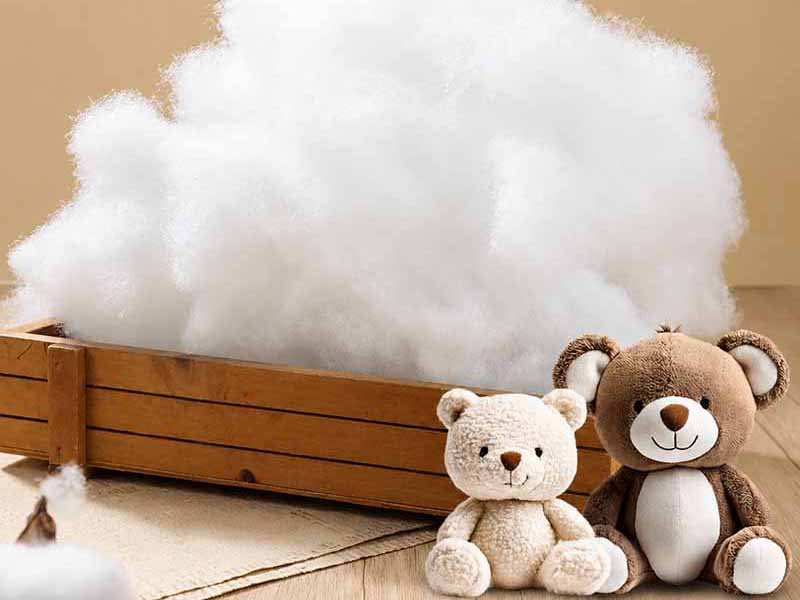
A plush toy may look simple from the outside, yet its filling quietly controls much of what customers notice first. It determines whether the toy feels soft or stiff, whether the head keeps its shape, whether the body sits correctly, and whether the product still looks presentable after being compressed inside a shipping carton. The wrong filling can turn a strong character design into a flat, uneven, or uncomfortable product.
The right stuffing material depends on the target age, product structure, required softness, total weight, washing method, safety expectations, sustainability goals, packaging method, and budget. Polyester fiberfill or PP cotton suits many general plush toys, while recycled fiber, weighted pellets, foam inserts, and hybrid systems are better for specialized performance requirements.
A filling decision should therefore be made during product development, not after the fabric has already been cut. Brands also need to approve more than the material name. Filling weight, density, location, recovery, containment, and batch consistency must all be defined. One character can feel premium in the sample room and disappointing in mass production simply because a few extra grams were pushed into the face, too little material reached the limbs, or the weight shifted during packing. That small detail is where many large plush programs succeed – or quietly go wrong.
What Does Stuffing Change in a Plush Toy?

Stuffing controls a plush toy’s softness, shape, weight, balance, recovery, washability, and long-term appearance. The same fabric and pattern can produce very different products when the filling material, quantity, or distribution changes. A dependable specification defines what filling is used, how much goes into each area, and how the finished product should feel.
Softness and Hand Feel
Softness is not determined by the fiber name alone. It comes from the interaction between fiber structure, filling quantity, outer fabric, internal volume, and the way the operator distributes the material. A fine, resilient fiber can feel soft when loosely placed in a rounded body but noticeably firmer when compressed into a small head or narrow limb.
A lightly filled body usually feels floppy and easy to squeeze. That can suit relaxed animals, long-limbed characters, and plush products intended to drape across the arms. However, low filling levels may also leave wrinkles, weak neck support, or empty corners. A more densely filled product holds its outline more clearly, which helps character heads, mascots, and products that must sit upright on a retail shelf. Excessive filling creates a hard hand feel, stretches the shell, moves embroidered features, and increases pressure on the closing seam.
Different areas of the same toy often need different densities. The body may remain soft for hugging, while the face needs enough support to preserve the expression. Arms can be lighter for movement, while the feet may be firmer for posture. Terms such as soft, firm, and squishy are too subjective for production approval. A physical reference sample, a recorded filling weight, and clear body-area instructions provide a much more dependable standard.
Shape and Character Accuracy
Stuffing turns a flat sewn shell into a three-dimensional product. It pushes panels outward, creates curves, and supports the proportions developed in the pattern. Too little filling makes the toy look wrinkled or collapsed. Too much can widen the face, push the muzzle forward, stretch the seams, and change the apparent size even when the paper pattern has not changed.
The head is usually the most sensitive area. Small changes in volume can alter the cheeks, forehead, jawline, and eye position. This matters especially for licensed characters and brand mascots, where a slight shift can make the expression feel unfamiliar. Ears, tails, horns, fingers, and narrow limbs also require a planned filling order. Operators normally fill the farthest points first because they become difficult to reach once the main body is full.
Posture depends on filling as well. A sitting animal needs enough support in the lower body to remain stable. A large-headed character may need firmer neck support or an internal structure. A long pillow needs even distribution along its full length. The best shape is not produced by adding the most filling; it comes from balancing pattern geometry, fabric stretch, internal pressure, and the intended hand feel.
| Filling variable | Visible effect | Risk when uncontrolled | Practical control |
|---|---|---|---|
| Head filling | Face width and expression | Distorted eyes, cheeks, or muzzle | Separate head-weight reference |
| Body density | Fullness and posture | Collapsed or overly hard body | Approved hand-feel sample |
| Limb filling | Movement and symmetry | One limb fuller than the other | Left-right comparison |
| Neck support | Head position | Forward-leaning head | Local density instruction |
| Base filling | Sitting stability | Rolling or leaning | Balance check on a level surface |
| Tail and ear filling | Detail definition | Empty tips or hard lumps | Fill narrow areas first |
Weight and Balance
Lightweight fiberfill gives volume without adding much mass. This works well for most general plush toys, but some products need additional weight to create stability or a more substantial feel. Weighted products may use plastic pellets, glass beads, or another approved dense material inside a separate inner pouch.
Weight must be planned rather than simply added. An insert placed too high can make a toy topple. Too much weight on one side can create visible leaning. A dense pouch close to the surface may feel like a hard lump, while a concentrated load near a weak seam increases the risk of failure during handling. Balance should be checked in the position in which the product will normally be used – sitting, lying, draping, or being carried.
Commercial teams also need to include logistics in the decision. Added mass affects unit freight, carton loading, warehouse handling, and sometimes packaging strength. A weighted design should therefore be reviewed for total weight, center of gravity, pouch position, seam loading, user experience, and delivered cost before the final sample is approved.
Recovery and Long-Term Appearance
A plush toy may look excellent immediately after stuffing but perform poorly after compression, storage, washing, or repeated use. Recovery describes how well the filling returns to its original form after pressure is removed. Large plush products and pillows are especially sensitive because they are often compressed to reduce shipping volume.
A weak filling can remain flat after unpacking or migrate away from the face, corners, and limbs during transport. Recovery should be checked under the actual packaging method. A short hand squeeze is not enough to predict what happens after days or weeks in a compressed bag and carton. A useful trial compares dimensions and appearance before packing, immediately after unpacking, after 30 minutes, and again after 24 hours.
Poor recovery does not always mean the fiber itself is unsuitable. Excessive compression, long storage, high density, narrow cavities, and packaging design may also be responsible. Washing creates another challenge because fiber can clump or remain damp in dense sections. Care instructions should reflect the complete finished construction, not only the filling supplier’s general description.
Which Stuffing Materials Are Used in Plush Toys?

Commercial plush toys commonly use polyester fiberfill, high-rebound fiber, recycled polyester filling, weighted pellets or beads, foam inserts, and mixed filling systems. Each option creates a different combination of softness, support, weight, recovery, washability, cost, and production complexity. The material must be evaluated inside the actual product, not only as loose filling.
Polyester and PP Cotton
Polyester fiberfill is the most widely used filling for general plush production. In many manufacturing regions, it is also called PP cotton, although buyers should confirm the exact composition and grade because trade terminology is not always consistent. Its main advantages are low weight, broad availability, adjustable softness, and the ability to fill complex body shapes.
Not all polyester filling performs the same way. Fiber thickness, length, hollow structure, surface treatment, elasticity, and cleanliness affect the finished result. One grade may feel smooth and springy, while another may clump, flatten, or create an uneven surface. A loose handful can feel soft but become firm when packed into a small head. The opposite can happen in a large body, where a weak fiber loses volume and leaves thin areas.
The material should be approved inside the finished sample, and the exact supplier and grade should be recorded. For repeat orders, changing the source can alter shape and recovery even when the weight remains the same. Good control therefore combines the material specification with section weights, an approved physical sample, and batch inspection.
High-Rebound Fiber
High-rebound fiber is selected when a product needs stronger shape recovery and a fuller silhouette. It is useful for plush pillows, hugging products, large animals, and items expected to withstand repeated squeezing. After pressure is removed, the fibers spring back more effectively than lower-grade filling, which can improve shelf presentation and recovery after compact packing.
Higher rebound is not automatically better. In a small character head, strong internal pressure can stretch the shell and change the face. In narrow limbs, it can create a springy, overfilled feel that does not suit the design. The filling level must be adjusted rather than copied from a standard polyester specification.
The sample should be tested after realistic packaging, not just pressed briefly by hand. A higher material cost may be justified when it reduces flattening, maintains a premium appearance, and improves product life. The decision should be based on total performance – shape, feel, recovery, packing efficiency, and return risk – rather than price per kilogram alone.
Recycled and Natural Options
Recycled polyester filling is increasingly used in product lines that aim to reduce reliance on virgin material. When the grade and source are controlled, it can provide softness and production efficiency similar to conventional polyester. The recycled-content claim should be supported by relevant supplier documentation, while incoming inspection should still cover odor, foreign matter, fiber consistency, rebound, and batch variation.
Natural options may include cotton, wool, kapok, or other plant-based fibers. These materials can suit particular brand concepts, but they may differ in weight, moisture behavior, drying time, compression recovery, allergen considerations, and supply consistency. Natural does not automatically mean technically better or lower impact in every product.
Environmental statements should be precise. ‘Filled with recycled polyester’ is clearer than suggesting the entire toy is recyclable or biodegradable when the shell, thread, embroidery, accessories, labels, and packaging use different materials. Durability also matters. If a filling clumps early or shortens the useful life of the product, the broader environmental benefit may be reduced.
Weighted and Structural Fillings
Weighted plush products may use plastic pellets, glass beads, or another dense medium to add mass without making the entire body firm. These materials should normally be placed inside a dedicated inner pouch. The pouch controls distribution, prevents migration, and provides an additional containment layer.
Glass beads can provide more weight in a smaller volume than many plastic pellets, but the concentrated load requires careful pouch and seam design. Plastic pellets occupy more space and can create a softer, more flexible weighted area. The final choice depends on target weight, available volume, surface feel, cost, and the intended age group.
Foam inserts are used when loose fiber alone cannot hold a stable form. A foam core may support a large head, geometric shape, display product, or firm cushion. The trade-off is a firmer hand feel and reduced washability or compressibility. Many products wrap foam with soft fiber to avoid an abrupt hard surface. Hybrid systems are valuable, but every material, position, orientation, and closure method must be documented for repeatable production.
| Filling material | Feel and behavior | Best suited to | Main control points |
|---|---|---|---|
| Standard polyester fiber | Light, soft, adjustable | General plush toys | Grade, weight, distribution |
| High-rebound polyester | Fuller and more resilient | Pillows and large plush | Pressure, recovery, shape |
| Recycled polyester | Similar to standard fiber when well specified | Sustainability-focused ranges | Traceability, odor, consistency |
| Plastic pellets | Flexible weighted feel | Sitting plush and weighted bases | Pouch security and migration |
| Glass beads | Dense weight in small volume | Compact weighted inserts | Seam loading and containment |
| Foam core | Firm structural support | Large or geometric products | Density, placement, washability |
| Mixed filling system | Combines softness, support, and weight | Specialty and interactive plush | Internal layout and assembly |
How Do You Match Stuffing to Product Type?

Stuffing should be matched to the product’s size, shape, target age, intended use, washing method, posture, packaging, and desired feel. A baby plush needs different controls from a weighted toy, character collectible, interactive product, or large pillow. The best choice supports the finished product’s real use rather than a general material preference.
Baby and Child Plush
Baby and young-child products usually require soft, clean filling that remains securely contained during foreseeable use. The complete construction is more important than the filling name alone. Polyester fiberfill is often chosen because it is lightweight and can provide a gentle hand feel, but the grade should be clean, low-odor, consistent, and compatible with the intended care method.
Dense sections should be avoided when they make washing and drying difficult. Loose weighted media, hard internal components, and complicated removable parts require additional review. The closing seam deserves particular attention because it is completed after filling and may remain under pressure if the product is overstuffed. Baby-focused designs also often use embroidered facial details instead of attached plastic eyes.
A washable claim should be confirmed on the complete sample. A toy can feel dry on the surface while remaining damp inside a dense body. Fabric, filling, embroidery, seams, labels, accessories, and packaging should be assessed as one product system, with the intended age and sales market defined before the sample is finalized.
Character and Mascot Plush
Character plush requires controlled filling to protect visual accuracy. Small changes in the head can alter the expression even when the pattern and embroidery remain unchanged. The face may need separate control around the cheeks, muzzle, forehead, and chin, while the body remains softer for hugging.
Mascots with large heads often need stronger neck support. Sitting characters may require additional density in the lower body. Long ears, horns, hair shapes, and tails may need lighter filling or internal support to hold the intended angle. The approved sample should be checked from the front, side, rear, and three-quarter views because a product that looks accurate from the front may have an overfilled muzzle or incorrect head depth from the side.
For multi-character collections, the goal is not identical filling weight. Different body volumes require different quantities. The goal is a consistent quality level, planned hand feel, and faithful appearance across the range. Every SKU should have its own weight and density references rather than borrowing a single specification from the first character.
Pillows, Large Plush, and Keychains
Plush pillows need even filling and good recovery. Wide, flat bodies can develop thin edges and dense centers if the fiber is not distributed carefully. Some shapes benefit from internal divisions that limit migration. The product should compress comfortably without developing hard corners, permanent dents, or empty zones.
Large plush products use much more filling and are affected by gravity. Fiber can settle into the lower body during storage, leaving the upper section underfilled. Large heads may lean forward, and long bodies may develop uneven areas. Weight references are especially useful because hand judgment becomes less reliable when each unit uses a substantial amount of material. Compression trials should use the actual bag, carton, stacking pressure, storage time, and unpacking process.
Keychain plush presents the opposite challenge. The body is small, so a few grams can noticeably change firmness and dimensions. Excessive filling may distort embroidery, widen the face, or make the closing seam bulky. Small products often need tighter gram-based control and closer measurement after shaping.
| Product type | Common filling approach | Primary quality concern | Useful approval check |
|---|---|---|---|
| Baby plush | Soft synthetic fiber | Containment and washability | Seam and care test |
| Character plush | Zoned fiber density | Expression and proportions | Multi-angle comparison |
| Mascot plush | Supported head and softer body | Neck stability | Upright posture test |
| Plush pillow | Even, resilient filling | Recovery and comfort | Compression trial |
| Large plush | Sectional or high-rebound filling | Settlement and shipping deformation | Packed recovery test |
| Plush keychain | Low-volume controlled filling | Overfilling and size variation | Unit weight and dimensions |
| Weighted plush | Fiber plus inner weight pouch | Balance and leakage | Position and drop review |
| Interactive plush | Fiber around a secured module | Function and access | Full functional inspection |
Weighted and Interactive Plush
Weighted plush requires a planned total weight and clear distribution. A sitting animal often performs better when the mass is concentrated low in the body, while a draping product may use several smaller pouches. The inserts should not move freely because migration changes balance and creates unexpected hard areas.
Interactive plush needs internal space for sound modules, lights, sensors, batteries, switches, or removable components. Filling must support the body without blocking a speaker, pressing a switch, covering a microphone, or pulling a cable. Modules should be fixed inside a defined pocket or support so that they do not move during stuffing, shipping, or use.
Cleaning instructions must match the internal system. A removable module can make the soft part easier to wash, while a permanently enclosed design may require surface cleaning. Both weighted and interactive products need more detailed production instructions than a basic fiber-filled toy. The internal layout should be documented through section diagrams, component weights, positions, access methods, and functional checks.
Which Safety Factors Matter Most?

The most important safety factors are target age, material traceability, filling containment, seam strength, cleanliness, weighted-insert security, wash performance, and market-specific testing. A filling material cannot be judged as safe in isolation. Safety depends on how it is enclosed, how the toy is used, and whether the finished product meets applicable requirements.
Age and Intended Use
The intended age group should be defined before material approval because it affects filling structure, accessories, labels, seam design, and the testing plan. Baby and young-child products generally require more conservative construction. Loose particles, hard internal components, and complex removable parts can create additional concerns, while soft fiber still needs reliable containment if a seam opens.
Adult collectibles may use more detailed accessories or firmer support, but the actual presentation and marketing still matter. A product described as an adult collectible may attract children if its design and retail placement are child-oriented. Intended use also changes the stresses applied to the toy. A display item experiences less repeated pressure than a product used as a pillow, carried daily, squeezed frequently, or attached to a bag as a keychain.
Safety decisions should therefore reflect foreseeable handling rather than only the ideal use stated in the brief. The brand and manufacturer should agree on age grade, use scenario, care method, sales channel, and destination market before sample approval, because those decisions can influence both internal construction and the documentation required later.
Material Cleanliness and Traceability
Filling should arrive clean, dry, sealed, and identifiable by supplier batch. Incoming inspection can cover odor, visible contamination, foreign fibers, moisture, color variation, and damaged packaging. Odor is easy to overlook in an open production area, yet it can become more noticeable after the toy is sealed in a polybag and exposed to heat during transport.
Traceability allows the production team to identify which material lot was used in a particular order. This is useful when investigating poor recovery, inconsistent softness, odor, or contamination. Recycled filling requires the same physical checks as virgin filling, together with documentation supporting the recycled-content statement.
Storage conditions also matter. Approved material can absorb moisture, dust, smoke, or chemical odors if the bags are left open or placed directly on the floor. Filling should be protected from damp areas, uncontrolled humidity, strong-smelling substances, and contamination throughout receiving, storage, and production.
Seams and Filling Containment
Filling leakage is often a construction problem rather than a raw-material problem. Weak closing seams, skipped stitches, damaged fabric, excessive internal pressure, and poor reinforcement can allow fiber or weighted particles to escape. The closing opening is a common risk point because it is sewn after stuffing and may remain under constant pressure when the product is overfilled.
Narrow necks, tails, limbs, and attachment points can experience concentrated stress. Weighted products create additional load because the inner pouch moves with greater force when the toy is lifted, squeezed, or dropped. Inspection should include visual checks, hand compression, controlled pulling at vulnerable areas, and confirmation that no fiber is working through the shell or needle holes.
Weighted media should have a secure inner containment layer in addition to the outer shell. The pouch material, seam type, closure, anchoring, and position all need to be checked during production rather than assumed from a single approved sample. Seam control and filling control must be managed together because a well-sewn seam can still fail when internal pressure is excessive.
Washing and Market Compliance
Washability depends on the complete product. Polyester fiber may tolerate washing, but electronics, foam, weighted pouches, coatings, adhesives, trims, and accessories may limit the care method. A dense toy can dry slowly, leaving moisture inside after the surface feels dry. This can lead to odor, clumping, or material deterioration.
Care instructions should be based on tests performed on the finished sample. The brand should decide whether the product is machine washable, hand washable, removable-cover only, or surface clean only. Interactive products may benefit from removable modules, while weighted products should be checked for pouch movement and seam strain after repeated care cycles.
Applicable requirements vary by destination, age group, design, materials, and sales channel. Common frameworks may include EN 71, ASTM F963, CPSIA-related requirements, CE documentation, UK requirements, and chemical restrictions. Retailers and marketplaces may request additional tracking, test reports, labels, or supplier records. A responsible manufacturer supports compliance preparation and third-party testing; it should not promise that every design will automatically pass before the complete product is reviewed.
How Do Filling Weight and Density Affect Quality?

Filling weight measures how much stuffing is used, while density describes how tightly it is packed into the available space. Together, they control softness, fullness, dimensions, posture, seam pressure, recovery, and consistency. Two toys can use the same material and weigh the same overall but still feel different when the filling is distributed differently.
Unit and Section Weight
A total unit-weight target provides a basic production reference, but it is not enough for complex products. The same total quantity can be distributed incorrectly, leaving the head empty and the torso overfilled. Section weights are useful for heads, bodies, limbs, tails, and weighted compartments because they make the approved sample easier to reproduce.
The empty sewn shell can be weighed before stuffing, the fiber can be weighed separately before insertion, or the finished product can be checked after all accessories and labels are attached. The method should remain consistent throughout the order. Weight tolerances must also be product-specific. A small keychain can be sensitive to a few grams, while a large pillow requires a different control range.
Material variation still matters. Two fiber batches can have the same weight but different bulk and rebound. Weight should therefore be used together with the approved sample, dimensions, hand-feel checks, and recovery performance. For weighted products, the dense insert normally needs a tighter target than loose fiber because the stated total mass and balance are part of the product experience.
Density and Internal Pressure
Density affects how the toy feels and how the shell behaves. Low density creates a softer, looser product, but it can leave wrinkles, weak posture, and empty areas after transport. High density creates stronger shape support, yet it also raises pressure on the fabric, seams, embroidery, and closing opening.
Stretch fabrics may expand when overfilled, changing dimensions and moving embroidered features. Stable woven fabrics expand less, so the same filling weight can feel much firmer. High density can make the closing process difficult and create hard narrow parts. Low density can allow the head to collapse or the limbs to differ from left to right.
The correct density is a balance between visual form, touch, durability, and production feasibility. It should be approved on the final shell material because fabric stretch strongly influences the result. Separate density zones are often more effective than one uniform instruction for the whole toy.
Distribution and Symmetry
Good distribution means that filling reaches every intended area and supports the correct form. It does not mean that every body section contains the same density. Operators normally fill small extremities first, followed by larger areas. Ears, paws, tail tips, horns, fingers, and narrow muzzles can remain empty if the main body is filled too early.
Symmetry should be checked by both touch and sight. The left and right sides may contain equal weight but look different if the material is compressed or positioned differently. Character faces make these differences particularly visible. Weighted inserts require position checks as well as weight checks because a small shift can change the center of gravity.
The product should be inspected from front, side, rear, seated, standing, and handled positions as appropriate. A toy may appear symmetrical while lying flat but lean once placed upright. Foam cores and electronic modules also need orientation checks because a twisted internal part can create surface distortion or interfere with function.
Useful Control Ranges
There is no universal filling tolerance that suits every plush toy. Product size, fabric stretch, shape, function, and target feel all affect the acceptable range. Practical starting points can help a development team discuss control, but the final limits should be established from the approved sample and confirmed during a pilot run.
| Control item | Practical starting point | When tighter control is needed |
|---|---|---|
| Medium-size fiber-filled plush | Finished filling weight often discussed around +/-3% to +/-5% | Character faces, narrow bodies, or strict hand-feel targets |
| Small plush and keychains | Gram-based tolerance set from the approved sample | Products below roughly 15 cm or with dense embroidery |
| Weighted inserts | Usually controlled more tightly than loose fiber | Products sold by a stated total weight |
| Left-right symmetry | Visual and touch match supported by key measurements | Paired limbs, facial detail, or sitting posture |
| Compression trial | Check before packing, after unpacking, and after 24 hours | Vacuum-packed, large, or high-value plush |
| Section filling | Separate targets for head, body, and key appendages | Large heads, mascots, weighted products, or long limbs |
| Finished dimensions | Measure after shaping and a defined resting period | Stretch fabrics and high-density filling |
These ranges are not product standards and should not be copied without testing. A project with an advertised weight, complex posture, or licensed character may need narrower limits. A soft pillow may be controlled more effectively through weight, thickness, hand feel, and recovery than through one tight dimensional tolerance. The key is to use a small set of measurements that genuinely reflects the customer experience.
How Do Manufacturers Control Stuffing in Bulk Production?
Bulk stuffing is controlled through an approved sample, fixed material specifications, section-weight instructions, trained operators, in-line checks, seam inspection, recovery testing, and final batch comparison. The goal is not simply to fill every shell, but to reproduce the approved shape, softness, balance, and internal structure across hundreds or thousands of units.
Sample and Material Locking
The approved sample should be clearly identified as the final production reference. Earlier revisions must not remain on the line where they can be confused with the approved version. The sample establishes appearance, softness, posture, dimensions, and weighted balance, while written records capture details that cannot be seen from the outside.
Those records may include filling grade, total weight, section weight, inner-pouch construction, foam position, electronic-module orientation, and closing method. Incoming material should be compared with the approved specification before production starts. The team checks supplier, grade, batch, cleanliness, odor, packaging, and apparent rebound.
Unapproved substitutions should not be accepted simply because two fibers look similar. A small difference in bulk or elasticity can change the product’s dimensions, hand feel, and recovery. For repeat orders, retaining material records helps the factory match earlier production. If the exact grade is no longer available, the replacement should be sampled and approved before it enters the bulk order.
Work Instructions and Operator Control
Operators need clear, practical instructions. A combination of weight targets, section diagrams, photographs, and the approved physical sample is usually more useful than a long written description. Complex products may require a defined sequence, such as filling ears and paws first, inserting and securing a weighted pouch, shaping the head, and finishing with the body.
The instruction should state which areas are firm, medium, or soft. It should also identify spaces that must remain clear for electronics, zippers, access openings, or internal supports. Operators should be trained on the approved hand feel before the full run begins, and the first units from each workstation should be checked before production continues.
Different operators naturally apply pressure differently. Weight references reduce this variation, while in-line touch comparisons help maintain the intended result. For long production runs, periodic checks are important because hand feel can drift gradually as operators become faster, material batches change, or the approved sample is handled repeatedly.
In-Line and Seam Inspection
In-line inspection should begin early. Waiting until the order is closed and packed makes correction slower, more expensive, and more likely to delay shipment. Inspectors select units from different operators, shifts, material lots, or production lines and compare them with the approved reference.
Checks can include finished weight, section fullness, dimensions, symmetry, posture, softness, head support, weighted balance, and internal component position. Inspectors also feel for lumps, empty corners, twisted pouches, displaced foam, or moving electronic modules. The closing seam is reviewed for stitch continuity, tension, fabric damage, visible fiber, and excessive pressure.
When a problem appears repeatedly, the team should stop and identify the cause. It may be related to a material batch, incorrect weight setting, operator technique, pattern variation, or shell dimensions. Reworking isolated units without correcting the process allows the same defect to continue and can create large quantities of inconsistent finished goods.
Final Consistency and Packing
Final consistency is checked by comparing units from different operators, production periods, lines, and material batches. The review should focus on variation across the order, not only the average. Several units can have an acceptable average weight while some are noticeably soft and others hard.
Finished products are checked for shape, seams, filling leakage, labels, accessories, functions, and packaging condition. Interactive items require functional inspection. Weighted items require total-weight and balance confirmation. Large or compressible products should undergo a packing trial using the planned bag, compression method, carton, storage period, and unpacking process.
The final reference is the product as the customer receives it, not only the freshly stuffed unit. A plush toy that is correct before packing but visibly deformed after delivery has not been fully controlled. A complete evidence chain – approved sample, material records, section weights, in-line inspections, seam checks, recovery trials, and pre-shipment inspection – is what turns a good sample into a repeatable commercial product.
Turn the Filling Decision into a Production-Ready Specification
Choosing the right filling is not about selecting the most expensive fiber or copying what another plush toy uses. It is about matching material behavior to the product’s shape, target user, safety needs, care method, packaging, sales channel, and commercial target. The strongest result is a plush toy that looks right, feels intentional, survives transport, and can be reproduced consistently across the complete order.
Delsney supports global brands, IP owners, retailers, and e-commerce teams with material evaluation, engineering sampling, sample revision, stuffing specifications, bulk production, quality control, custom packaging, and global delivery. The company has 18+ years of plush manufacturing experience, 500+ skilled staff, 18 production lines, 25+ engineers, 10+ designers, and 20+ QC personnel. Standard samples commonly take 5-7 days, complex samples 7-15 days, and standard bulk production approximately 20-30 days after sample approval, depending on materials, testing, quantity, and packaging.
Send your artwork, target size, order quantity, target market, age group, preferred softness, filling requirement, and packaging plan for a practical project review and quotation.