Skip to content

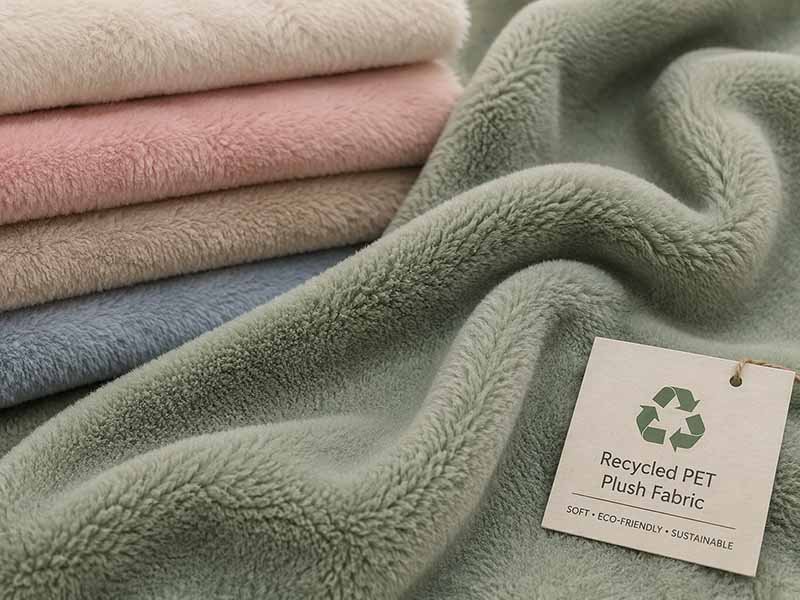
A sustainability claim can be printed on a hang tag, but hand feel is judged in seconds. The moment someone picks up a plush toy, the surface tells them whether it feels smooth, dense, fluffy, dry, silky, springy, or unexpectedly firm. That makes the move from virgin polyester to recycled polyester more complicated than simply changing a fiber specification. Product teams often want the environmental benefit of RPET while worrying that the finished toy may feel rougher, flatter, or less refined than the version customers already know. The concern is reasonable, but it is often framed too narrowly. Recycled content is only one part of a textile system that also includes fiber fineness, yarn structure, pile height, pile density, fabric weight, backing, stretch, finishing, stuffing, and the pressure created by the finished shape.
Recycled fabric does not automatically make a plush toy less soft. A well-developed RPET plush can feel smooth, dense, fluffy, and resilient when pile structure, GSM, backing, finishing, stuffing, and pattern tension are correctly matched. The most reliable comparison is between equivalent fabric constructions tested as finished plush samples, not between recycled and virgin swatches chosen only by fiber origin.
The difference becomes obvious during sampling. A beautifully soft fabric can feel tighter after it is stretched around a firmly filled head, while a modest-looking swatch can become surprisingly rich once the right pile, brushing, stuffing weight, and grooming are combined. That is also why recycled material should not be approved by certification documents or a flat swatch alone. The better question is whether the complete plush product still delivers the tactile experience, visual accuracy, durability, and repeatability the brand expects. The sections below follow that question from first touch through material selection, comparison testing, sample approval, bulk production, and packed recovery.
What Does Plush Hand Feel Mean?

Plush hand feel is the combined tactile experience created by the fabric surface, pile structure, backing, stretch, filling, and finished shape. It is broader than softness alone. A plush can feel smooth but flat, fluffy but coarse, or soft on the surface yet too firm when squeezed. For product development, hand feel should be treated as a controlled performance characteristic rather than a vague description.
Softness Is a System
When people describe a plush as “soft,” they are usually combining several sensations without separating them. The fingertips first notice the exposed pile: whether it feels fine, smooth, dry, silky, fuzzy, or furry. A moment later, the hand notices density and loft. When the product is squeezed, the perception shifts again to filling resistance, body support, rebound, and shape recovery. Two fabrics can therefore both be called soft while creating very different finished products. Minky is commonly selected when a smooth and gentle touch is important, while faux fur is better suited to a deeper, more realistic coat effect. Short plush often sits between those goals because it can retain a soft surface while preserving cleaner facial and embroidery definition.
A useful development review separates the experience into surface softness, smoothness, pile fullness, flexibility, squeeze resistance, rebound, and perceived density. This makes comments such as “the body feels too firm,” “the face feels flat,” or “the pile is soft but sparse” much more useful than asking for a softer toy. It also prevents the team from solving the wrong problem. A fabric can be perfectly suitable while the stuffing is too dense, or the stuffing can be correct while the backing stretches enough to open the pile on curved areas. Once those sensations are separated, hand feel becomes something a development team can discuss, compare, and reproduce with far less ambiguity.
Surface Feel and Squeeze Feel
Surface feel comes mainly from the outer textile, while squeeze feel is heavily influenced by what happens underneath it. This is why a swatch can feel excellent on a table but produce a disappointing finished plush. Once the fabric is cut, sewn, embroidered, turned, and filled, the backing is placed under tension and the pile is forced to follow three-dimensional curves. A tightly filled 20 cm character can therefore feel noticeably firmer than a 30 cm pillow-style plush made from the same material. The material has not necessarily changed; the geometry, internal volume, seam placement, filling amount, and distribution have changed the way the hand experiences it.
For practical approval, tactile review should distinguish at least four checkpoints: first-touch softness, surface fullness, whole-body squeeze, and recovery after pressure. These do not need to be converted into a laboratory claim to be useful. A product team can simply agree that the approved sample should feel soft on first contact, retain medium body support, avoid visible backing at normal stuffing tension, and recover quickly after being squeezed. Those descriptions are much more repeatable than a single word such as premium. They also make it easier for the sample room and production team to understand which part of the experience must remain unchanged when an RPET alternative is introduced.
Filling Changes the Final Feel
Stuffing can improve or destroy the hand feel of an otherwise good fabric. Too little filling may make the body collapse, leave the head unsupported, or create an empty sensation that makes the product feel inexpensive. Too much filling can make the plush hard to squeeze, stretch the surface, expose more backing between pile fibers, and reduce the relaxed drape that attracted the team to the material in the first place. The key variables are filling weight, filling density, distribution, softness level, and the amount of structural support required in individual zones such as the head, body, ears, limbs, or base.
A character may need firmer support around the face to preserve expression, medium support in the body, and lighter filling in ears or a tail. Trying to achieve identical firmness everywhere can make the toy feel unnatural. This becomes especially important when a sustainability project changes both the outer fabric and the filling. Recycled filling is a separate decision from RPET outer fabric, and changing both at once can make diagnosis difficult. If the new sample feels different, the team needs to know whether the change came from the textile surface, the internal fiberfill, the pattern volume, or the interaction between them. Controlled sampling keeps those variables visible instead of blaming recycled content for every tactile difference.
Is Recycled Plush Less Soft?

Recycled plush is not automatically less soft than virgin-polyester plush. RPET describes the recycled origin of the polyester, but it does not define pile height, density, GSM, backing, stretch, or surface finishing. A well-matched RPET fabric can deliver the softness required for a commercial plush program, while a poorly specified conventional fabric can still feel thin, stiff, dry, or coarse.
Recycled Content Is Not a Texture
One of the most common sourcing mistakes is to treat “recycled polyester” as if it were a single fabric type. It is not. Recycled polyester can be engineered into short plush, minky-like surfaces, fleece, sherpa-like textures, or longer-pile constructions, and each one creates a different hand feel. The same logic already applies to virgin polyester. Velboa, minky, short plush, fleece, and faux fur may all contain polyester, yet nobody expects them to feel identical. Recycled content should be understood in the same way: it describes material origin, while the fabric construction determines how the consumer experiences the surface.
The commercial question is therefore more useful when phrased as, “Which recycled construction can reproduce the tactile profile required by this SKU?” A character with small embroidered eyes may need an RPET short-pile construction that keeps the face crisp. A soft gift product may benefit from a recycled minky direction. A realistic animal may need longer recycled fur on selected zones. This keeps sustainability connected to product engineering instead of forcing one generic RPET fabric into every application. It also helps prevent the opposite mistake: assuming that a fabric is good simply because it carries a recycled-material story. The right material still has to perform in the actual plush design.
What Actually Changes the Feel
When an RPET sample feels different from an existing virgin-polyester sample, recycled content may be only one of several differences. The real cause can be pile height, pile density, backing rigidity, stretch, fabric thickness, surface finish, or how the material responds to dyeing and brushing. If the original fabric has a dense short pile and the proposed RPET version has a longer but less dense pile, the recycled sample may feel fluffier yet less substantial. That does not demonstrate inferior recycled fiber; it shows that two different constructions were compared.
Pile direction can also change how a fabric feels when brushed. Stretch can make a surface open up around a tightly filled curve. A fabric that looks dense while flat may reveal more backing after stuffing. Shedding can reduce perceived quality even when the initial touch feels soft, and a stiffer backing can make a smooth pile feel less luxurious once it is sewn into a small shape. This is why experienced development teams record several material parameters instead of approving by touch alone. The more precisely the difference is described, the easier it becomes to improve the RPET option without abandoning the sustainability objective.
Compare Construction Before Fiber Origin
A meaningful comparison holds as many variables constant as reasonably possible. If a brand wants to know whether changing to RPET affects hand feel, it should compare fabrics that are attempting to perform the same job rather than placing two random swatches side by side. At minimum, the team should review composition, GSM, pile height, pile density or coverage, stretch, backing, pile direction, surface finish, color, and intended product zone. The same pattern, embroidery file, filling material, and target filling level should then be used where technically appropriate.
This approach often reveals that the real question is not “recycled versus virgin” but “which specification gives us the feel we need?” If the first RPET option feels too dry, another RPET construction may solve the issue. If the recycled sample has excellent softness but loses shape after packing, the problem is recovery rather than first-touch comfort. Conversely, a recycled option should not be approved only because the environmental story is attractive if it clearly fails on surface density, durability, or product recovery. A strong material decision protects both promises at the same time: the sustainability claim and the physical experience customers expect when they pick up the finished plush.
Which Factors Affect RPET Hand Feel?
RPET hand feel is shaped mainly by GSM, pile height and direction, surface density, stretch behavior, backing construction, finishing, shedding, and compression recovery. These variables interact. A heavier fabric is not automatically softer, and a longer pile is not automatically more premium. The correct combination depends on product size, geometry, filling pressure, embroidery, intended user, packaging, and the tactile experience the product is supposed to deliver.
GSM, Pile, and Density
GSM, or grams per square meter, records fabric weight. It is useful because it gives the manufacturer a repeatable material reference, but it should not be treated as a standalone quality score. A higher GSM can come from more pile, a heavier backing, greater density, or a combination of these. Pile height affects how the surface moves and how clearly the product outline remains visible, while surface density affects whether the fingertips feel a full fiber layer or quickly reach the backing. Those variables can create very different results even when two materials share a similar composition.
Product scale changes the decision as well. A small keychain plush may need controlled short pile because long fibers can swallow a mouth line or distort the apparent size of embroidered eyes. A 30-50 cm animal has more physical space for a longer surface and may benefit from greater coat depth. The correct specification is therefore the one that supports the finished design, not simply the highest GSM or longest pile available. When teams review RPET options this way, they can discuss the trade-off between softness, visual clarity, seam behavior, stuffing pressure, and material cost rather than chasing one number that cannot describe the complete hand feel.
| Parameter | Useful Specification | Main Hand-Feel Effect | Common Development Risk |
|---|---|---|---|
| GSM | Record in g/m² | Thickness, substance, drape, cost | Assuming heavier always means softer |
| Pile height | Record in mm or approved fabric code | Fluffiness, softness, visual depth | Long pile hiding facial or seam detail |
| Surface density | Physical swatch / coverage check | Fullness and backing coverage | Sparse pile feeling thin after stuffing |
| Pile direction | Nap direction on pattern | Brush feel and light/dark appearance | Adjacent panels looking inconsistent |
| Stretch | Direction + controlled comparison | Surface tension after stuffing | Pile opening on tight curves |
| Compression recovery | Packed/unpacked sample check | Post-shipping loft and feel | Flat surface after transport |
Stretch and Backing
Plush fabric is rarely experienced in a relaxed flat state. It is cut into curved panels, sewn, turned, embroidered, and placed under pressure from filling. That makes backing behavior and stretch especially important. If the backing stretches too much, stuffing can enlarge the product beyond the intended proportions and spread the pile enough to make the surface look thinner. If the backing is too rigid, small curves may feel board-like and the product can lose the relaxed squeeze expected from a soft toy. Two fabrics can therefore have similar top surfaces yet behave very differently once wrapped around the same head or body pattern.
Stretch also affects character accuracy. An RPET fabric that expands more than the original material can widen the face, change eye spacing, soften cheek definition, or alter the way embroidery sits on the surface. That is not merely a visual problem; the tighter or looser tension changes the tactile experience as well. Experienced sample teams therefore bend, stretch, and sew candidate materials rather than relying on supplier photographs. For a direct material conversion, the most useful test is to put the new fabric into the same critical pattern zones and compare the finished geometry, backing coverage, surface tension, and squeeze against the approved reference.
Finishing and Recovery
The final surface is strongly influenced by finishing and post-sewing handling. Brushing can open compressed fibers and improve loft, grooming can release pile caught inside seams, and trimming can uncover eyes, mouths, or other detail zones. These operations may appear minor on a production sheet, but they often decide whether the product feels carefully finished or merely assembled. A recycled material that seems ordinary in an unfinished state can become much more attractive after the correct surface treatment, while an excellent fabric can look flat if the pile is trapped or poorly groomed after sewing.
Recovery matters because the consumer usually touches the product after packaging and transport, not immediately after the final grooming station. Plush may remain in polybags, retail cartons, master cartons, or compressed logistics conditions for an extended period. A fabric with weak recovery can arrive with flattened pile even though it looked excellent at the factory. Higher-value programs should therefore review the same prototype freshly groomed, packed, and recovered after unpacking. The goal is not to invent a universal recovery time; it is to confirm that the chosen fabric and filling return to an acceptable shape under the actual packing method planned for the order.
Which Recycled Plush Fabric Feels Best?

No recycled plush fabric is universally the softest or best. The right material depends on what the product needs to communicate through touch and appearance. Recycled minky can suit smooth, gentle products; short RPET plush can balance softness with precise character details; and recycled faux-fur directions can create richer animal textures. Material choice should follow product function, scale, embroidery, stuffing, and retail positioning rather than one generic softness claim.
Minky and Short Plush
Minky is a natural direction when the brief calls for smoothness, gentle touch, and an immediately soft surface. It is frequently considered for baby-oriented plush, comfort products, plush pillows, and higher-softness gift items. Short plush solves a different problem. It can still feel soft, but the shorter surface gives the pattern maker and embroidery team more control over seams, facial details, color blocks, and small curves. For character-based products, that precision can be more important than adding maximum fluffiness across every panel.
This becomes particularly visible at smaller sizes. When a 10-15 cm plush or keychain has only a limited area for the entire face, long pile can visually swallow a mouth or change the apparent shape of the eyes. A shorter construction leaves more of the engineered design visible. Brands moving an existing character to RPET often benefit from testing at least one recycled minky direction and one recycled short-pile direction on the actual face and body. One material may win on first-touch softness, while the other preserves character identity, embroidery clarity, and surface coverage more consistently after stuffing.
Faux Fur and Long Pile
Faux fur and longer-pile plush are better suited to projects where coat depth, movement, and realism are part of the product value. Pet-inspired products, zoo animals, wildlife collections, manes, tails, and fantasy creatures often need a surface that behaves more like fur than a smooth toy textile. A recycled faux-fur direction can create a rich tactile result, but longer pile adds engineering variables that short plush does not. Nap direction must follow the intended coat direction, fibers trapped in seams may need brushing out, and facial zones may require trimming or shorter material so the expression remains visible.
Packaging also becomes more important. Long fibers can lie flat after carton pressure, and the product may need grooming after unpacking before it looks like the approved sample. This does not make faux fur unsuitable; it means premium feel is created by the whole process. A beautiful long-pile fabric that hides the muzzle, mats under normal handling, or fails to recover after shipping can create a weaker customer impression than a slightly shorter pile that remains full and defined. For realistic products, the best recycled fur is therefore the one that balances tactile richness, visual accuracy, seam control, shedding performance, and recovery rather than simply the longest or heaviest option.
Match Fabric to the Product Zone
Complex plush products do not always need one fabric everywhere. In fact, forcing one material across every zone can reduce both visual accuracy and tactile quality. A character may use short RPET plush around the face for clean embroidery, a softer minky-type construction across the body for touch, and a longer recycled fur on hair, ears, a mane, or a tail. This lets each material solve a specific problem rather than asking one textile to provide perfect detail, maximum softness, structural stability, and realistic texture at the same time.
The same logic applies when cost and manufacturability matter. A premium material can be concentrated in the zones customers touch most, while a more stable surface can support embroidered or highly curved areas. That kind of zoned material plan should still look intentional, with controlled color matching, pile direction, seam transitions, and compatible thicknesses. For sourcing teams, the specification becomes much more useful when it says “RPET short plush for the face and recycled minky for the body” instead of “use eco-friendly plush fabric.” The first instruction describes a product; the second only describes an environmental preference.
How Should You Compare Recycled and Virgin Fabric?

Compare recycled and virgin fabrics under matched conditions. Keep the product pattern, filling material, filling target, embroidery, size, and intended pile construction as similar as possible. Then evaluate surface softness, fullness, stretch, detail clarity, squeeze feel, and recovery. If several variables change at once, the test cannot reliably show whether recycled content caused the difference or whether another construction variable changed the finished feel.
Hold the Variables Constant
A good comparison starts by reducing noise. If the current product uses one virgin-polyester construction and the proposed RPET version changes GSM, pile length, stretch, filling, and pattern at the same time, the final samples may feel very different but the team will not know what caused the change. A cleaner trial keeps the approved pattern, dimensions, embroidery files, filling type, filling target, and packaging method stable where technically possible. Only the material is changed first. If the RPET version then needs engineering adjustment, those changes can be introduced one at a time and judged against the same reference.
The material record should include at least composition, GSM, pile characteristics, stretch behavior, color reference, surface direction, and the specific product zone where the fabric will be used. This does not mean the recycled option must copy the original fabric perfectly. Sometimes the best RPET solution uses a slightly different construction to reach the same finished experience. The point is to understand the difference rather than changing multiple variables blindly. That allows a team to make a commercial decision based on evidence: direct replacement, engineered RPET alternative, mixed-material solution, or retention of the existing material until a better recycled option is validated.
Use a Structured Hand Test
Touch is subjective, but the review process does not have to be vague. One practical method is to let several team members handle the samples and score the same set of properties without first telling them which sample contains recycled polyester. A blind comparison can reveal whether the perceived difference is obvious or whether expectations are influencing the judgment. The score itself should never be presented as a universal industry test; its value is internal consistency. If every reviewer evaluates the same properties, comments become easier to compare and the development team receives more actionable feedback.
| Review Item | 1 | 3 | 5 | What the Team Should Record |
|---|---|---|---|---|
| Surface softness | Coarse / dry | Acceptable | Very soft | Immediate first-touch response |
| Smoothness | High drag | Moderate | Very smooth | Hand brushed with and against pile |
| Surface fullness | Sparse | Balanced | Dense / full | Backing visibility under normal tension |
| Squeeze feel | Too hard or empty | Balanced | Target comfort | Whole-product resistance and support |
| Recovery | Weak | Acceptable | Strong | Return after pressure or packing |
| Detail clarity | Blurred | Acceptable | Crisp | Eyes, mouth, seams, logos |
| Overall match | Poor | Close | Approved | Comparison with current reference |
The useful information is often found in the difference between scores. “Sample B is not premium enough” is weak feedback. “Sample B has excellent surface softness but lower fullness, more backing visibility on the cheeks, and slower recovery after packing” tells the engineering team what to investigate. The issue may be pile density, backing stretch, stuffing pressure, or finishing rather than recycled content itself. Structured language prevents good materials from being rejected for the wrong reason and helps the team improve the next prototype without starting the entire material search again.
Test the Finished Product
A flat swatch is useful for shortlisting materials, but it should not be the final approval for a new plush construction. The product experiences cutting, embroidery, sewing, turning, filling, shaping, grooming, and packaging before anyone buys it. Each process changes the way the material behaves. Dense embroidery can compress the pile around an eye or logo, tight curved seams can alter nap direction, stuffing can open the backing, and longer fibers can become trapped at seams. Compression packaging can then change the surface again after the sample leaves the factory.
A robust comparison therefore uses at least three physical states: flat material, finished prototype, and packed/recovered prototype. The finished sample should be handled in the same places where a customer naturally touches it, including the face, body, arms, ears, or belly. The packed sample should use the planned retail or shipping method rather than an artificial test that has little connection to the real order. If the fabric passes all three stages, the team has much stronger evidence that the tactile result will survive production and logistics. If it fails, the failure point also becomes clearer, which makes revision faster and more precise.
How Do You Keep Hand Feel Consistent?
Consistent plush hand feel depends on controlling both the outer fabric and the internal construction. The production reference should lock the approved material, GSM record, color lot, filling type and weight, pattern, embroidery, packaging, and approved physical sample. In-line checks then look for drift before it becomes a full-order problem. Consistency is created through repeatable records and physical references, not memory or informal instructions.
Use the Golden Sample and Records
The approved sample should function as a manufacturing standard, not as a display piece that disappears after sign-off. It captures details that technical data alone cannot fully communicate: facial volume, squeeze resistance, surface fullness, ear support, and overall tactile balance. For repeatable production, that physical reference should be linked to the material record, pattern version, embroidery file, filling target, color reference, and packaging specification. If the order returns months later, the factory can compare the new production against a real approved object rather than trying to reconstruct the feel from an old email saying “make it like last time.”
Delsney’s engineering framework uses a detailed Golden Sample record that can include 25-60 measurement points depending on product complexity, along with embroidery DST files, fabric GSM records, fabric color records, seam-density guidance, accessory installation notes, multi-angle photography, assembly instructions, packaging references, and an approved-sample archive. Those records do not replace touch, but they stabilize the construction that creates it. A fabric GSM record reduces the risk of an unnoticed material substitution, while a filling-weight reference helps keep the body from becoming firmer or softer between runs. Together, the documents turn a subjective product experience into a more repeatable production standard.
Control Filling During Production
Filling is one of the most common sources of tactile variation because even the correct fabric can feel different when stuffing amount or distribution changes. Control should address both quantity and location. Total filling weight answers “how much,” but distribution answers “where.” A plush head may need enough support to protect the face while the body remains more squeezable. Long ears may need very little filling, while a seated animal may require more support around the base. One total weight does not describe those differences, so the approved sample remains essential for confirming how the weight should be distributed.
Experienced operators can feel variation quickly, but bulk production should not rely only on operator intuition. A filling-weight reference, in-line comparison, and periodic checks against the approved sample make the result more repeatable. This is particularly important for multi-SKU collections, where each character may have a different silhouette but the range should still feel as though it belongs to one product family. The control target is not mathematical sameness; it is a commercially consistent experience. Small natural production variation may exist, but the consumer should not pick up two pieces from the same SKU and find one soft and relaxed while the other feels noticeably overfilled and rigid.
| Production Stage | Key Hand-Feel Controls | Useful Reference | Typical Risk if Uncontrolled |
|---|---|---|---|
| Incoming fabric | GSM, pile, surface, stretch, color lot | Approved fabric / material record | Similar-looking fabric feels or behaves differently |
| Cutting and sewing | Pile direction, seam tension, panel accuracy | Pattern + nap direction | Uneven surface or distorted shape |
| Filling | Weight, distribution, softness, support | Approved sample + filling reference | Firmness varies piece to piece |
| Final grooming | Pile release, trimming, surface fullness | Approved appearance sample | Seams trap fibers or details disappear |
| Packing | Compression level and recovery | Packaging specification | Plush arrives flat or misshapen |
| Repeat order | Same approved fabric and construction records | Golden Sample archive | Silent material or firmness drift |
Check Packing and Repeat Orders
Hand feel can drift after the sewing line is finished. Packing pressure, carton loading, warehouse storage, and long-distance transportation can flatten pile or shift filling, particularly in large or long-pile products. Before finalizing packaging, a representative sample should be packed in the same configuration intended for shipment. Once unpacked, the team can review whether the product returns to its approved shape and whether the pile needs only normal grooming rather than major reshaping. This connects the factory-floor standard to the actual condition a retailer or end customer will see.
Repeat orders create a different risk: silent substitution or gradual specification drift. A fabric may share the same commercial name and color while differing in GSM, pile, stretch, backing, or finishing. A new color lot can also change the appearance of directional pile. Keeping the approved material record and physical sample reduces this risk. Delsney supports a fabric library of more than 600 plush material options, which is useful for development but also makes exact material identification important. The larger the material choice, the more necessary it becomes to record which specific construction was approved rather than relying on a generic description such as “soft recycled plush.”
How Do You Choose RPET Without Losing Softness?
Choose RPET by defining the required finished hand feel first, then matching a recycled fabric construction to that target. Review physical swatches, build the actual plush prototype, adjust stuffing or pattern where needed, test packed recovery, and lock the final material against an approved sample. Sustainability should become another controlled product specification, not a reason to accept weaker tactile performance or inconsistent bulk production.
Start With the Target Feel
A useful material brief describes the experience the product needs rather than merely requesting an environmental attribute. “Use recycled polyester” is a sourcing direction. “Smooth short pile, soft first touch, medium body support, clean facial embroidery, low visible backing after stuffing, and good recovery after packing” is a product-development brief. The manufacturer should also know the product type, size, quantity, intended market, age group, filling preference, embroidery or printing needs, accessories, packaging method, and delivery timing because each one can influence material choice and the way the finished surface behaves.
The target can also vary within one product. A baby-oriented plush may prioritize a gentle surface, controlled shedding, embroidered facial details, and easy handling, while a collector mascot may place more weight on character accuracy, costume detail, visual richness, and presentation. A realistic animal may need different pile lengths on the face and body. Defining those priorities before fabric selection prevents the sustainability requirement from taking over the entire development brief. It also allows the manufacturer to narrow a large material library to a few realistic candidates instead of presenting dozens of swatches that share a recycled claim but solve different tactile problems.
Approve Material, Then Approve the Plush
Fabric approval and product approval should be treated as two related but different decisions. First, shortlist physical RPET options based on surface feel, pile, stretch, thickness, color, backing, and intended use. Then put the strongest option into the actual sample. Only after sewing, embroidery, filling, shaping, grooming, and packaging can the team judge whether the material truly delivers the desired result. For complex projects, comparing two or three serious candidates is often more efficient than reviewing dozens of near-identical swatches because it keeps the decision focused on clearly different constructions.
Material documentation should also be checked separately from hand feel. Recycled-content proof supports the sustainability claim; it does not prove that the product will feel soft or recover well after shipping. Likewise, a soft sample does not prove the recycled-content percentage or chain of custody behind the material. Commercial approval therefore needs two parallel answers: “Does this material meet the project’s recycled-content requirement?” and “Does the finished plush meet the approved tactile and visual standard?” Keeping those questions separate prevents a certification document from becoming a substitute for product development and prevents a good sample from being used as evidence for a material claim it cannot verify.
Change the Fabric Only When It Is the Problem
When a sample does not feel right, replacing the fabric should not automatically be the first response. First determine whether the problem comes from the outer material, stuffing, pattern volume, embroidery, seam tension, or packaging. If the body feels too hard but the surface is correct, reducing or redistributing filling may solve the problem. If the face loses definition, switching only the face to a shorter pile can work better than changing the entire toy. If the surface looks sparse because the backing is stretched over a tight curve, pattern or stuffing adjustment may fix the issue without restarting the material search.
A fabric change becomes more reasonable when the material itself repeatedly fails the target: insufficient surface softness, unsuitable pile length, excessive shedding, poor compression recovery, weak visual quality, or incompatibility with the product’s intended positioning. The reason for the change should be written down because every material replacement can affect color matching, fabric consumption, cutting, seam bulk, embroidery behavior, sample timing, cost, and future availability. Experienced plush development is often less about making more changes and more about isolating the failing variable accurately. That discipline saves time, preserves useful work from earlier samples, and makes it much easier to judge whether the final RPET solution is genuinely better.
Turn the Approved Feel Into a Bulk Standard
Once the RPET version is approved, the tactile target needs to be translated into production references so the order does not drift away from the sample. That usually means locking the fabric code or supplier reference, GSM record, color lot, pile direction, filling material, filling-weight reference, critical construction notes, packaging method, and physical approved sample. Photographs can record areas that require grooming or trimming, while sample notes can identify zones that should remain softer or receive more structural support. The objective is to make the approved hand feel understandable to people who were not present during every development discussion.
Delsney’s development process is built around project review, feasibility evaluation, sampling, revision, sample approval, material preparation, production, quality inspection, and shipment. For a recycled-material conversion, that sequence allows an existing product, artwork, or reference sample to be compared against realistic RPET options before the full order is committed. The strongest outcome is not a toy that advertises recycled content at the expense of touch. It is a product that still looks right, feels right, survives packing, and can be reproduced consistently while giving the brand a more sustainable material direction.
Recycled polyester changes the sourcing conversation, but it does not rewrite the basic rules of good plush development. Consumers still judge the finished product by what their hands and eyes tell them: softness, fullness, shape, detail, recovery, and overall quality. The most reliable way to protect those qualities is to compare equivalent constructions, test the real stuffed sample, separate fabric issues from filling or pattern issues, and preserve the approved result through material records and a physical production reference. When that process is followed, sustainability does not need to feel like a compromise. The recycled content becomes one controlled part of a product that was engineered to deliver the tactile experience the brand intended from the beginning.
Frequently Asked Questions
Is recycled polyester plush as soft as virgin polyester?
It can be. Recycled polyester does not have one fixed hand feel, just as virgin polyester does not. Softness depends on how the fiber is turned into yarn and fabric, the pile height and density, the backing, finishing, stretch behavior, and the way the finished plush is stuffed. The fairest comparison uses similar fabric constructions in the same product pattern. If an RPET option has comparable surface coverage, finishing, and recovery, many consumers may notice little or no meaningful loss of softness in the finished plush.
Does RPET plush feel rougher than regular polyester?
Not necessarily. Some recycled fabrics can feel drier or firmer than a specific virgin-polyester reference, but that difference should not automatically be attributed to recycled content. A coarser pile, lower surface density, stiffer backing, different finish, or stronger stuffing pressure can all change the result. When an RPET sample feels rougher, compare the construction details first. Testing another recycled fabric with a finer pile, denser surface, or more suitable finish may solve the problem without abandoning the recycled-material goal.
What is the softest recycled fabric for plush toys?
There is no single recycled fabric that is always the softest because commercial names cover many constructions. Recycled minky-type fabrics are often considered when smooth, gentle touch is the priority, while short RPET plush can provide a good balance between softness and clear facial detail. Recycled faux fur can feel very rich when a deeper coat is desired. The best choice depends on product size, embroidery, pile direction, stuffing pressure, intended user, and packaging. A physical finished sample is more reliable than choosing only from a fabric name.
Does higher GSM make a recycled plush fabric softer?
Higher GSM can make a fabric feel more substantial, but it does not automatically make it softer. GSM records the weight of one square meter of fabric, and that weight can come from the pile, the backing, greater density, or several factors together. A lighter fabric with fine fibers and good finishing may feel smoother than a heavier fabric with a stiff backing. GSM is therefore useful for specification control, but it should be reviewed together with pile height, surface density, stretch, backing, and finishing.
How should plush hand feel be tested before bulk production?
Begin with physical swatches, then test the selected fabric in the actual product. Compare first-touch softness, smoothness, surface fullness, backing visibility, squeeze feel, detail clarity, and recovery after pressure. The sample should also be reviewed after the planned packaging method because compression can temporarily change both pile and body shape. Once the tactile result is approved, keep a physical reference sample and record the fabric, filling, pattern, and packaging specifications so the production team has a clear standard for the bulk order.
Can recycled filling change the softness of a plush toy?
Yes. The outer RPET fabric and the internal filling influence different parts of the experience. A soft surface can still produce a firm toy if the filling is dense, overpacked, or unevenly distributed. Recycled filling can also have different loft or recovery characteristics depending on its specification, so it should be sampled rather than assumed to behave exactly like the previous fill. When both the outer fabric and filling are being changed for sustainability reasons, testing them in separate steps makes it easier to identify the source of any tactile difference.