Skip to content
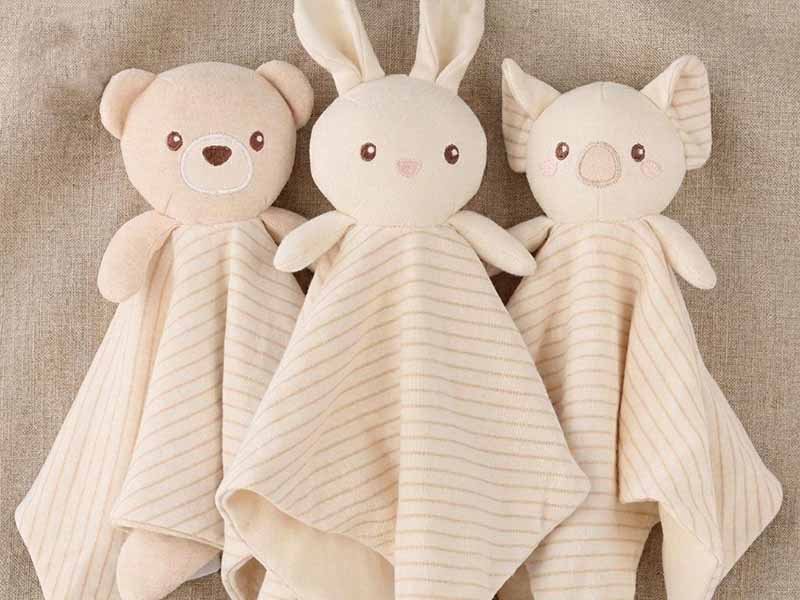
Organic cotton sounds like an easy material decision: choose a natural fibre, add a sustainability message, and develop a softer-looking plush collection. In practice, the decision is much more technical. A fabric can contain certified organic cotton yet still be unsuitable for a stuffed animal because it stretches unpredictably, shrinks after washing, hides embroidery, releases surface fibres, or loses shape once filled. The fibre claim and the finished product performance must therefore be evaluated separately.
Organic cotton fabric can work well for baby plush, comfort toys, soft dolls, decorative animals, pillows, and sustainability-led collections when fabric construction, weight, stretch, shrinkage, colour performance, certification documents, sewing method, filling pressure, and target-market safety requirements are controlled as one production system.
The more useful question is not simply, ‘Is the cotton organic?’ It is, ‘Can this certified fabric become a consistent, washable, compliant, and commercially scalable plush product?’ One development team once approved a beautiful cotton velour by touching a small swatch. After the first stuffed prototype was washed, the body shortened, the face widened, and the embroidered eyes no longer appeared level. The textile had not failed. The development process had failed to study how the textile behaved as a three-dimensional toy. The following sections show how to avoid that expensive distinction.
What Is Organic Cotton Fabric?

Organic cotton fabric is made from cotton grown under recognised organic farming requirements and processed through a traceable textile supply chain. For plush products, the organic claim alone is not enough. Brands must also examine fibre content, fabric construction, dyeing, finishing, certification scope, shrinkage, stretch, surface durability, sewing performance, and finished-toy safety.
Organic Cotton Is a Verified Material Claim
The word ‘organic’ should describe a verified production system, not simply a natural-looking fabric. Conventional cotton, unbleached cotton, recycled cotton, and organic cotton are different categories. A beige fabric may look natural while containing conventionally grown cotton, chemical finishes, synthetic blends, or undocumented dyes.
For a plush project, buyers should identify exactly what the certification covers. It may apply to raw fibre, yarn, finished fabric, processing facilities, traders, or a defined chain of custody. A supplier scope certificate confirms that an organisation is certified for certain activities, but it does not automatically prove that every shipment supports a specific product claim.
The material file should record the full fibre composition, fabric article number, certified organic percentage, construction, dyeing and finishing route, certificate number, validity period, colour, and lot reference. This becomes especially important when the finished toy also contains polyester filling, synthetic sewing thread, embroidery thread, plastic accessories, printed labels, electronics, or metal parts. A certified cotton shell does not automatically make the entire toy organic.
Fabric Construction Matters More Than the Fibre Name
Organic cotton can be knitted or woven into jersey, interlock, velour, fleece, sherpa-style fabric, canvas, twill, poplin, muslin, and other structures. These materials do not behave the same way during cutting, sewing, filling, washing, or daily use.
A smooth interlock can support clean facial embroidery and stable applique. A lightweight jersey may stretch around curved seams and distort a small character’s expression. Velour provides a short, soft nap, but every panel normally needs to follow one nap direction to avoid visible shade differences. Fleece adds body and warmth, although loose constructions may pill or release surface fibres. Woven cotton holds shape well but can fray and may feel less like a conventional furry plush toy.
An experienced product developer therefore does not approve ‘organic cotton’ as a general category. The exact article must be tested on the intended pattern. A material that works on a 30 cm nursery bear may perform poorly on an 8 cm keychain with narrow limbs, tight curves, and dense embroidery.
Organic Does Not Automatically Mean Safer
Organic farming and textile certification can reduce uncertainty about fibre origin and certain processing controls, but they do not replace finished-product safety evaluation. Toy safety also depends on seams, small components, cords, accessible filling, prints, coatings, flammability, labelling, age grading, and mechanical strength.
A responsible product team separates three questions: Is the cotton genuinely organic and traceable? Is the fabric chemically and physically suitable for the intended use? Does the completed toy meet the applicable requirements of its destination market? These questions require different evidence. A material certificate cannot prove that an eye attachment is secure, while a finished-toy test report cannot prove that the cotton was organically grown.
For baby and toddler products, the review should also consider surface fibre release, realistic cleaning behaviour, drying time, embroidered facial details, seam access, filling migration, and the removal of unnecessary hard components.
Why Brands Choose It
Organic cotton is often selected for nursery collections, baby plush, comfort toys, soft dolls, educational products, gift sets, and sustainability-focused ranges. Its matte surface, natural hand, and restrained colour character can create a warmer visual identity than glossy synthetic plush.
The material is most effective when the complete product story is consistent. A certified cotton shell paired with soft colours, accurate fibre labelling, appropriate filling, durable construction, restrained packaging, and honest care instructions gives retailers and consumers a coherent reason to trust the product.
Organic cotton is less convincing when it is used only as a marketing badge. If the fabric shrinks badly, cannot be replenished, hides the design, or lacks shipment-level documentation, the claim will not rescue the project. The strongest result combines verified sourcing with practical engineering so the material not only sounds responsible on a hangtag but also cuts cleanly, holds shape, survives handling, and remains reproducible.
Which Fabrics Work Best for Plush Products?

Organic cotton velour, interlock, fleece, jersey, sherpa-style fabric, and selected woven cottons can all work for plush products. The right choice depends on product size, surface texture, stretch, washability, embroidery, filling pressure, age group, and visual style. No single organic cotton construction is ideal for every plush design.
Velour and Interlock
Organic cotton velour is one of the closest natural-fibre options to a traditional short-pile plush surface. It has a soft face, compact appearance, and enough texture to make animals and dolls feel warm without hiding every small detail. It is often suitable for baby animals, comfort toys, soft character dolls, nursery collections, and premium gift plush.
The main production risk is nap direction. Two panels cut in opposite directions can appear to be different colours even when they come from the same roll. Pattern markers should therefore show a single cutting direction. Dense embroidery also needs stabilisation because it can flatten the surface, pull the knit, and alter facial proportions.
Interlock is smoother and normally more stable than single jersey. It does not create a furry effect, but it works well for cloth dolls, printed characters, flat comforters, applique details, inner ears, and products requiring clean lines. It is usually easier to print and embroider than raised-pile fabric, making it a practical choice for detailed faces and graphics.
Fleece and Sherpa
Cotton fleece creates more body than jersey or interlock. Depending on the construction, the brushed or looped surface may appear on one or both sides. It can be suitable for larger animals, pillows, simple dolls, home accessories, and winter gift collections.
Sherpa-style cotton fabric gives a deeper, curlier texture that suits bears, sheep, clouds, rounded pillows, and simple characters. The name must be checked carefully because some fabrics use cotton on the face with a synthetic backing, while others are cotton-rich blends rather than 100% cotton.
Deep texture creates practical limits. Small seams are harder to locate, narrow limbs are difficult to turn, embroidery can sink into the surface, facial details may disappear, and thick seam intersections become bulky. Surface shedding and pilling should be evaluated before approval. Sherpa is generally more suitable for medium and large products than for miniature keychains or highly detailed licensed characters.
Jersey and Woven Cotton
Jersey is soft, flexible, and useful for dolls, printed faces, character clothing, flat comforters, and lightly stuffed shapes. It follows curves easily, but it can also grow, twist, curl, or reveal seam allowances. Pale lightweight jersey may show filling through the shell, particularly around highly stuffed heads and narrow limbs.
Woven cotton behaves differently. Poplin, twill, canvas, and muslin offer lower stretch and more predictable cutting. They work well for structured cloth dolls, printed educational products, decorative patches, clothing, hats, bags, and mixed-material designs. A woven shell can produce crisp geometry, but tight curves may require more seams, clipping, darts, or gussets.
Neither knit nor woven is automatically superior. The pattern engineer must consider grain, fraying, stretch recovery, turning radius, seam bulk, filling pressure, and how the finished toy will be cleaned.
| Fabric type | Common development weight* | Surface | Stretch tendency | Suitable products | Main concern |
|---|---|---|---|---|---|
| Cotton jersey | 140-220 GSM | Smooth knit | Medium to high | Dolls, clothing, printed panels | Curling and distortion |
| Cotton interlock | 180-280 GSM | Smooth, compact | Low to medium | Baby plush, comforters, applique | Limited furry effect |
| Cotton velour | 220-350 GSM | Short soft nap | Medium | Animals, dolls, nursery plush | Nap direction |
| Cotton fleece | 240-400 GSM | Brushed or looped | Medium | Pillows, animals, simple shapes | Pilling and bulk |
| Cotton sherpa | 280-450 GSM | Deep curly texture | Low to medium | Bears, sheep, large plush | Shedding and hidden detail |
| Woven cotton | 120-320 GSM | Flat woven surface | Low | Cloth dolls, accessories, panels | Fraying and stiffness |
Matching Fabric to Product Scale
Product size changes how a material looks and performs. A 5 mm surface texture may appear subtle on a 40 cm bear but overwhelm a 10 cm collectible. Heavy fleece can make small ears too thick to turn. Lightweight jersey may work on a flat comforter yet stretch excessively on a fully stuffed round head.
A practical selection process starts with the smallest and most technically difficult part of the design. If the material cannot form the ears, tail, fingers, muzzle, or narrow limbs reliably, it will not become easier during mass production. Faces also deserve separate attention: short pile and stable surfaces support fine eyes, mouths, logos, and applique, while deep pile is better suited to simple expressions and larger embroidered elements.
Multi-material construction is often more effective than forcing one fabric into every component. A product might use velour for the body, interlock for the face, woven cotton for clothing, and a separately specified filling. Every component and claim should remain clearly documented.
How Does Organic Cotton Compare?

Organic cotton offers natural-fibre content, a matte appearance, moisture absorption, and a strong traceability story when properly certified. Polyester plush offers wider pile choices, brighter colours, fast drying, and reliable shape recovery. RPET provides similar synthetic performance with recycled-content verification. The best option depends on the product function, care needs, design, and brand promise.
Organic Cotton vs Polyester Plush
Polyester dominates the plush industry because it is versatile. It can be produced as minky, velboa, short plush, faux fur, sherpa, fleece, and long-pile materials in a broad range of colours and textures. It normally dries quickly, recovers well after compression, and performs consistently in rounded or heavily stuffed shapes.
Organic cotton feels different. It often has a warmer, drier, more textile-like touch and a matte rather than glossy surface. That character suits nursery products, natural-looking animals, comfort toys, and understated gift collections.
Softness should not be judged by fibre name alone. A dense polyester minky may feel smoother than a cotton fleece, while a well-made cotton velour may feel softer and more natural than a basic synthetic short plush. Yarn quality, density, brushing, finishing, and filling pressure all influence the final hand. Cotton is usually slower to dry and may recover less strongly after compression, while polyester is more suitable where long pile, vivid colour, rapid drying, or strong shape recovery is essential.
Organic Cotton vs RPET
RPET fabric uses recycled polyester feedstock and is commonly selected when a product needs synthetic-plush performance together with verified recycled content. From a manufacturing standpoint, RPET can behave similarly to conventional polyester and may be available as minky, velboa, short plush, fleece, or faux fur.
Organic cotton and RPET address different sourcing objectives. Organic cotton focuses on certified agricultural origin and natural fibre. RPET focuses on recycled synthetic content and chain-of-custody evidence. Organic cotton supports a nursery and textile-led appearance, while RPET supports broader pile effects, saturated colours, dimensional recovery, and quick drying.
Neither is universally more sustainable in every product. Durability, wash frequency, energy use, packaging, transport, microfibre release, repairability, and useful lifespan also matter. The more credible decision is to choose the material that supports the intended use and then describe the verified claim precisely.
| Decision factor | Organic cotton | Conventional polyester | RPET plush |
|---|---|---|---|
| Material origin | Certified natural fibre | Virgin synthetic fibre | Recycled synthetic feedstock |
| Surface options | Best in jersey, interlock, velour, fleece, sherpa | Very broad, including long pile | Broad, similar to polyester |
| Colour range | Often more limited | Very wide | Wide, supplier dependent |
| Drying speed | Slower | Fast | Fast |
| Shape recovery | Moderate | Strong | Strong |
| Shrinkage sensitivity | Higher | Usually low | Usually low |
| Primary claim | Natural and organic fibre | Performance and versatility | Verified recycled content |
| Best fit | Baby, nursery, natural gift lines | General plush and vivid characters | Sustainability-led synthetic plush |
Baby Products and Comfort Toys
Organic cotton is often chosen for baby-facing products, but it is not automatically the best option in every case. The material must be reviewed together with wash frequency, drying conditions, saliva contact, surface fibre release, colourfastness, seam construction, and filling.
Smooth interlock and short cotton velour are usually easier to control than deep-pile sherpa for very young users. Embroidered features reduce reliance on detachable hard eyes and noses. Seam allowances should stay enclosed, and stuffing openings need secure closure and reinforcement.
Polyester minky may still be more practical when a product requires frequent washing, rapid drying, bright colours, or strong dimensional recovery. A natural-fibre nursery brand may reasonably accept a narrower palette and more careful care instructions in exchange for certified organic content. The decision should follow actual household behaviour: parents rarely treat a comfort toy like a delicate decorative item.
Cost, Availability, and Repeat Orders
Organic cotton plush fabric may cost more because of certified raw fibre, controlled processing, lower production volume, specialised dyeing, documentation, and narrower supplier availability. Custom colours, exclusive constructions, and low material quantities can increase both minimums and lead time.
Continuity can be a greater risk than price. A beautiful stock fabric may be available for sampling but disappear before the repeat order. Buyers should ask whether the article is regularly produced, supported by current certification, available in repeat colours, subject to a mill dye minimum, reservable for the order, and replaceable with an approved backup.
A slightly more expensive standard article may be safer than a discounted end-of-line fabric. For licensed collections, retailer replenishment, and multi-year programmes, repeatability should carry as much weight as initial softness. Total project cost also includes cutting waste, rejected embroidery, shade variation, rework, testing, delays, and returns.
How Does It Perform in Production?
Organic cotton performs reliably in plush manufacturing when stretch, shrinkage, grain, nap direction, embroidery, seam construction, filling pressure, and wash behaviour are controlled before bulk production. The approved prototype must use production-intent materials because a visually attractive fabric swatch cannot predict how the completed three-dimensional toy will behave.
Stretch and Shrinkage
Cotton knits can stretch differently in length, width, and diagonal directions. Plush products rely on matched curved panels, so inconsistent grain direction can make one side of a head grow more than the other. Limbs may twist, ears become uneven, and round bodies turn oval after filling.
Shrinkage should be assessed using the intended care method. Steam testing alone is not enough when the final label permits machine washing. Likewise, a machine-wash programme may be unnecessary for a surface-clean-only product, but the care instruction must be realistic. The development team should measure length and width before and after treatment, check colour and surface change, inspect embroidery movement, and review the shape after drying.
An internal target of roughly 3%-5% dimensional change is common in development discussions, but it is not a universal regulatory limit. A 4% change may be manageable on a flat comforter yet visibly alter a small embroidered face. Patterns should be adjusted after testing rather than enlarged by one blanket percentage.
Cutting, Sewing, and Nap Control
Organic cotton velour and fleece often require one-way cutting. When the nap changes direction, light reflects differently and creates an apparent shade variation. Production markers should show the face side, grain, and nap direction, and paired panels should remain within the same controlled orientation.
Knitted cotton can move under a cutting blade. Excessive layer height may create differences in ears, muzzles, and small facial panels. Stable spreading, relaxed fabric, sharp tools, controlled layer counts, and bundle identification help reduce variation.
Sewing settings should be established during sampling. Needle type, thread, stitch length, presser-foot pressure, differential feed, and seam allowance all depend on the material. Excess thread tension causes puckering; a very strong thread can cut through a delicate knit under force. Stuffing openings, limb attachments, tails, keychain loops, handles, weighted compartments, and accessory seams need special reinforcement based on the design.
Embroidery and Printing
Embroidery changes the behaviour of soft cotton fabric. Dense stitches add stiffness and can compress pile, create wrinkles, or pull a flexible face panel inward. Small changes in eye height, eye spacing, mouth angle, and thread colour can alter an entire character expression, so approval should be completed on the actual production fabric.
A reliable embroidery trial evaluates stabiliser type, underlay, stitch density, frame tension, needle size, thread weight, placement tolerance, surface compression, reverse-side cleanliness, and distortion after the intended cleaning cycle. Large filled areas should be used carefully on soft baby products because they can create hard patches.
Printing works best on smooth interlock, jersey, or woven cotton. Raised pile interrupts fine lines and reduces image sharpness. Printed areas should be checked for rubbing, cracking, colour transfer, wash resistance, and changes in hand feel. The printing chemistry and certification status should also be compatible with the product claim.
| Production item | Practical development check | Common internal reference* |
|---|---|---|
| Fabric weight | Compare each lot with approved specification | Often controlled around +/-5% |
| Finished width | Confirm usable cutting width by roll | Record actual width by roll |
| Dimensional change | Test with the stated care method | Common target: within 3%-5% |
| Colour shade | Compare under agreed lighting | Approve a physical standard |
| Embroidery placement | Measure from fixed pattern points | Often controlled within 1-3 mm |
| Filling weight | Weigh completed product and review firmness | Set by approved sample |
| Seam quality | Check puckering, skipped stitches, and openings | No visible functional defect |
| Product dimensions | Measure defined points after conditioning | Tolerance set by product size |
Filling and Wash Performance
The same organic cotton shell can feel soft or rigid depending on filling pressure. Overfilling stretches the knit, hardens the surface, exposes seam lines, and increases stress at closures. Underfilling creates wrinkles, weak proportions, and uneven filling migration.
The approved sample should therefore include a filling-weight range or a clearly retained firmness reference. Detailed characters may require controlled distribution between the head, body, and limbs rather than one total number. Large pillows may tolerate a wider range, but the target shape must still be defined.
Wash evaluation should use the complete product rather than an empty swatch. Review shape loss, seam opening, filling clumping, pilling, fibre release, colour transfer, embroidery distortion, drying time, label damage, and odour after drying. Cotton absorbs moisture, so dense products need enough drying time. Care instructions that are technically possible but unrealistic for households often lead to poor reviews.
Is Organic Cotton Safe for Plush Toys?

Organic cotton can be suitable for plush toys, including baby products, but organic certification does not prove finished-toy safety. Safety depends on the complete construction, including fabric, dyes, seams, filling, embroidery, accessories, cords, labels, packaging, age grade, and destination-market requirements. Material evidence and finished-product testing answer different questions.
Material Safety and Toy Safety
A fabric can have strong organic traceability and still perform poorly in a toy. It may release fibres, bleed colour, weaken at seams, react badly to washing, or fail to protect the filling. Conversely, a fabric may pass certain chemical tests without carrying an organic claim.
The evidence chain should remain clear. Organic certification supports the fibre-origin claim. Chemical testing evaluates specified substances. Physical fabric testing evaluates performance. Finished-toy testing evaluates the complete design. Production inspection confirms that the manufactured batch matches the approved sample and specification.
A supplier statement saying ‘safe for babies’ is not enough. The intended age group, use, destination market, and complete bill of materials must be defined before a test plan is prepared. For infant products, smooth short-pile fabric is often easier to control than loose long fibres, embroidered features can reduce detachable parts, and filling should remain inaccessible during normal and reasonably foreseeable use.
Certifications and Their Limits
Different certification systems answer different questions. GOTS applies label grades based on certified organic fibre content and includes processing, environmental, social, and chain-of-custody requirements. Under current GOTS label rules, the ‘organic’ grade requires at least 95% certified organic fibres, while ‘made with organic’ covers products with at least 70% and below 95% certified organic fibres.
The Organic Content Standard focuses on verifying the presence and amount of certified organic material and maintaining chain of custody. It does not replace broader chemical, social, or finished-product safety evaluation. OEKO-TEX ORGANIC COTTON offers farm-to-product verification and tests for GMO cotton, pesticides, and other harmful substances under its programme.
The exact scope still matters. A certificate may cover a mill but not the particular fabric article, colour, print, filling, or final toy. A useful compliance file connects the certified organisation, material article, purchase documents, tested sample, and production batch. Collecting unrelated certificates is less valuable than maintaining a clear evidence chain.
Finished-Toy Testing
The required test plan varies by market, age group, and product features. A simple stuffed animal with embroidered details has a different risk profile from a sound toy, weighted plush, battery-powered product, keychain, teether, or toy with hard accessories.
Common evaluation areas can include small parts, seam strength, accessible filling, sharp points and edges, cords and loops, flammability, restricted substances, coatings, sound level, battery access, weighted filling containment, labels, and warnings. In the United States, toys intended primarily for children 12 and under generally require third-party testing for applicable children’s product safety rules and certification in a Children’s Product Certificate. CPSC guidance also identifies ASTM F963 provisions that commonly apply to stuffed and beanbag-type toys and other specific features.
The laboratory sample should match the intended bulk product. Changing the shell, filling, thread, accessory, print, or construction after testing can reduce the relevance of the report. A manufacturer can support design review and test preparation, but no responsible supplier should promise that every design will automatically pass every test.
Avoiding Greenwashing
Overstated sustainability claims often begin with imprecise language. Phrases such as ‘100% eco-friendly,’ ‘chemical-free,’ ‘zero impact,’ or ‘fully biodegradable’ are difficult to support for a complete plush toy, especially when it includes synthetic filling, sewing thread, labels, prints, plastic accessories, electronics, or mixed packaging.
A more accurate claim identifies what is verified: the percentage of certified organic cotton, the product component containing it, the certification system, the filling composition, relevant safety testing, packaging specification, care method, and known limitations. A shell made with certified organic cotton does not make an entire toy organic if other components are not covered.
Precise language may sound less dramatic, but it gives retailers, compliance teams, and consumers something they can verify. Marketing, sourcing, manufacturing, and compliance teams should approve the wording together. The product claim should never extend beyond the documents and tested construction supporting it.
How Do Brands Source and Scale Production?
Brands scale organic cotton plush production by approving the actual fabric, verifying certification, testing production-intent samples, documenting colour and performance standards, controlling dye lots, and inspecting each manufacturing stage. A commercially successful sample must be reproducible across hundreds or thousands of units, not merely attractive as a one-off prototype.
Fabric and Sample Approval
Fabric approval should move from swatch to decoration trial, construction trial, full prototype, revised sample, and final production-intent sample. A small swatch reveals colour and initial touch, but it cannot show turning difficulty, embroidery distortion, filling coverage, seam performance, wash response, or the finished silhouette.
A practical sequence is to verify composition and certification, approve hand and colour, test embroidery or printing, build the first full sample, revise the pattern and filling, produce a final sample with intended labels and packaging, complete the planned safety review, and retain one sealed reference for bulk production.
The sealed sample should be technical as well as visual. Record finished dimensions, fabric article and colour, filling weight or firmness, stitch details, embroidery coordinates, label location, packaging, and tolerances. Replacing a fabric after approval because it ‘looks similar’ can change stretch, shrinkage, shade, certification, and test relevance.
Supplier Documents
Documentation should be requested during sourcing rather than after bulk production. Depending on the claim and market, the package may include a fabric specification, full composition, scope certificate, transaction certificate or shipment evidence, test reports, lab-dip approval, dye-lot records, restricted-substance declarations, care instructions, finished-toy reports, labels, traceability codes, and inspection records.
Names, article numbers, colours, quantities, and dates should match across the documents. A certificate belonging to a different company or a report for another fabric does not support the current product. Expired certificates, altered PDFs, and unmatched legal names should be resolved before material purchase.
Document control should remain proportionate. The goal is not the thickest folder; it is a reliable connection between the product claim, the material shipment, the tested production-intent sample, and the final manufacturing lot.
| Document or control | What it confirms | When to review |
|---|---|---|
| Fabric specification | Composition, GSM, width, structure, finish | Before sampling |
| Scope certificate | Supplier certification scope and validity | Before purchase |
| Transaction document | Certified material linked to a shipment | Before or during bulk sourcing |
| Fabric test report | Defined chemical or performance results | Before approval |
| Lab dip or colour record | Approved physical colour standard | Before dyeing |
| Lot and roll record | Traceability within bulk production | At material receipt |
| Finished-toy report | Results for the tested production-intent toy | Before shipment |
| Inspection report | Bulk conformity with approved requirements | Before shipment |
MOQ, Lead Time, and Colour Control
The toy factory’s MOQ and the textile mill’s MOQ are separate. A manufacturer may accept a 500-piece plush order while a mill requires more fabric for custom dyeing, a special GSM, or an exclusive knit. Unused material still affects project cost and storage planning.
A realistic schedule includes fabric sourcing, certificate review, lab dips, material production, inspection, sampling, revisions, testing, packaging, bulk manufacturing, final inspection, and shipping. Standard projects may move quickly once material is available, while custom-certified colours or constructions can add several weeks before production begins.
Colour approval should use a physical standard under agreed lighting. A Pantone reference is helpful, but final appearance depends on fibre, dye process, pile texture, and nap direction. Bulk rolls should be grouped by shade, and paired panels should come from compatible lots. For repeat orders, retain fabric cuttings, lot references, approved samples, and digital records.
Bulk Quality and Project Briefs
Bulk inspection should compare production with both the sealed sample and written specification. Incoming fabric, cutting, embroidery, sewing, filling, shaping, labelling, packaging, and carton preparation all require checkpoints. The strongest control plans define measurable dimensions, filling weights, embroidery positions, shade standards, seam requirements, label placement, and packaging details before production begins.
A useful inquiry should include artwork or three-view drawings, finished size, order quantity, number of SKUs, target age group, destination market, preferred organic cotton construction, certification needs, filling, colour references, embroidery or printing, branding, packaging, intended care method, testing requirements, and delivery deadline.
Delsney supports custom organic cotton plush projects through design review, material selection, engineering sampling, sample revision, bulk manufacturing, quality inspection, packaging, and global delivery. Company-provided production facts include 18+ years of plush manufacturing experience, 500+ skilled staff, 18 production lines, 25+ engineers, 10+ designers, 20+ QC personnel, a standard MOQ of 500 pieces, and 100% pre-shipment inspection. Send the team your artwork, size, quantity, market, age group, material claim, packaging, and launch schedule for a project assessment.
Start Your Organic Cotton Plush Project
Send your artwork, target size, order quantity, destination market, age group, preferred certification, filling, branding, packaging, testing requirements, and delivery date.