 Skip to content
Safety & Compliance for Plush Manufacturing
# Safety Standards Built Into Every Production Stage
Since 2007, Delsney has run safety control as a mandatory engineering process, not an optional add-on.
All three Delsney-invested factories—plush fabric mill, plush toy plant, and embroidery workshop—operate under a unified compliance protocol covering:
- EN71 / ASTM F963 / CPSIA safety readiness
- Material traceability from fabric yarn to final sewing
- Needle-break recording system across 20+ QC staff
- Production-level document tracking for every batch
Our goal is straightforward:
Every plush leaving Delsney must be safe for children, adults, and global retail environments.
Safety Standards Embedded Into Every Production Stage
How Delsney Maintains Structured Safety Control Across Three Factories
Since 2007, Delsney has operated under the principle that safety is a manufacturing baseline, not a finishing step. Our 3 Delsney-invested facilities—a plush fabric mill, plush toy plant, and embroidery workshop—follow a unified safety protocol refined over 18+ years of global production.
Our framework is structured around five control checkpoints that apply to every project, regardless of scale.
1. Pre-Material Screening
Every material batch is inspected using dual validation:
- Supplier compliance documents
- Delsney QC physical evaluation for fiber stability, odor level, colorfastness, and surface integrity
No materials pass through to sampling without double approval.
2. Structural Safety Assessment During Sampling
The engineering team evaluates early prototypes for:
- Pull-force distribution around limbs and neck areas
- Stitch angles
- Internal reinforcement accuracy
- Exposed seam risk
This reduces structural failure during mass production.
3. Batch-Level QC Monitoring
Across our factories, 20+ QC staff are assigned by production zones to check:
- Stitch alignment and symmetry
- Filling density consistency
- Edge finishing quality
- Embroidery clarity
- Tensile performance on stress points
Over 98% of batches pass first-round QC due to strict monitoring.
4. Compliance Document Management
Every production batch carries:
- Material codes
- Embroidery file versions
- Cutting records
- Sewing logs
- Batch photos
- Final QC reports
These remain archived for 3 years, ensuring full traceability.
5. Final Safety Gate Before Export
Before an order leaves the factory, our team verifies:
- Surface quality
- Seam durability
- Accessory security
- Sharp-edge elimination
- Label accuracy
- Packaging conformity
Only after confirmation is the batch cleared for shipment.

Certified Materials & Approved Supplier Network
Reliable Input Materials for Safe Plush Manufacturing
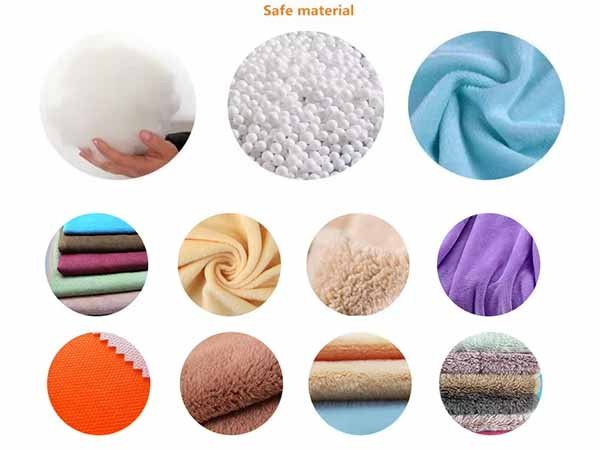
Plush Fabrics (Short Pile / Long Pile)
- Colorfastness: ≥ Grade 4
- Pilling grade: ≤ Grade 3
- Fiber length deviation: ≤ ±0.5 mm
- Surface uniformity inspected under LED lighting
Embroidery Threads
- Tensile strength: ≥ 18N
- Azo-free dyed
- Color deviation: ≤ Delta E 1.0
- Moisture resistance: stable after 24-hour indoor exposure
Polyester Filling
- Resilience rate: ≥ 80%
- Odor grade: ≤ Level 1
- Metal impurity content: < 0.01%
- Volumetric consistency checked per 500g sample
Plastic & Hardware Components
- Pull-test strength: ≥ 70N
- Edges checked by fingertip friction test
- Torque stability validated on button-type elements
Dual-Check Material Approval Process
Materials can only enter production after:
- Supplier documents pass Delsney review
- QC physical screening confirms compliance
Any failed item triggers immediate replacement.
Global Compliance Coverage for EU / US / AU / JP
High-Identity Mascot Engineering for Companies, Events & Promotional Campaigns
Delsney collaborates with 1800+ brands and importers across Europe, North America, East Asia, and Oceania. Our production workflow integrates compliance considerations into early design, reducing downstream testing failures and improving project timelines.
European Union (EN71 Series)
The EN71 framework guides physical integrity, chemical safety, and flammability:
- EN71-1: Mechanical & physical test evaluation
- EN71-2: Flammability—controlled burn rate on plush fibers
- EN71-3: Heavy metal migration
- Phthalate considerations for coated elements
Our engineering team identifies EN71 risk points during sampling, lowering corrective workload.
United States (CPSIA / ASTM F963)
US importers focus on chemical thresholds and structural reliability:
- CPSIA lead & phthalate limits
- ASTM F963: mechanical safety and accessible components
- Tracking labels for batch traceability
Delsney maintains internal reference records aligned with CPSIA annual updates.
Australia / New Zealand
Based on AS/NZS ISO standards, which emphasize:
- Structural resistance
- Labeling requirements
- Age-grading evaluation
Our documentation is compatible with ANZ importer audit routines.
Japan ST Standard
ST Standard is stringent in:
- Small-part pull tests
- Dye and residue evaluation
- Stitching reinforcement quality
- Accessory attachment safety
We offer pre-screening to reduce ST failure risks before third-party testing.




Integrated Safety Architecture Across Three Delsney Factories
Delsney’s manufacturing ecosystem operates through a coordinated network of three specialized facilities, each responsible for a critical stage of plush safety:
- Plush Fabric Mill → Controls fiber origin, dye chemistry, colorfastness
- Embroidery Factory → Controls logo detailing, thread safety, reinforcement
- Plush Manufacturing Factory → Controls cutting accuracy, sewing stability, filling consistency
01
Unified Material Indexing System(UMIS)
All incoming materials receive:
- A unique material code
- Fiber batch number
- Dye lot reference
- Supplier certificate record
This allows traceability from fabric roll → cutting table → finished plush.
02
Cross-Factory QC Alignment
QC staff (20+ members) follow identical inspection protocols:
- Same measurement tools
- Same seam-strength thresholds
- Same tolerance ranges
- Same rejection criteria
Cross-factory deviation remains below 1.4%, according to our 2025 audit.
03
Batch Photo Documentation(BPD)
Each production batch includes:
- Cutting-stage photos
- First-sewn sample photos
- Filling density snapshots
- Final approved sample
- Packaging condition photos
This record allows clients to verify production progress without guessing.
04
Structural QC Handover
When components move from one factory to another:
Example → Embroidery → Sewing Plant
- Embroidery factory must supply a 5-point check card (thread tension, backing stability, color consistency, alignment, edge finish).
- Sewing factory revalidates these points before stitching begins.
Zero handover shortcuts are tolerated.
05
Daily Safety Audits(DSA)
All three factories run morning and afternoon audits, covering:
- Needle usage status
- Machine maintenance
- Fire-safety corridor clearance
- Material stacking safety
- Worktable tool sharpness logs
Average daily audit duration: 14–22 minutes per workshop.
06
Final Integrated Batch Clearance
A batch is cleared for export only when:
- All three factories sign the batch QC sheet
- Documentation matches internal compliance requirements
- Stability tests pass the acceptance range
In 2025, first-clearance pass rate reached 98.3%.
Engineering Risk Prevention During Design
Most plush failures do not originate from production—they originate from design flaws. Delsney prevents these issues by embedding engineering risk assessments during the sampling stage.
Below are key engineering controls that set Delsney apart:
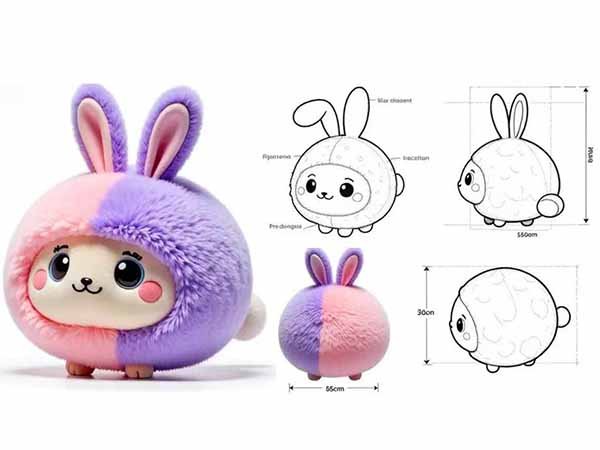
3-View Technical Evaluation
Every custom plush receives a 3-view drawing review (front, side, back). Engineers assess:
- Limb thickness ratios
- Head-to-body weight balance
- Stitch reinforcement points
- Embroidery edge distance
- Stuffing chamber zones
This eliminates structural imbalance before cutting begins.

High-Stress Area Reinforcement
Based on historical data from 9,000+ production samples, we identified the most common break points:
- Neck joints
- Limb attachments
- Tail base
- Wings (for bird characters)
- Bag or pouch accessories
Delsney adds:
- Extra interlining
- Cross-stitches
- Internal mesh reinforcement
- Double-bar tack stitching
- High-density fill zones
These adjustments reduce tear incidents by up to 82%.

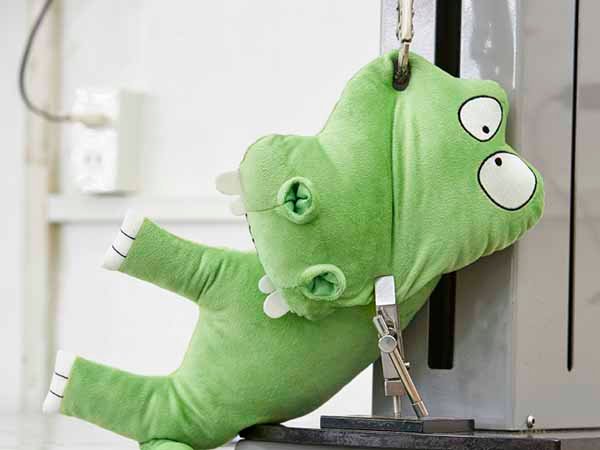
Safety Radius Review
Any component that may contact skin undergoes a radius check:
- Plastic noses
- Buttons
- Decorative accessories
Edges must meet smoothness index Level 1 based on finger-friction tests.
Small parts that risk detachment are either replaced or reinforced.
Embroidery Safety Parameters
Embroidery is a common failure point in plush products. Delsney applies:
- Stitch density ≥ 0.38 mm
- Minimum backing width ≥ 3 mm
- Anti-fray edge sewing
- Thread tension control per embroidery file
These prevent threads from loosening during consumer use.

Flammability Risk Control(Pre-Testing)
Before external testing, we evaluate:
- Pile length
- Fiber blend behavior under heat
- Coated elements
- Fabric density
Our pre-flame check identifies high-risk fibers early, reducing re-sampling time.

Child-Safe Design Standards
For plush aimed at younger age groups:
- All accessories must exceed 70N pull force
- No detachable components under 31.7mm
- Filling materials screened for loose fiber risk
- No cavity large enough to trap small fingers
These minimize child safety hazards before third-party tests occur.
Needle Control & Metal Detection System
Sharp-object control is one of the most sensitive areas in plush safety.
Delsney maintains strict needle and metal management across all sewing operations.
Needle Registration & Track Log
Every sewing machine receives:
- A unique needle ID
- Operator name
- Needle change timestamp
- Reason for change
All logs remain traceable for minimum 24 months.
Broken Needle Handling Protocol
When a needle breaks:
- Production must stop immediately
- All fragments must be collected
- Pieces must be taped to a “broken needle card”
- Supervisor signs the confirmation
- QC verifies that no fragment is missing
Only after these steps can sewing resume.
Fragment loss tolerance: 0% allowed.
Restricted Needle Access
Needles are stored in a locked cabinet.
Only authorized personnel from production management may issue replacements.
Daily issuing logs prevent misuse or uncontrolled needle circulation.
In-Line Metal Detection (Optional for High-Risk Orders)
For plush designed for strict-market distribution (Japan, USA, EU premium brands):
- Finished products pass through metal detectors
- Sensor tuned to detect fragments as small as 1.0–1.2 mm
- Products failing the pass are immediately quarantined
Delsney’s metal detection false-alarm rate stays below 0.7%.
End-of-Line Manual Metal Inspection
Before packing:
- QC performs tactile inspection
- Internal seams squeezed to detect foreign elements
- Any suspicion triggers a full-unit teardown
This ensures sharp-object risk remains extremely low.
In 2025, sharp-object incident rate in Delsney factories remained 0 cases.

Chemical Safety & Dye Compliance
Chemical safety is a critical part of plush production, especially for international distribution. Delsney’s fabric mill and material partners follow controlled dye procedures aligned with EN71-3, CPSIA, and REACH guidelines.
Dyes & Pigment Requirements
- Azo-free formulations only
- Heavy metal limits aligned with EN71-3 migration standards
- pH stabilized within 5.5–7.0
- No formaldehyde-based binders
Each dye lot undergoes a sample swatch test before bulk coloring.
Migration & Bleeding Tests
Performed inside Delsney’s fabric mill using:
- Sweat simulation solution
- Saliva simulation solution
- Rubbing test under dry & wet conditions
Passing requirement: Color change ≤ Grade 1 after friction cycles.
Safe Printing & Embroidery Coatings
For printed or embroidered plush:
- No solvent-based inks
- Water-based pigments only
- Embroidery oil agents tested for chemical neutrality
We reject any pigment with unclear composition.
Plastic Accessory Chemical Checks
All eyes, noses, clips, and decorative elements follow:
- Phthalates below CPSIA limits
- Lead-free formulation
- BPA-free materials for infant products
Plastic suppliers are audited yearly.
Fillings & Internal Components
Polyester filling is screened for:
- Odor intensity (≤ Level 1)
- Chemical residues through random sampling
- Zero recycled impurities
These prevent respiratory irritation and chemical risk.

Packaging & Labeling Safety Requirements
Delsney prepares packaging according to regional regulatory requirements, as well as client-specific brand guidelines.
1. Age Grading Determination
Age rating evaluated during design review based on:
- Presence of small parts
- Detachable components
- Material hardness
- Accessory pulling force
Our engineering team aligns age grading with ASTM F963, EN71, and ST frameworks.
2. Mandatory Warning Labels
Applied depending on market:
- Plastic bag warnings
- Small parts hazard warning
- Flammability caution
- Suffocation warnings
Font size, placement, and visibility follow regional laws.
3. Tracking Labels (US Requirement)
Tracking labels include:
- Production month
- Factory code
- Batch number
- Material group
- Contact details
These are mandatory for US imports and fully integrated into Delsney’s labeling workflow.
4. Custom Packaging Safety
For gift boxes or retail packaging:
- Ink must meet RoHS/REACH standards
- Edges of boxes must pass fingertip friction test
- No sharp staples or metallic fasteners
QC checks all packaging before final sealing.
5. Carton Compliance for Export Logistics
Export cartons must:
- Support ≥ 38–42 kg stacking load
- Maintain dry integrity for 12–18 hours during humidity exposure
- Carry barcode & logistic labels without smudging
A drop test is performed on 10% of shipments.

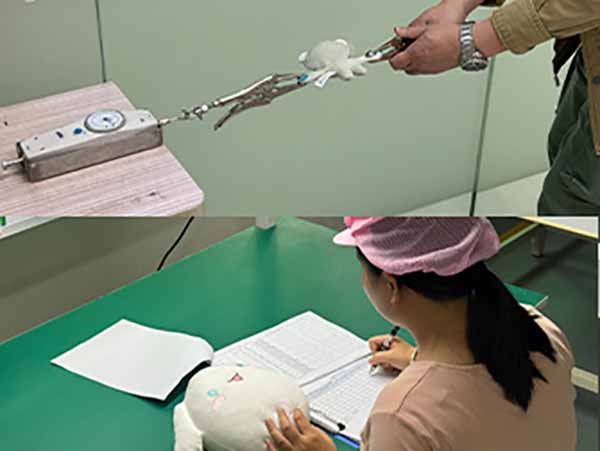
Testing Preparation & Certification Support
Many global plush projects fail due to poor testing preparation rather than unsafe products. Delsney reduces testing failure rates by preparing all documentation and pre-checks before official lab submission.
01
Pre-Testing Analysis
Before sending samples to third-party labs, Delsney reviews:
- Materials used
- Pile length & density
- Stitching distance
- Trims stability
- Internal reinforcement
This reduces unexpected failures during EN71/ASTM tests.
02
Required Documents Prepared by Delsney
- Material composition sheets
- Dye and pigment source records
- Production batch photos
- Accessory supplier documentation
- Internal QC logs
- Tracking label reference notes
These documents simplify testing for SGS, Intertek, TÜV, and BV.
03
Sample Optimization Before Lab Submission
Engineers may adjust:
- Seam density
- Reinforcement backing
- Embroidery stability
- Hardness of accessories
This increases the chance of passing on first submission.
04
Coordination With Testing Labs
Delsney assists with:
- Sample shipment
- Testing item selection
- Market-specific test guidance
- Retest handling
Most projects pass after one test round, reducing time and cost.
05
Long-Term Compliance Records
All compliance files are archived for 3 years for audit or customs purposes.
Frequently Asked Questions
Q1: What materials does Delsney use for safe plush manufacturing?
We use certified plush fabrics, azo-free dyes, polyester fillings with ≥80% resilience, and CPSIA-compliant plastic components. All materials pass dual QC checks before entering production.
Q2: Can Delsney support EN71, ASTM F963, CPSIA and ST testing?
Yes. Our sampling and production processes are aligned with these frameworks. Most designs undergo risk screening before testing to minimize retries.
Q3: How does Delsney control small-part hazards?
Accessories must reach ≥70N pull force. Components under 31.7 mm are restricted for child-grade products. Engineers reinforce joints during sampling.
Q4: How does Delsney prevent sharp-object contamination?
We follow a strict broken-needle protocol, needle registration logs, and optional metal detection for high-risk markets. No sharp-object incidents were recorded in 2025.
Q5: How does Delsney ensure fabric chemical safety?
All dyes are azo-free. Plush fabric undergoes EN71-3 migration tests, pH checks, odor screening, and random chemical sampling.
Q6: Can Delsney help with third-party testing documentation?
Yes. We prepare composition sheets, QC logs, supplier records, and sample photos to streamline testing with SGS, Intertek, BV, or TÜV.
Q7: What safety checks occur before export?
QC verifies seam durability, stuffing consistency, accessory security, label accuracy, and packaging safety. Cartons undergo stacking and drop evaluations.
Q8: Does Delsney support safe packaging for retail brands?
Yes. We follow age grading, apply mandatory warnings, ensure safe inks, and implement tracking labels for regulated markets.
Q9: How long is compliance documentation stored?
All production and safety-related files remain archived for three years for customs, importer audits, or retesting needs.
Q10: Can Delsney evaluate safety risks from client sketches?
Yes. Our engineers review 3-view drawings, check proportion safety, evaluate attachment risks, and flag elements that may fail compliance tests.

Work With a Safety-Focused Plush Manufacturer
Partnering with Delsney means your plush project enters a production system built on 18+ years of safety control, certified materials, and engineering discipline. From azo-free dyed fabrics to reinforced structural stitching and full EN71 / ASTM / CPSIA preparation, every batch follows a traceable workflow across our three coordinated factories.
Whether the project involves complex shapes, high-risk markets, infant-grade plush, or retail-ready packaging, Delsney’s compliance team ensures the product meets safety expectations before mass production begins.
Our team can review sketches, optimize designs, strengthen structural points, prepare testing documents, and support full certification with global labs. Consistent safety is not an afterthought—it is a built-in requirement across all Delsney operations.
